The Movie Cricket

Movie reviews by Sean P. Means.

  • The Movie Cricket
  • Sundance 2025
  • Reviews
  • Other writing
  • Review archive
  • About

Filmmaker Jay Rosenblatt climbs a fence to get into his old elementary school in Brooklyn, in a moment from the Academy Award-winning documentary short film “When We Were Bullies.” (Photo courtesy Shorts International.)

Review: This year's short-film Oscar nominees offer a strong slate, thought the animated work doesn't impress as much as usual

February 24, 2022 by Sean P. Means

I have often referred to the annual compilations of the nominees in the short-film Academy Award categories as akin to Forrest Gump’s mama’s box of chocolates — in that you never know what you’re going to get — but this year, that sentiment is really true.

The variety assortment proves to be a bit of a disappointment with the animated shorts. Three of the five nominees are adults-only, with animated genitalia and — in the Chilean ceramic stop-motion work “Bestia” — a bit of off-putting animal-on-human contact. The comical British/Canadian hand-drawn “Affairs of the Art” has some funny moments, but is sometimes shrill. And “The Windshield Wiper,” an American/Spanish production, is a series of rotoscoped interludes, some of them sexual, without much resolution.

The one G-rated work in the bunch is “Robin Robin,” a delightful stop-motion work from the folks at Britain’s Aardman Studios. (I think it was a Christmas offering on one of the British TV channels; it’s available on Netflix now in the states.) It’s a charming story, rendered with wonderful tactile felt characters, of a young robin raised by a family of mice, but utterly lacking in mousy stealth. Richard E. Grant voices a preening magpie, and Gillian Anderson purrs menacingly as a cat on the robin’s scent.

If I was an Academy voter, my pick might have gone to the wordless Russian “BoxBallet,” director Anton Dyakov’s line-drawn story of a pencil-thin ballerina who finds a surprise protector in a gruff boxer. As I write this, news bulletins are arriving about Russia’s invasion of Ukraine, so selecting this one as a favorite feels off in the current climate — but I don’t know whether Dyakov, as a filmmaker, should be punished for decisions made in the Kremlin.

The choices in the live-action short category are unequivocally top-drawer. 

The Danish “On My Mind” is a heartwarming tragedy that starts as comedy, with a guy walking into a bar on a Tuesday morning and asking the bartender to fire up the karaoke machine so he can sing “Always on My Mind” — for reasons that will have viewers tearing up. 

“The Dress,” from Poland, and the filmed-in-Kyrgyzstan “Ala Kachuu (Take and Run)” are harrowing and well-staged stories about women left at the whims of men — respectively, a four-foot-tall Polish motel maid (Anna Dzieduszycka) seeking love and a Kyrgyz student (Alina Turdumamatova) kidnapped into a forced marriage. 

And the last two are incendiary takes on injustice and systemic racism. “Please Hold,” directed by K.D. Dávila (who won the Waldo Salt Screenwriting Award at this year’s Sundance Film Festival for the comedy-drama “Emergency”), follows a Latino man (Erick Lopez) in a slightly futuristic dystopia where he’s arrested, jailed and nearly convicted all by drones and automated machines. It would be my favorite, if not for the intensity of the British/Dutch production “The Long Goodbye,” written by its director, Aneil Karia, and its star, Riz Ahmed, in which a South Asian family’s wedding preparations are interrupted by a brutal paramilitary raid — ending with Ahmed’s character delivering a to-the-camera rap with devastating power and immediacy.

The documentary slate features two inspiring and entertaining sports stories: “Audible,” which follows members of the successful football team at the Maryland School for the Deaf; and “The Queen of Basketball,” a profile of Lusia Harris, who was probably the best women’s basketball player in the 1970s, but an era when there wasn’t much one could do with that talent after college. (She was drafted by the New Orleans Jazz, which is an interesting footnote.)

Two more films chronicle seemingly intractable problems. In “Three Songs for Benazir,” married filmmakers Elizabeth and Gulistan Mirzaei follow a newly married couple living in a camp for displaced people in Afghanistan, as youthful hope curdles into something else. And in “Lead Me Home,” filmmakers Pedro Kos (“Rebel Hearts”) and Jon Shenk (“Truth to Power: An Inconvenient Sequel”) capture life among those experiencing homelessness in Los Angeles, San Francisco and Seattle — finding touching individual stories and tragic common threads.

My favorite among the documentaries is the most inward-looking, Jay Rosenblatt’s “When We Were Bullies,” in which the director revisits his old elementary school in Brooklyn — and reunites with another old classmate to examine a bullying incident from 50 years earlier. Rosenblatt’s narrative never goes where you expect, and raises intriguing questions about memory, guilt and complicity.

——

Oscar-nominated animated shorts

★★★

Opens Friday, February 25, at the Broadway Centre Cinemas (Salt Lake City). Not rated, though probably R for animated full-frontal nudity, strong sexuality and some violence in some of the films. Running time: 97 minutes; two of the films are in Spanish, with subtitles.

—

Oscar-nominated live-action shorts

★★★1/2

Opens Friday, February 25, at the Broadway Centre Cinemas (Salt Lake City). Not rated, though probably R for violence and some sexuality in some of the films. Running time: 125 minutes; one film is in Danish, another in Polish, and a third in Kyrgyz, with subtitles.

—

Oscar-nominated documentary shorts

★★★1/2

Opens Friday, March 4, at the Broadway Centre Cinemas (Salt Lake City). Not rated, though probably PG-13 for suggestions of violence and substance abuse, and discussions of suicide in some of the films. Running time: 160 minutes; one film is in American Sign Language, another in Pashtu and Dari, with subtitles. 

February 24, 2022 /Sean P. Means
Comment

Jackson Briggs (Channing Tatum), a former Army Ranger, drives with Lulu, a retired Ranger dog, in a scene from the drama “Dog.” (Photo by Hilary Bronwyn Gayle, courtesy of Metro-Goldwyn-Mayer Pictures.)

Review: 'Dog' is a touching story of two soldiers — one human, one canine — trying to heal from the emotional scars of war

February 17, 2022 by Sean P. Means

Between a chaotic opening 30 minutes and a marketing campaign that pretends the rest of the movie never happened, a moviegoer might be forgiven for thinking “Dog” is going to be a frisky comedy — rather than what it turns out to be, a dark and surprisingly thoughtful drama about war and its aftereffects.

Screenwriter Red Carolin and star Channing Tatum team as co-directors on this film, which focuses on Tatum’s character, Jackson Briggs, a former Army Ranger — yeah, I know, once a Ranger, always a Ranger — who’s living in Washington state and still dealing with the scars, physical and emotional, of fighting in Iraq and Afghanistan.

Briggs is broke, and hopeful a new job as security for U.S. diplomats will ease his financial problems. To get the job, he must get his former commander, Capt. Lewis (Luke Forbes), to sign the paperwork that shows he’s medically cleared to serve — three years after a traumatic brain injury that still disrupts his sleep and causes seizures if he doesn’t take his meds.

Capt. Lewis tells Briggs that he’ll sign the papers if Briggs performs a favor: Transport a dog, a Belgian Malinois that served in Iraq, from Fort Lewis (near Tacoma) to Arizona, for the funeral of the dog’s handler, and Briggs’ Ranger pal, Riley Rodriguez. The dog, named Lulu (and played by three dogs), is a handful — reacting badly to loud noises, liable to bite anyone who gets too close, and especially anyone who tries to touch her ears. 

In short, Lulu is suffering from post-traumatic stress, much as Briggs is. But where one can’t say what’s wrong, the other won’t.

Carolin, who wrote both “Magic Mike” movies in which Tatum starred, wrote the screenplay here (sharing story credit with Brett Rodriguez). The road trip goes through some meant-to-be-humorous antics,most of them mocking the off-kilter residents of Portland, Ore., that aren’t as hilarious as the makers think they are. The always-wonderful Jane Adams pops up for some choice minutes as an amateur clairvoyant married to a blustering pot grower (Kevin Nash), but that’s about it for effective comedy — and that includes the uncredited appearance of Bill Burr as a San Francisco cop.

As the road trip continues, though, things get far more serious — as Tatum’s Briggs starts bonding with Lulu, and begins to confront his own problems as a survivor of war. The second half of the film has some moments of heartfelt emotion, and Tatum shows his mettle as he portrays Briggs’ growing realization that being tough can sometimes delays efforts to become whole.

“Dog” ends up being a solid drama about loyalty and loss, and a certain kind of audience will appreciate it for those strengths. I’m just concerned that an audience expecting the lighthearted comedy the marketing promises may not be as receptive.

——

‘Dog’

★★★

Opens Friday, February 18, in theaters everywhere. Rated PG-13 for language, thematic elements, drug content and some suggestive material. Running time: 100 minutes.

February 17, 2022 /Sean P. Means
Comment

Julie (Renata Reinsve, right) shares a smoke, and some intimacy, with Elvind (Herbert Nordrum), a man she meets at a wedding party she crashed, in Joachim Trier’s Oscar-nominated “The Worst Person in the World.” (Photo courtesy of Neon.)

Review: 'The Worst Person in the World' is a beautifully made story of a woman figuring out what she wants to be in life

February 16, 2022 by Sean P. Means

Director Joachim Trier’s “The Worst Person in the World” arrives in America (both with an Oscar-qualifying run and a slot in the 2022 Sundance Film Festival’s Spotlight section) with a strong tailwind of praise, including a Best Actress win at the Cannes Film Festival for its young star, Renate Reinsve. (Since then, it’s also scored two Academy Awards nominations, for International Film and for Trier’s original screenplay.)

I’ll add to the pile of praise: This is a funny and touching comedy-drama, and Reinsve is outstanding as the sorta-title character, who’s not that bad but still figuring things out.

Reinsve’s character, Julie, is 27 and not sure where she’s going in her life. Flashbacks of her college life find her switching her majors from pre-med to psychology to photography — and not fully satisfied in any of them, leaving her to toil in a job at an Oslo bookstore. It’s because of the job that he meets Aksel (Anders Danielsen Lie, a frequent Trier collaborator), an abrasive comic-book artist about a decade her senior, and soon they become lovers.

But there’s something missing in the relationship, something Julie can’t quite describe. It’s clear when she leaves Aksel’s book-signing party early, and on her walk home ends up crashing a wedding — where she meets Eivind (Herbert Nordrum), a nice guy whose personality is the opposite of Aksel’s. The scenes of Julie and Eivind at the wedding, talking and flirting into the morning but never so much as kissing, are heartbreaking in their pure impact.

Trier and his frequent writing partner, Eskil Vogt, send Julie into some visually stunning flights of narrative fancy. In one, she leaves one man for another — with every human between them frozen in time. In another, a dose of hallucinogenic mushrooms has her imagining a reunion with her estranged father, among other wild visions.

Trier — whose output has ranged from addiction drama (“Oslo, August 31st”) to psychological horror (“Thelma”) — and Vogt wrote this film specifically for Reinsve, and it’s a perfect fit. Julie isn’t the worst, though she sometimes does things that make her feel that way, which just makes her human. Reinsve finds the humor and pain of living in those in-between stages of life, when someone thinks their close to figuring it all out, and having the epiphany that nobody ever completely figures it out, but it’s the attempt that makes life interesting and meaningful.

——

‘The Worst Person in the World’

★★★1/2

Opens Friday, February 18, at the Broadway Centre Cinemas (Salt Lake City). Rated R for sexual content, graphic nudity, drug use and some language. Running time: 127 minutes; in Norwegian, with subtitles.

——

This review originally appeared on this site on January 21, 2022, when the movie debuted at the 2022 Sundance Film Festival.

February 16, 2022 /Sean P. Means
Comment

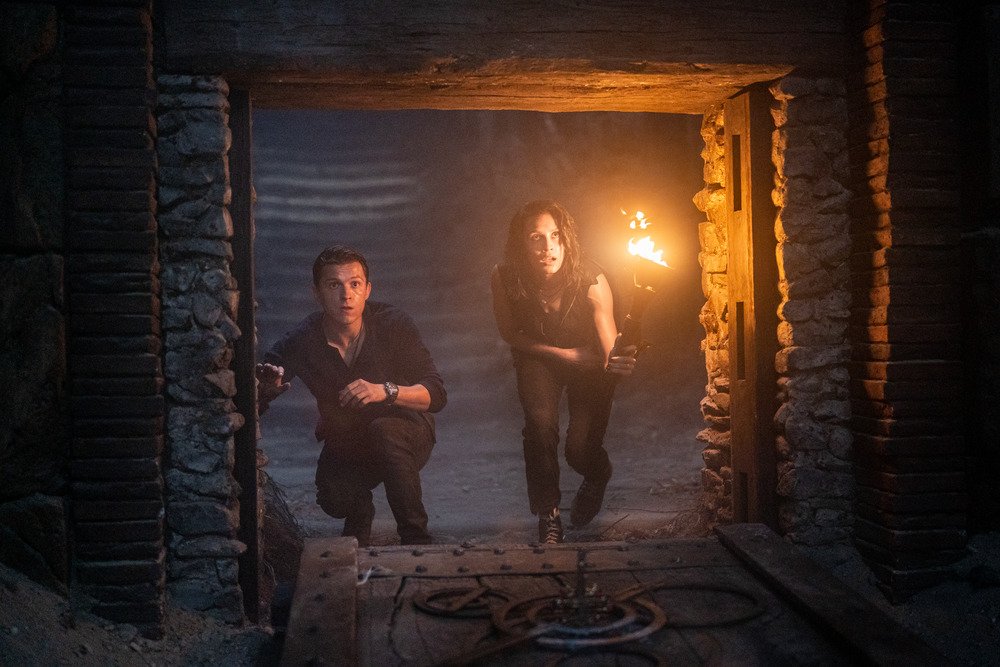
Nathan (Tom Holland, left) and Chloe (Sophia Ali) search for treasure under the streets of Barcelona, in a scene from the action-adventure “Uncharted.” (Photo by Clay Enos, courtesy of Columbia Pictures.)

Review: 'Uncharted' is a generic action movie that holds the key to why video-game adaptations never work as movies.

February 14, 2022 by Sean P. Means

It would be hard to find a movie that’s as much a generic corporate product as “Uncharted,” a paint-by-numbers action-adventure made by one arm of Sony — Columbia Pictures — based on an intellectual property from another arm of Sony, Playstation., and starring another Sony product, Tom Holland, aka Spider-Man.

Holland portrays Nathan Drake, a Manhattan bartender and masterful pickpocket who catches the attention of Victor “call me ‘Sully’” Sullivan (Mark Wahlberg), a smooth-but-shady procurer of things he’s not supposed to procure. Sully wants Nathan to join him on a quest, to find the legendary lost gold of Ferdinand Magellan’s ill-fated circumnavigation of the globe.

Nathan catches on quickly that Sully is not to be trusted. But one thing convinces Nate to sign on: Sully says he knows what happened to Nathan’s brother, Sam — who Nathan hasn’t seen since they were boys, in the orphanage in Boston, getting into trouble and dreaming of adventures like this. (We meet the young brothers — Nate played by Tiernan Jones, Sam played by Rudy Pankow — in the prologue.)

The quest begins with Nathan and Sully trying to steal a bejeweled gold crucifix from an auction house, where tycoon Santiago Moncada (Antonio Banderas) is eager to possess it. Moncada, we’re told, is the scion of the family that bankrolled Magellan’s voyage 500 years ago, and he believes it’s his destiny to reclaim the fortune. Moncada hires a knife-wielding operative, Jo Braddock (Tati Gabrielle, from “The Chilling Adventures of Sabrina”), to keep Nathan and Sully out of his way.

After the New York adventure, Nathan and Sully follow the trail to Barcelona — which happens to be Moncada’s base of operations. There, they team up with another thief, Chloe Frazer (Sophia Ali), who knows Sully well enough not to trust him, and assumes Nathan is untrustworthy because he’s with Sully. The bulk of the Barcelona segment involves following clues through an underground maze, with the requisite cobwebs and booby traps. Someone calls someone else “Indiana Jones,” and the audience’s response is: “You wish.”

It goes on like this, as director Ruben Fleischer (“Venom,” “Zombieland”) and a tag-team of screenwriters connect the dots from one action set piece to the next. Exactly one of these action sequences is in any way remarkable, and it’s the one that dominates the movie’s trailer: Nathan hanging onto the netting of a line of cargo containers dangling behind the back door of a plane somewhere over the Philippines. 

The movie might have had a chance, if screenwriters Rate Lee Judkins, Art Marcum and Matt Holloway had given Holland or Wahlberg characters to play instead of one-note cliches — or made Gabrielle’s Braddock something more than an anime figure, or given Banderas anything interesting to work with in his villain role. These aren’t characters, they’re avatars, hollow figures to mark the place someone real should be.

And that, I realized after watching “Uncharted,” is the answer to the question Hollywood has been asking for decades: Why movies based on video games never work. 

When you play the game, you solve the riddle or win the boss battle, and you get to the next cut scene. If you fail, you keep trying again until you succeed, and the cut scene is waiting for you. A movie like “Uncharted” is all cut scenes, with the action connecting the viewer from one to the next — and where’s the surprise in that?

Also, think about it this way: The most interesting character in a video game isn’t Mario or Lara Croft or (for my game of choice, “FIFA 22”) Lionel Messi. The most interesting character is always you, the player. And substituting a movie star in that central role is never as fascinating to you as you are — I don’t care how boyishly handsome Tom Holland is. And when you substitute yourself with a character with no discernible personality, as this movie does with both Holland’s Nate and Wahlberg’s Sully, it’s game over.

——

‘Uncharted’

★★

Opens Friday, February 18, in theaters everywhere. Rated PG-13 for violence/action and language. Running time: 116 minutes.

February 14, 2022 /Sean P. Means
Comment

Schoolteacher Charlie Gilbert (Owen Wilson, left) finds himself in an instant marriage to pop icon Kat Valdez (Jennifer Lopez) in the romantic comedy “Marry Me.” (Photo by Barry Wetcher, courtesy of Universal Pictures.)

Review: 'Marry Me' is 'Notting Hill' to a pop beat, but Jennifer Lopez and Owen Wilson make a surprisingly charming screen couple

February 10, 2022 by Sean P. Means

Sure, “Marry Me” is all empty calories as a romantic comedy, but somewhere between Jennifer Lopez’s glamour and Owen Wilson’s aw-shucks sincerity, there’s something earnest and heartwarming about it all.

Lopez plays Kat Valdez, a mega-selling pop star whose life is spent going from concert hall to limo to penthouse, with a small army of assistants capturing her life for commercial endorsements and her social-media following. As the movie starts, Kat is about to score the biggest public-relations coup of her career: Marrying her fiancé, the pop star Bastian (played by the pop star Maluma), live in concert in New York City, ending their vows by debuting their sure-to-be-hit single “Marry Me.”

But just as Kat is about to take the stage for the big moment, she sees what Page Six is reporting: That Bastian was having an affair with one of Kat’s assistants, Tyra (Katrina Cunningham). Distraught, Kat stops the music and declares she’s still going to get married — and picks a random guy in the crowd, who’s holding a “Marry Me” sign.

That random guy is Charlie Gilbert, played by Wilson, a nice-guy math teacher in a New York high school. Charlie wasn’t even supposed to be going to the concert; his coworker, Parker Debbs (Sarah Silverman), was going to go with her girlfriend and another friend, but they broke up just days before the show. So, suddenly, Charlie and his daughter, Lou (Chloe Coleman), are joining Parker at the show — and just as suddenly, Charlie is sucked into a pop-culture nightmare.

The next day, Kat and her manager, Colin (John Bradley, from “Game of Thrones” and “Moonfall”), talk over damage-control options, and Kat decides she’ll keep the marriage going — at least for a little while, until the publicity storm dies down. Colin arranges some interviews, and some carefully stage-managed “date nights,” to feed the appetites of Kat’s fans. But, over time, a spark starts to develop, as Kat sees how grounded and kind Charlie is, and Charlie sees the person behind Kat’s manufactured persona. But the idea of a real relationship is put into question when Bastian tries to insert himself back into the picture.

Director Kat Coiro (whose numerous TV credits include the pilot for “Girls5Eva”) and writers Harper Dill,  John Rogers and Tami Sagher (adapting Bobby Crosby’s graphic novel) mine plenty of jokes out of the absurdities of the entertainment-industrial complex, from Kat’s Vitamix TikTok ads to the nonstop Instagram postings.

Plotwise, there’s nothing fresh about “Marry Me” — in fact, it follows the contours of the Julia Roberts/Hugh Grant romance “Notting Hill” to a surprising degree. But Lopez and Wilson, who are not the most natural choices for a movie power couple, have a gentle, lived-in chemistry that serves the movie well. (Trivia nuts may remember they co-starred 25 years ago in “Anaconda.”) You may not immediately imagine these two as a couple, but you can easily imagine spending two hours with them in a fluffy date-night movie.

——

‘Marry Me’

★★★

Opens Friday, February 11, in theaters and streaming on Peacock. Rated PG-13 for some language and suggestive material. Running time: 112 minutes.

February 10, 2022 /Sean P. Means
Comment

Lennie (Grace Kaufman, right) and her classmate Joe (Jacques Colimon) share a musical listening experience, in a scene from the young-adult drama “The Sky Is Everywhere.” (Photo courtesy of A24 / Apple TV+.)

Review: 'The Sky Is Everywhere' traces the trajectory of grief and love, through imaginative imagery and a winning performance by Grace Kaufman

February 10, 2022 by Sean P. Means

The charmingly off-kilter young-adult drama “The Sky Is Everywhere” hinges on a challenging question for a 17-year-old: When you’ve lost your soulmate, what’s next in your life?

In director Josephine Decker’s adaptation of Jandy Nelson’s Y.A. novel (for which Nelson wrote the screenplay), Lennie (played by Grace Kaufman) is dealing with that question. As she enters her senior year, she’s bearing up after her older sister, Bailey (Havana Rose Liu), died suddenly from a heart arrhythmia. Lennie and Bailey did everything together, and even planned to get into Juilliard together.

Alone, Lennie is consumed by her grief, has trouble rehearsing on her clarinet, and gets challenged for first chair by her perfect preppy classmate Rachel (Julia Schlaepfer). Lennie spends the day wearing Bailey’s sweaters, despite pleas from her grandma (Cherry Jones) to pack up Bailey’s belongings and move on, and walking among the redwoods near their house, which is also occupied by Lennie’s perpetually stoned Uncle Big (Jason Segel).

Further complicating her life, Lennie is simultaneously experiencing her first love and her second. One is Toby (Pico Alexander), Bailey’s morose boyfriend, who understands the weight of their shared grief. The other is Joe (Jacques Colimon), who’s in Lennie’s band class, and is attuned to her musical wavelength. This love triangle propels much of the drama, and the inventive and beautiful flights of magical realism that Decker injects into the story. (The rose garden scene is perhaps the apex of the movie’s imaginative moments.)

Decker is a fast-rising indie director, on the strength of “Madeline’s Madeline” and “Shirley” — and here she takes well-worn themes of teen love and makes them feel fresh and alive, as if Lennie is the first person who’s ever felt them. Through flashback scenes, and some creative animated flourishes, Decker also illuminates the particular bond between Lennie and Bailey, and how no amount of music or kissing is ever going to fill completely the Bailey-sized hole in Lennie’s heart.

Kaufman, a former child star who turns 20 in April, is a real discovery (if you never saw the Matt LeBlanc sitcom “Man With a Plan,” where she played the oldest daughter). Kaufman captures all of Lennie’s conflicting emotions — pain at her sister’s death, guilt at surviving, joy when playing music, and everything else — and always feels authentic doing it. Kaufman is going places, and “The Sky Is Everywhere” will be noteworthy as the movie that gave her that first platform to shine.

——

‘The Sky Is Everywhere’

★★★1/2

Opens Friday, February 11, in theaters and streaming on Apple TV+. Rated PG-13 for language, sexual references and drug use. Running time: 103 minutes.

February 10, 2022 /Sean P. Means
Comment

Kenneth Branagh directs and stars, as detective Hercule Poirot, in the movie adaptation of Agatha Christie’s “Death on the Nile.” (Photo courtesy of 20th Century Studios.)

Review: 'Death on the Nile,' Kenneth Branagh's solid second turn with Hercule Poirot, brings melancholy to the murder mystery

February 09, 2022 by Sean P. Means

“Death on the Nile” is Kenneth Branagh’s second stab at playing Agatha Christie’s prim and proper detective Hercule Poirot, and directing a murder mystery that’s not quite as twisty as “Murder on the Orient Express,” but just as stylish.

An air of melancholy has always hung around the Belgian detective, and here screenwriter Michael Green (who also adapted “Murder on the Orient Express”) provides a prologue to deliver the backstory. We see a young, clean-shaven Poirot (played by Branagh with some de-aging CGI) in the trenches of the Great War, using his observational skills to give his commander advice for a forward push. The plan is successful, but at a cost that explains Poirot’s famous mustache — an addition that may rankle some Christie fans. (The one to whom I’m married didn’t think it necessary.)

Cut to 1937 London, and we find Poirot in a nightclub, enjoying the song stylings of blues singer Salome Otterbourne (Sophie Okenedo), when he witnesses a love triangle in the making. Gorgeous Jacqueline de Belleforte (Emma Mackey) is in love and lust with dashing Simon Doyle (Armie Hammer), when in walks Jacqueline’s school friend, the super-rich and super-beautiful Linnet Ridgeway (Gal Gadot).

Flash-forward six weeks from this scene, and we find Poirot vacationing in Egypt, and running into his young friend Bouc (Tom Bateman), who’s there as part of a wedding celebration. The happy couple is none other than Simon and Linnet — whose newlywed joy is interrupted by the unwelcome arrival of Jacqueline.

The wedding party is sizable, and everyone has a connection to Linnet, and a potential motive to do her harm. They include: Linnet’s former fiance, Dr. Windlesham (Russell Brand); her business manager and “cousin,” Andrew Katchadourian (Ali Fazal); her godmother, Marie Van Schuyler (Jennifer Saunders), a Communist who has given away part of the family fortune; Marie’s nurse-maid, Miss Bowers (Dawn French); Linnet’s personal maid, Louise Bourget (Rose Leslie); Bouc and his mother, Euphemia (Annette Bening); and Salome and her niece/manager Rosalie (Letitia Wright), who was also a classmate of Linnet’s. And, as it turns out, Jacqueline isn’t too far away.

Once the party board the S.S. Karnak for a trip down the Nile, Linnet confides in Poirot. “When you have money, no one is your friend,” she tells him. “I don’t feel safe with any of them.”

Sure enough, this being an Agatha Christie story, someone is murdered, and Poirot finds his vacation becomes a case to which he must apply “the little gray cells” of his prodigious brain.

Branagh adds a touch of melancholy to his second outing as Poirot, ruminating on love, the one emotion that can drive someone to murder. In his directing role, Branagh revels in the period trappings paid for by the Ridgeway fortune, and the lush Egyptian vistas provided by cinematographer Hans Zambarloukos (who also worked on Branagh’s “Belfast”) and some computer embellishment.

The ensemble is strong throughout, with the standouts being Gadot as the object of desire and envy, Mackey’s femme fatale, Leslie’s shy maid, Bening’s acerbic Mrs. Bouc, and Okenedo’s world-weary musician — who comes off as a kindred spirit to the jaded Poirot. (It’s also a hoot to see French and Saunders, who have been comedy partners for some 40 years, as sharp as ever.)  

It works well enough, even if you’re familiar with the story, either through Christie’s novel or the 1978 adaptation that starred Peter Ustinov as Poirot with a cast that included Mia Farrow, Bette Davis, Maggie Smith and Jane Birkin. (The ’78 was on heavy rotation on HBO when I was in high school, so I saw it a lot.) As a companion to Branagh’s “Murder on the Orient Express,” it’s a solid, and visually arresting, whodunit — and makes one wonder how many more times Branagh wants to portray the detective again.

——

‘Death on the Nile’

★★★

Opens Friday, February 11, in theaters everywhere. Rated PG-13 for violence, bloody images, and sexual material. Running time: 127 minutes.

February 09, 2022 /Sean P. Means
1 Comment

Clifton Collins Jr., in purple, stars as a jockey given one last chance to win a title, in “Jockey.” (Photo courtesy of Sony Pictures Classics.)

Review: 'Jockey' is a beautifully rendered look at a horse racer in his twilight, with a moving performance by Clifton Collins Jr.

February 09, 2022 by Sean P. Means

There is beauty and pain at the heart of “Jockey,” director Clint Bentley poetic and spartan study of a man realizing he’s near the end of his ride.

Jackson Silva, played by the veteran character Clifton Collins Jr., is a jockey who’s worked the circuit of thoroughbred racing for decades, and has the scars and mended bones to show for it. He mostly works with one trainer, Ruth (Molly Parker), usually riding the horses she trains for other owners.

This season, at Phoenix’s Turf Paradise (where the film was shot), Ruth has her own horse, a filly Ruth bought as a yearling when other owners passed her over. Ruth sees something in this horse, named Dido’s Lament, and Jackson sees it, too. They make a deal that Jackson will ride Dido’s Lament, provided he bring his weight down.

Jackson’s pursuit of a late-career championship hits some snags. There’s a health issue that he tries to ignore, until he can’t. One of his best friends, Leo (Logan Cormier), takes a spill in a race, and lands in the hospital. And a young jockey, Gabriel (Moises Arias), arrives at the track to declare that Jackson is the kid’s father.

Within this simple story, Bentley and his writing partner Greg Kwedar explore the rough-and-tumble life of a jockey. Bentley, whose father was a jockey, goes into the locker rooms and onto the track with real-life jockeys, capturing the racetrack life with more authenticity than most horse-related movies ever get. Cinematographer Adolpho Veloso shoots most of the film at “magic hour,” those times near sunrise and sunset when the light is just perfect — a visual match for the twilight of Jackson’s career.

Parker and Arias are powerful in their supporting roles. But the movie belongs, first and foremost, to Collins, who has earned his spot in the saddle after a long career as a supporting player that runs from “Traffic” to “Westworld.” Collins embodies the bone-weary struggles of an aging athlete, when there’s more track behind him than in front, in a performance that is spare and graceful.

There’s an amazing moment where Bentley and Collins crystalize the thrill and peril of the racer’s life. There’s a race midway through the film, which Bentley shows us only as a single long take, the camera close up on Jackson’s face, from the starting gate to the finish line. Everything we need to know is conveyed in that scene, and it’s an indicator of what a mature, beautiful film “Jockey” is.

——

‘Jockey’

★★★★

Opens Friday, February 11, at the Broadway Centre Cinemas. Rated R for language. Running time: 95 minutes.

——

This review ran previously on this site on January 31, 2021, when the film premiered at the 2021 Sundance Film Festival.

February 09, 2022 /Sean P. Means
Comment
  • Newer
  • Older

Powered by Squarespace