The Movie Cricket

Movie reviews by Sean P. Means.

  • The Movie Cricket
  • Sundance 2025
  • Reviews
  • Other writing
  • Review archive
  • About

The Endeavor space shuttle dodges debris on its way to the moon, in a moment from Roland Emmerich’s “Moonfall.” (Image courtesy of Lionsgate.)

Review: 'Moonfall' is a science-fiction mash-up that's silly and stupid, even by the standards of 'Independence Day' director Roland Emmerich

February 03, 2022 by Sean P. Means

Director Roland Emmerich has made a career out of facepalm-inducing dumb science-fiction — from “Independence Day” (where Jeff Goldblum found alien tech was Mac-compatible) to “The Day After Tomorrow” (where Jake Gyllenhaal outran cold) to “2012” (which treated plate tectonics like Chutes and Ladders).

But he outdoes himself with the silliness of “Moonfall,” a bombardment of fake-science nonsense and ludicrous action set pieces. It’s a movie that seems designed for one purpose only: To make Neil deGrasse Tyson cry.

The prologue puts in outer space in 2011, as astronaut Brian Harper (Patrick Wilson) and a crewmate are on an EVA, while his — and “work wife,” as he puts it — Jocinda Fowl (Halle Berry) monitors things in the space shuttle’s cockpit. Then something big and ugly attacks the shuttle, killing the crewmate, knocking Jocinda unconscious, and forcing Brian to land the shuttle without power. NASA investigators don’t believe Brian’s account, Jocinda doesn’t back him up, and his life and reputation are destroyed.

Flash-forward to today, and a shady scientist, Dr. K.C. Houseman (John Bradley, who was the bookish Samwell Tarley on “Game of Thrones”) has the calculations to show the moon is out of orbit, but he can’t convince anyone at NASA to take him seriously. K.C. tries to enlist Brian — who’s now divorced with a troubled 18-year-old son, Sonny (Charlie Plummer) — to advocate for him with NASA, but, as Brian says, “NASA and I aren’t on speaking terms.”

Not necessary, as it turns out NASA has spotted the moon’s orbital problems already, and Jocinda — now second-in-command at NASA — and the folks at Mission Control see something inexplicable: A deep hole in the middle of a massive moon crater. The hole is at the same spot Brian said the space anomaly emerged a decade before.

This being a Roland Emmerich movie — he cowrote with Harald Kloser, his regular collaborator and composer, and Spenser Cohen — things start going haywire. Gravity shifts and high tides cause disasters, flooding the west coast, and sending the top of the Chrysler building airborne. Jocinda has a desperate plan, to unretire a space shuttle and get a crew to the moon. And since staffing decisions like this are decided by which characters have the steepest redemption arc, and which actors have top billing, you know that it’s going to be Brian, Jocinda and K.C. in the cockpit.

All of this is fine, as far as it goes, and Emmerich still knows how to introduce a lot of potentially interesting characters and stage exciting escape scenes. (Nice job working in the Lexus product placement, too, by casting Michael Peña as a car-salesman stepdad for Sonny.) But as the moon gets dangerously close to Earth, and gravity waves turn up to down, the movie throws everything at the screen except common sense.

Of course, any disaster movie today — whether it means to or not — must carry the burden of becoming a metaphor for our current struggles with COVID-19 and climate change. With “Moonfall,” the danger comes in the way Emmerich treats scientists, the people who understand what’s going on, as either crackpots or nerdy know-it-alls. And when the “science” they’re trying to explain is rank nonsense about “megastructures” and manufactured planets, the net effect is making science look like guesswork — and we don’t need any more voices doing that.

——

‘Moonfall’

★★

Opens Friday, February 4, in theaters everywhere. Rated PG-13 for violence, disaster action, strong language, and some drug use. Running time: 135 minutes.
February 03, 2022 /Sean P. Means
Comment

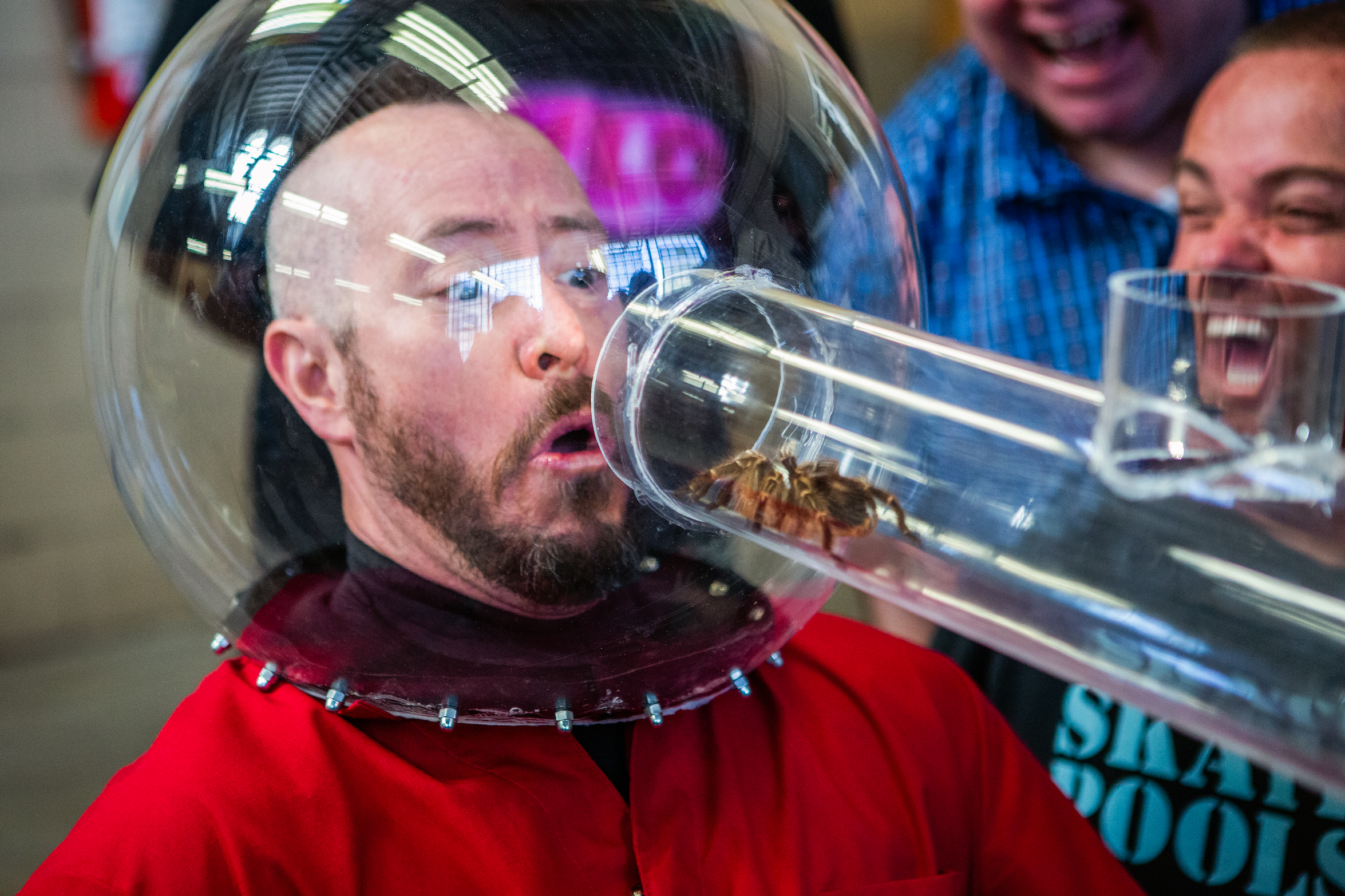
Danger Ehren is face to face with a massive spider, in a stunt from “Jackass Forever.” (Photo courtesy of Paramount Pictures and MTV Films.)

Review: 'Jackass Forever' shows the law of diminishing returns also applies to taking shots to the groin

February 03, 2022 by Sean P. Means

Is it even necessary, after more than 20 years of this crap, to send movie critics to see “Jackass Forever”?

Certainly the critics are in a no-win situation in the eyes of the makers of this fourth movie installment of men enduring idiotic stunts and shots to the crotch. If a critic likes the movie, then the “Jackass” faithful can declare they’ve made another convert. If the critic dislikes the movie — and this is the more likely scenario — then they “don’t get it,” and have a stick up their ass. 

Oddly, “stick up their ass” is one of the few physical challenges the “Jackass” guys — and, with one exception, they all are guys — put on display in “Jackass Forever.” Also on display are their poor judgment, their willingness to do anything for a laugh, and their obsession with the penis and, frequently, the scrotum.

The opening sequence pretty much sets us up for what’s to come. Johnny Knoxville, who is both the Riff and the Tony to the “Jackass” gang’s Jets, dresses as a general, barking orders to soldiers during a kaiju attack on a city. Every so often we see what the monster is: Co-star Chris Pontius’ penis and scrotum, both painted green, being maneuvered through a model-sized Tokyo.

The movie re-creations don’t end there. There’s a bit where co-conspirator Preston Lacy inserts his scrotum into a hole — which is revealed to lead to the ceiling of a mock boxing gym, so that Lacy’s testicles become a punching bag.

Sometimes a stunt isn’t enough, and they take the act out into public. These person-on-the-street segments are my favorite, because they show how much people should be reviled by the nonsense going on.

Beyond the bad taste — which is in the eye of the beholder — the most consistent problem of “Jackass Forever” is that the jokes hit a level of diminishing returns, which means things must escalate. After someone gets hit in the nuts five times, the next guy can only be funny after getting hit in the nuts 10 times. This gets old really fast.

Speaking of old, “Jackass’s” Pied Piper, Johnny Knoxville, is 50 years old, and his hair, a silver fox white because he stopped dying his hair during the pandemic, looks the part. He’s surrounded himself with a new generation of performers, many of whom seem to have gotten the job because they were fans of the show when they were kids. 

And while these fans-turned-performers seem to be having a good time, one senses they would turn hostile at anyone who, for a moment, questions the entertainment value of having high-speed objects hurtling toward their crotch. I’d strongly advise them not to read the reviews, including this one.

——

‘Jackass Forever’

★★

Opens Friday, February 4, in theaters everywhere. Rated R for strong crude material and dangerous stunts, graphic nudity and language throughout. Running time: 96 minutes.

February 03, 2022 /Sean P. Means
1 Comment

Tim Roth plays Neil, an Englishman who makes a radical change in his life, in the drama “Sundown,” written and directed by Michel Franco. (Photo courtesy of Bleecker Street Films.)

Review: 'Sundown' is a fast and sharp study of a man at the end of his rope, with a strong performance by Tim Roth

February 03, 2022 by Sean P. Means

The latest drama from Mexican director Michel Franco, “Sundown,” is quite fascinating and a little bit frustrating, a character study of one man apparently deciding to chuck it all.

Neil Bennett (Tim Roth) and Alice Bennett (Charlotte Gainsbourg) are wealthy British siblings, on vacation at an Acapulco resort with Alice’s grown children, Colin (Samuel Bottomless) and Alexa (Albertine Kotting McMillan). The vacation is cut short when Alice gets a call that their mother is dying. After rushing to book flights and pack up, another call on the way to the airport informs Alice and Neil that their mother has died.

At the airport, Neil tells Alice that he’s forgotten his passport back at the resort. With the flight boarding in minutes, Alice and the kids rush to the plane, and Neil says he’ll catch a later flight once he has his passport.

Here is where the movie makes a sharp turn into mystery. Neil doesn’t go back to the resort, but instead books a room in a cheap hotel near the beach. When he opens his suitcase, we can see that he had his passport with him all along.

Franco — whose last film was the Mexican political thriller “New Order,” where a rich family gets caught in a revolution — writes the script for “Sundown” in the opposite direction from most films. In other films, writers would lay bits of information like land mines, and the audience anticipates when they’ll go off later. With Franco’s script, those bits of information are withheld for an annoyingly long time — but when we get them, it makes Neil’s behavior suddenly make sense.

Roth gives a strong performance, as a man seemingly chucking it all and starting over. It’s a role that is predicated on the audience knowing little about Neil and receiving eyedropper amounts of information as we go along, and Roth keeps the mystery alive from start to finish.

——

‘Sundown’

★★★

Opens Friday, February 4, in area theaters. Rated R for sexual content, violence, language and some graphic nudity. Running time: 83 minutes; in English, and Spanish with subtitles.

February 03, 2022 /Sean P. Means
Comment

Alma (Molly Kunz) looks after lion cub Dreamer and wolf pup Mozart, in the adventure “The Wolf and the Lion.” (Photo by Emmanuel Guionet, courtesy of Blue Fox Entertainment.)

Review: 'The Wolf and the Lion' is ridiculous family fare, but the four-legged stars and their two-legged friend are charming

February 03, 2022 by Sean P. Means

The four-legged stars in the family film “The Wolf and the Lion” fare a lot better than their two-legged co-stars, if only because they aren’t saddled with clunky dialogue and ludicrous plot development.

Alma (played by Molly Kunz) is a 20-year-old student pianist who seems to have her life mapped out in front of her. She’ll ace her upcoming piano competition, score a slot with the L.A. Philharmonic, and her career is set. But the death of her grandfather, who raised her when her parents died years earlier, forces Alma to return home, to an island in a lake in the forests of Canada.

In her grandfather’s cabin, she learns that a female snow wolf has been venturing close to the cabin, friendly but still wild. One day, the she-wolf enters the cabin, looking for a place to rest and nurse her wolf pup. At the same time, a storm cause a plane to crash near the cabin — and a lion cub, destined for a place in a circus, lands literally in Alma’s arms.

Soon Alma is cutting up steak meat and feeding two young predators, with the reluctant aid of her godfather, Joe (played by the great Canadian actor Graham Greene). The animals — Alma names the wolf Mozart, and the lion Dreamer — roughhouse with each other and bond like animal siblings. (I’m not sure if it’s heartwarming or creepy that the filmmakers raised a wolf pup and a lion cub for the purpose of making this movie — and that they now live together on a reservation owned by one of the executive producers.)

But the animals’ presence on the island doesn’t go unnoticed. There’s a wolf researcher (Charlie Carrick), who wants to preserve the wolf and help the species re-establish its wild populations. And there’s a nasty circus operator (Evan Buliung) who aims, with drugs and bullwhip, to tame a lion for the ring.

French director Gilles de Maistre developed the story with his wife, Prune, who is credited with the screenplay, which is both earnest and stilted. The wolf scientist and the wildlife protection officers are played for bumbling comic relief, while the circus boss is a one-note villain.

Kunz has to hold her own with her furry co-stars (reportedly, she was one of the few cast members who could get close to the animals), and she does so with poise and an adventurous spirit. She even makes Alma’s questionable choices — without which there would be no movie — come off as charming.

——

‘The Wolf and the Lion’

★★1/2

Opens Friday, February 4, in area theaters. Rated PG for thematic elements, language and some peril. Running time: 98 minutes.

February 03, 2022 /Sean P. Means
5 Comments

Amin tells his story of escaping Afghanistan for life in Denmark, in the animated documentary “Flee,” directed by Jonas Poher Rasmussen. (Image courtesy of Neon.)

Review: 'Flee' uses animation to tell the true story of an Afghan refugee, and put us in the middle of his journey

January 26, 2022 by Sean P. Means

The animated documentary “Flee” is doing so many things at the same time, and doing them so well, that it’s breathtaking — but you may not even notice, because director Jonas Poher Rasmussen keeps the focus on the amazing survival story at the center.

Rasmussen is interviewing Amin, 36, an academic originally from Afghanistan and now living in Denmark with his boyfriend, Kasper. Amin tells stories of his childhood in Kabul, flying kites, listening to European pop music, and being a kid — until the Taliban took power and cracked down on all Western influences. The Taliban took his father away, and things went downhill for the family from there.

Amin and his family struggle to get out of Afghanistan, first to Moscow, where things are scarcely better. They live in a tenement, and face regular harassment from corrupt police. Trying to hire a smuggler to get out of Moscow is difficult, and ultimately Amin must go alone.

Amin’s success getting out of Russia comes at a cost, though. To convince officials in Denmark to let him in as a refugee, he’s forced to tell a lie — and he lives the next 20 years fearful that the lie will be exposed, and he’ll be sent back to Russia or, worse, Taliban-run Afghanistan.

And, while he’s dealing with one secret he keeps from the government, there’s another one he’s trying to keep from his family: His homosexuality.

To keep his biggest secret — his identity — Rasmussen employs simple animation to hide Amin’s true face. The medium proves to be an inspired choice, because animation allows Rasmussen to visualize all the steps of Amin’s journey, including events where there were no cameras.

The animation of “Flee” reminded me of Art Spiegelman’s drawings in his landmark graphic history “Maus.” The art in both works adds a layer of artifice to the storytelling, allowing us to take one step back, emotionally — so we can absorb the details of the story without getting overwhelmed by it. Then, at a certain point, the humanity of the characters asserts itself, and we see in sharp relief the cost of Amin’s struggle.

The animation also allows the audience for “Flee” to see themselves in Amin’s place, and feel empathy not only for him but refugees from all over. If that’s not the purpose of movies – “a machine that creates empathy,” as Roger Ebert once said — I don’t know what is.

——

‘Flee’

★★★★

Opens Friday, January 28, at the Broadway Centre Cinemas, Salt Lake City. Rated PG-13 for thematic content, disturbing images and strong violence. Running time: 89 minutes; in Dari and Danish, mostly, with subtitles.

January 26, 2022 /Sean P. Means
Comment

Janis (Penélope Cruz, right) gives her baby Cecilia a bath, aided by best friend Elena (Rossy de Palma), in Pedro Almodóvar’s “Parallel Mothers.” (Photo courtesy of Sony Pictures Classics.)

Review: In 'Parallel Mothers,' Almodóvar turns melodrama into gold, and gives Penélope Cruz one of her meatiest roles ever

January 26, 2022 by Sean P. Means

What’s great about Spanish director Pedro Almodóvar is how he takes the melodramatic and elevates it into high art, as he does in his latest film, the drama “Parallel Mothers.”

Another thing that Almodóvar does expertly is he creates roles for Penélope Cruz that are light years above what Hollywood has offered her — and how she never squanders that opportunity.

Cruz plays Janis, a Madrid-based magazine photographer who, in 2016, draws the assignment to photograph Arturo (Israel Elejalde), an archaeologist whose work involves finding mass graves left by the fascist Franco regime. Janis’s father was killed by Franco’s death squads, and she asks Arturo for help unearthing her father’s grave.

Janis and Arturo, who’s married to someone else, are soon having sex — and nine months after that, Janis is having a baby, which she intends to raise alone. In the same maternity ward, Janis befriends Ana (Milena Smit), a teen girl who’s scared of becoming a mother. Janis gives Ana some moral support and her phone number, in case she ever wants to call.

A couple years pass, and Janis is happily raising her daughter, Cecilia, as a single mom. But a visit from Arturo to see his daughter leaves her stricken — because Arturo doesn’t see any of himself or his family in Cecilia. Janis performs a DNA test, and the results are a shock: She’s not the mother. This revelation spurs Janis to find Ana, to unravel the mystery.

Ana has her own problems. When we encounter her again, she’s working in a tavern near Janis’ apartment, raising her daughter, Anita, while Ana’s mom, Teresa (Aitana Sánchez-Gijon), is away pursuing her dreams of being an actress.

Almodóvar, as writer and director, uses these soap-opera plot devices to a higher purpose, to bring out the powerful emotions we associate with motherhood and let them play out in full. Even though it’s melodrama, though, Cruz and Smit keep their emotions tightly locked down — but when the situation is too much to bear, their hearts explode for us to see.

Cruz has never given a better performance, capturing Janis’s maternal joy and heartache beautifully. Smit is a relative newcomer, but she matches Cruz’s intensity and natural emotions at every turn. Together, these actresses from different generations deliver powerhouse performances in service to a warm and wise movie about the highs and lows of parenting.

——

‘Parallel Mothers’

★★★1/2

Opens Friday, January 28, at the Broadway Centre Cinema, Salt Lake City. Rated R for some sexuality. Running time: 123 minutes; in Spanish with subtitles.

January 26, 2022 /Sean P. Means
Comment

King Louis XIV (Pierce Brosnan, left) introduces his secret daughter, Marie-Josephe (Kaya Scoledario), to his court, in the fairy tale “The King’s Daughter.” (Photo courtesy of Gravitas Ventures.)

Review: 'The King's Daughter' is a chaotic mess of a fairy tale story that sat on the shelf too long

January 20, 2022 by Sean P. Means

The fantasy “The King’s Daughter” is a mess from start to finish, a slapdash mix of poorly conceived drama, cliched dialogue, hammy acting, shoddy special effects and the scars of too many attempts to salvage something in post-production.

On the bright side, the filmmakers didn’t let Pierce Brosnan sing. 

Brosnan plays King Louis XIV of France, who in the late 1600s is concerned about his legacy. Instead of being nice and generous, as kings almost never are, Louis orders his best naval captain, Yves De La Croix (Benjamin Walker), to sail out to find the fabled city of Atlantis to capture a mermaid, whose life force is believed to bestow immortality.

Because the king wants an appreciative crowd at Versailles, Louis makes arrangements to have his illegitimate daughter, Marie-Josephe D’Alember (Kaya Scodelario), brought from the convent — where she’s a rebellious pain to the abbess (Rachel Griffiths) — to play her cello in the king’s court.

Marie-Josephe no sooner arrives at the castle when she hears the mermaid’s song and wants to replay it on her instrument, and has soon befriended the underwater beauty (played, wordlessly, by the Chinese star Bingbing Fan). Marie-Josephe enlists the remorseful De La Croix to defy the king and his sniveling science advisor, Dr. Labarthe (Pablo Schreiber), by helping the mermaid escape back to open sea and her family. With Marie-Josephe and the good captain on one side and Louis and Labarthe on the other, the mystery becomes which side the King’s private priest, Pere La Chaise (William Hurt), lines up with before the credits roll.

Director Sean McNamara, a prolific filmmaker whose last credit was the made-in-Utah “Sister Swap” Christmas TV movies, probably could have had another eight years to work on the chaotic script (credited to two writers, but evidence suggests there were others) and it wouldn’t have helped. Scenes are cut off abruptly, or allowed to go on too long. Dialogue that is supposed to sound arch comes off as peevish. A open-the-book framing device, complete with Julie Andrews’ narration, is a sad callback to far better fairy-tale stories.

Scodelario — who had come off the first “The Maze Runner” movie when this one was made and was three years away from starring in the fifth “Pirates of the Caribbean” movie — is enchanting, again, as the headstrong Marie-Josephe, but even she has trouble finding any scraps from which to build a coherent character. (Apparently, some good did come out of all this for Scodelario: She and Walker, the dashing star of “Abraham Lincoln, Vampire Hunter,” started dating, and were married a year and a half later; last month, they had their second child.)

The only person who seems to have succeeded at their job in “The King’s Daughter” is the costume designer, Lizzy Gardiner (an Oscar winner for “The Adventures of Priscilla, Queen of the Desert”). Gardiner’s creations for the foppish French court, contrasted by Marie-Josephe’s elegant slim-figured gowns, are more inventive and original than anything else that made it onto the screen. One hopes they aren’t being used as dust rags seven years later.

——

‘The King’s Daughter’

★1/2

Opening Friday, January 21, in theaters everywhere. Rated PG for some violence, suggestive material and thematic elements. Running time: 98 minutes.

January 20, 2022 /Sean P. Means
1 Comment

Angel (Abigail Cowen, left) and Michael (Tom Lewis) take in the sunrise in the faith-based Western romantic drama “Redeeming Love.” (Photo courtesy of Universal Pictures.)

Review: 'Redeeming Love,' a Christian-themed romance with lots of sex in it, is a stew of mixed signals and murky motives

January 20, 2022 by Sean P. Means

For a drama that’s adapted from a romance novel popular with evangelical Christians, “Redeeming Love” has a lot more sexual content than you’d expect — just one of the aspects of this heavy-handed Western love story that is more confounding than enjoyable.

It’s 1850 in Pair-A-Dice, a boom town during the California gold rush. Those who have found a nugget or two of gold usually line up outside The Palace, the swankiest of the town’s brothels, to see if they win that day’s lottery. The prize: Thirty minutes with the most beautiful prostitute in the place, Angel (played by Abigail Cowen).

It wasn’t always that way, as the flashbacks show us. As a little girl (Livi Birch), Angel was witness when her mother, Mae (Nina Dobrev), was abused and discarded by the married man (Josh Taylor) who was the girl’s daddy. Mae had to take to prostitution, and died too soon of disease — leaving the girl in the not-so-tender mercies of Duke (Eric Dane), an unscrupulous gangster with brothels on both coasts.

Back to Pair-A-Dice — a pun that gets more groan-inducing with every utterance — where a godly farmer, Michael Hosea (Tom Lewis), rides into town. Before getting there, Michael has stopped into a chapel and asked God for a favor, to give him a companion to share his life. His only specific demands is that she have long legs and like fishing.

In town, Michael spots the most beautiful woman he’s ever seen, and knows she’s destined to become his wife. Yup, it’s Angel — and winning over the jaded prostitute is no easy challenge, even after getting past the brothel’s madam, Duchess (Famke Janssen), who guards Angel like the moneymaker she is.

It’s only after Angel is beaten horribly by Duchess’ goon Magowan (Brandon Auret) that Angel agrees to marry Michael. He takes her to the farm, tends to her injuries, and otherwise keeps his distance while waiting for Angel to heal from her years of trauma. Even when she offers to sleep with him, Michael demurs, saying he’ll wait until she comes to him out of love and not obligation.

Director D.J. Caruso (an action filmmaker whose last feature was the third “xXx” movie with Vin Diesel) rewrote the script by Francine Rivers, who wrote the Christian-themed novel on which it’s based, and he leans hard into the bodice-ripping elements of the historical romance genre. There are two, count ‘em, steamy sex scenes between Angel and Michael, and numerous scenes where Cowen’s Angel appears topless — though it’s “Little Mermaid” nudity, with her long hair or a stray hand covering up anything that would threaten the carefully constructed PG-13 rating.

Caruso captures the ramshackle ruggedness of the old West well (even if the movie was filmed in South Africa), and the story moves at a furious pace, particularly in the later scenes where Duke returns to the scene. 

Cowen (familiar to fans of “The Chilling Adventures of Sabrina”) is adept at playing the object of men’s lusts, and transitions well into her later role as a helpmeet who regularly abandons Michael because she feels unworthy of his devotion. It’s perhaps not surprising, considering its roots in the Old Testament — also centering on a man named Hosea — that the sexual dynamics here are all about a woman finding worthiness only in a man’s eyes.

“Redeeming Love” takes a page from “The Ten Commandments,” if only for the way Cecil B. deMille got to fill his biblical epics with copious amounts of suggestive content — and Anne Baxter in hip-hugging costumes — and get away with it, because God unleashes his wrath on the sinners in the final reel. Caruso knows he can spend plenty of time in the whorehouse, because his movie will end on the side of the angels.

——

‘Redeeming Love’

★★1/2

Opening Friday, January 21, in theaters everywhere. Rated PG-13 for mature thematic content, sexual content, partial nudity, and strong violent content. Running time: 134 minutes.

January 20, 2022 /Sean P. Means
Comment
  • Newer
  • Older

Powered by Squarespace