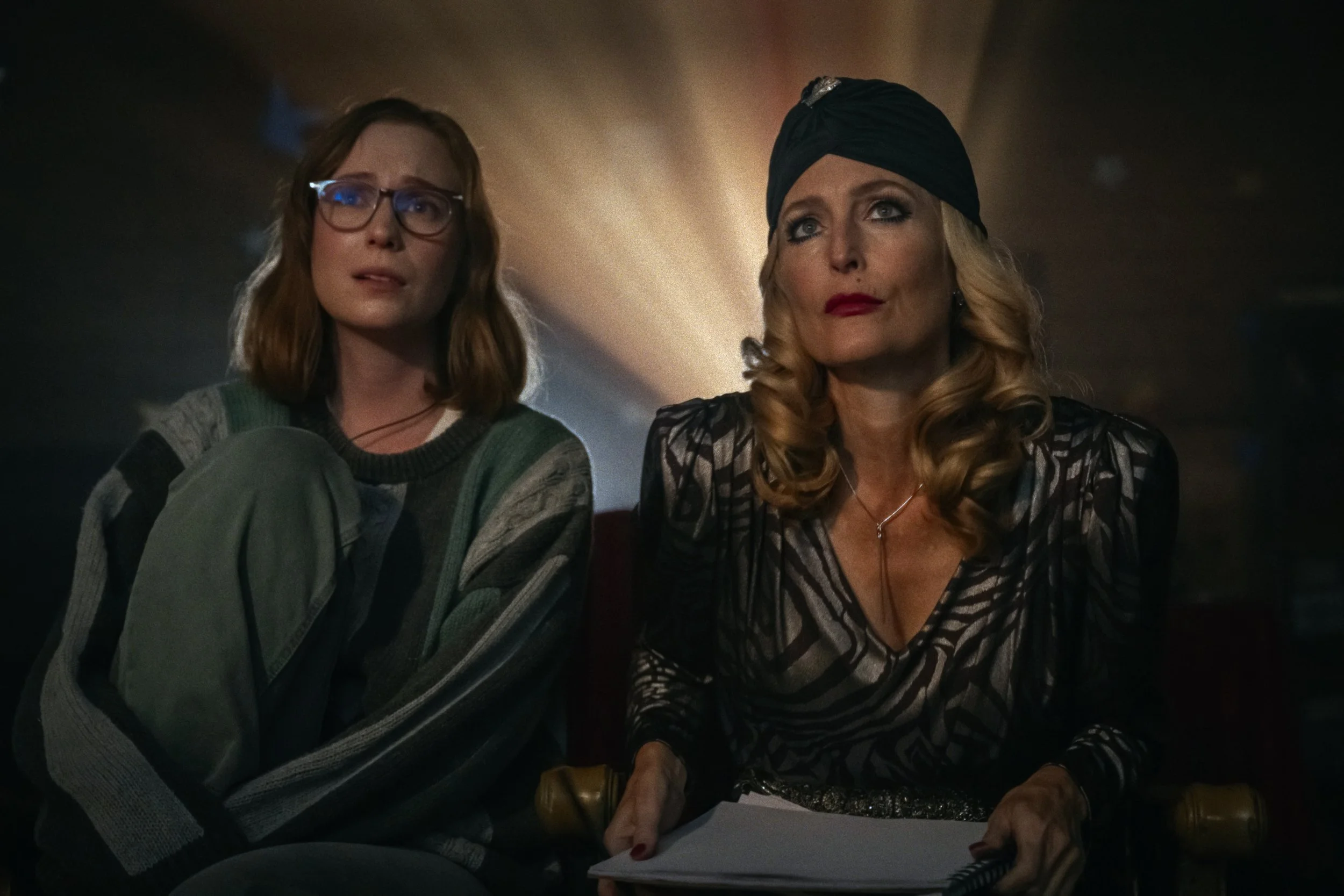
Review: 'Teenage Sex and Death at Camp Miasma' analyzes the sexual tension of horror movies, then dives into that fear and desire with gusto
Writer-director Jane Schoenbrun starts “Teenage Sex and Death at Camp Miasma” as a scholarly dissertation on the cultural power of the American slasher film — and that’s not nearly as dry as you might think. But when Schoenbrun shifts from discussing horror movies to diving headlong into one, the excitement and sexual tension become deliciously unbearable.
Schoenbrun’s introduction informs viewers of the existence of one of the longest running horror franchises Hollywood ever made: The “Camp Miasma” series. It began as a typical story of horny teenagers at a sleepaway camp, getting messily cut to ribbons by a mysterious killer called Little Death, identified by a headpiece that resembles the square vent of a swamp cooler. The series produced more than a dozen sequels, each one worse than the last, until the franchise became a gruesome and problematic shadow of its former self.
Young filmmaker Kris Williams (played by Hannah Einbinder) sees it differently. Kris, identified in a trade paper as a “Sundance wunderkind,” is obsessed with the “Camp Miasma” films, and has been picked to resurrect the franchise. She calls it “zombie I.P.,” a piece of the studio’s intellectual property that’s a known name, but so blisteringly transphobic that the only way the suits can save it is to hire a queer filmmaker like Kris.
Before making her pitch to the studio, Kris ventures to the snowy Pacific Northwest to convince someone else: Billy Presley, the actress who played the “final girl” in the first “Camp Miasma” movie, and never acted again. Billy (played by Gillian Anderson) now lives in the old campsite where the first movie was filmed, and Kris wonders if Billy has become a Norma Desmond, living in the dream world of her movie. Billy tells Kris that she lives at the camp because “someone’s got to be here when Little Death comes back.” When Kris declares that Little Death isn’t real, Billy replies, “Well, not with that attitude, he isn’t.”
Kris has told her agent (Sarah Sherman) that she wants Billy to star in her new “Camp Miasma” movie, not just appear in a fan-service cameo. Billy screens her personal copy of the first “Camp Miasma” for Kris (in which Schoenbrun lovingly copies the low-res style of the genre), and the young filmmaker starts revealing even deeper feelings.
It’s here that Schoenbrun, who explored similar themes of onscreen sexuality in her 2024 psychological thriller “I Saw the TV Glow,” shifts from mirroring the mechanics of slasher movies and gets to her real game — exploring the combustible mix of fear and desire that feeds the horror genre. It’s something Kris (and, one assumes, Schoenbrun) has thought about since childhood, staying up late in the dark watching movies that evoked feelings they weren’t old enough to process.
As the movie goes on, Schoenbrun bends the narrative, with twisty imagery that David Lynch and David Cronenberg would have recognized as resembling their own. Schoenbrun doesn’t shy away from scenarios where revulsion, horniness and gallows humor bleed (no pun intended) into one, reveling in the odd irony that movies about a camp are loaded with campiness.
Einbinder, as anyone who’s seen her work in “Hacks” already knows, gives a spectacular performance here, holding in the young filmmaker’s roiling emotions until she can’t any more. Anderson has seldom been given a role this juicy, and she shatters all expectations of a horror movie star. And let’s give a special shout-out to the actor playing Little Death, Jack Haven (who starred in “I Saw the TV Glow”), who gives the character what few slasher villains have ever shown: Humanity and vulnerability.
By the final reel, and the reveal of the movie’s true “final girl,” audiences may be torn about “Teenage Sex and Death at Camp Miasma.” Does it fulfill its promise of reimagining the horror thriller? Does it bring a jagged energy to some well-worn movie tropes? Does it suggest the most passionate love affair ever subjected to buckets of blood? I believe the answer to all three questions is “yes,” so I suggest you pack a bag and get to camp immediately.
——
‘Teenage Sex and Death at Camp Miasma’
★★★1/2
Opens Friday, August 21, at several theaters. Rated R for bloody violence, gore, sexual content, graphic nudity, drug use and some language. Running time: 112 minutes.