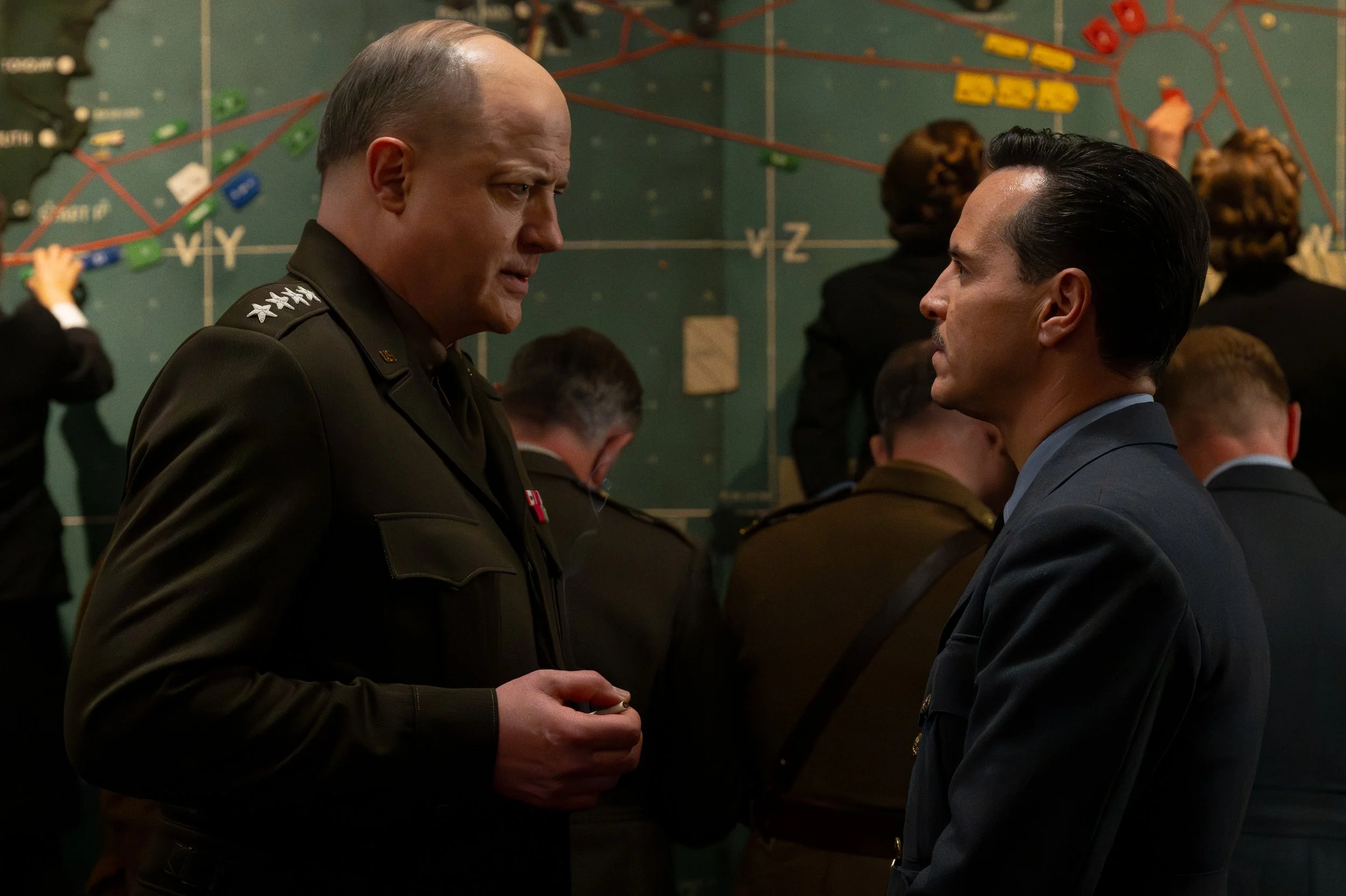
Review: 'Pressure,' a play-turned-movie about the decision to launch D-Day, is a showcase for Andrew Scott and Brendan Fraser
The World War II drama “Pressure” feels like a movie from another era — a self-contained chamber piece where men (and one woman) in uniform talk about a weighty decision that’s rapidly approaching, the outcome of which hinges on the force of their well-acted arguments.
Director Anthony Maras (“Hotel Mumbai”) focuses in on Allied headquarters in the U.K. in June 1944. The commander of the Allied forces, Gen. Dwight D. Eisenhower (Brendan Fraser), has a major decision ahead of him: To order some 160,000 troops to storm the beaches at Normandy by air, sea and land. They’re all ready to go on Monday, June 5.
The one uncontrollable factor in the invasion is the weather. Eisenhower’s meteorologist, Col. Irving Krick (Chris Messina), assures Ike that the skies will be calm on the 5th, just as they were on June 5, 1925, and other years on that date. But Ike has brought in another meteorologist, Group Capt. James Stagg (Andrew Scott), for a second opinion.
Stagg, a taciturn Scotsman, has no use for Krick’s charts of weather data from years past. He wants the current data, from weather balloons and observatories from Spain to Iceland. And what the data tells Stagg is that two massive storms are bearing down on England and Normandy on the 5th. Stagg’s recommendation is to wait, possibly as long as June 18th, even though that means the Germans will learn of the invasion plans in the meantime.
Maras wrote the screenplay with David Haig, based on Haig’s play — and the script’s concentration on tense conversation shows those theatrical roots. The movie is a series of one-on-one dialogues, between Stagg and Krick, or Stagg and Ike, or Ike and his secretary and chauffeur, Kay Summersby (Kerry Condon), or Kay advising Stagg on how to talk to Eisenhower. (The play doesn’t get near the speculation of an affair between Kay and Ike, which historians have largely discounted as false.)
The performances by Fraser and Scott highlight the contrasts between their characters. Eisenhower is the man of action, seeking a definitive answer to the weather problem, to fend off doubts prompted by a disastrous invasion dress rehearsal that left many troops dead. Stagg, on the other hand, is a man of science, which means he’s learned to comfortable with the uncertainty left by incomplete data.
The best parts of “Pressure” come when Scott and Fraser work off of each other, finding common cause within the gaps between command decisiveness and scientific ambiguity. And when the break in the weather comes, as history tells us it must, their reactions speak volumes.
——
‘Pressure’
★★★
Opens Friday, May 29, in theaters everywhere. Rated PG-13 for war violence, bloody images, some strong language, and smoking. Running time: 100 minutes.