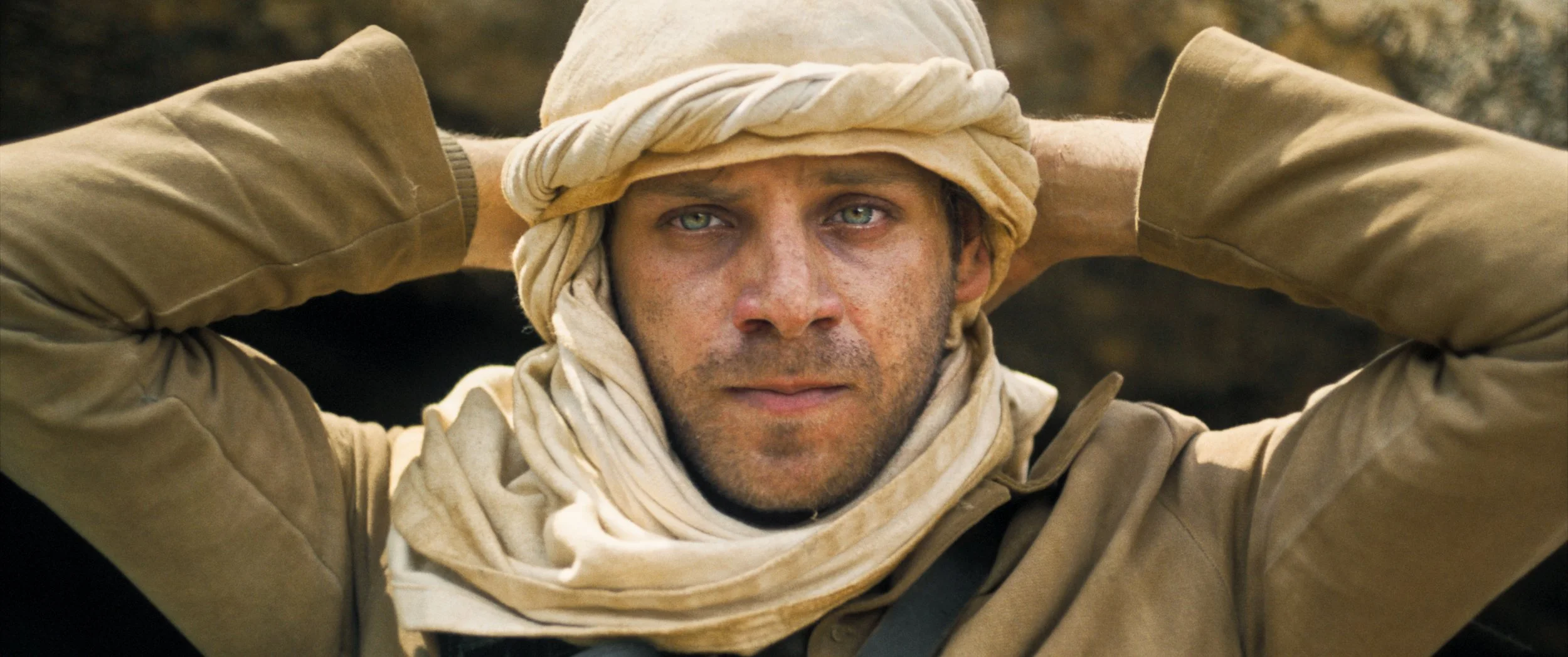
Review: 'Palestine 36' depicts a harrowing case of oppression from 90 years ago, and finds parallels to current struggles
Judging on filmmaking craft alone, “Palestine 36” is a moving depiction of a people facing persecution and answering with rebellion — and the escalation of that rebellion into brutal violence and repression.
And because the people being repressed in the film are Palestinians, and the ones committing the violence are occupying British forces who are working with unseen Jewish settlers, people will see this movie — or, more likely, not see it — and argue over its historical accuracy or its parallels to what’s happening 90 years later to modern Palestinians in Israeli-occupied Gaza and the West Bank.
As writer-director Annemarie Jacir tells it (and I stress that I’m merely describing her depiction of events here), the story begins with a young Palestinian man, Yusuf (Karin Daoud Anaya), finding work in Jerusalem as a servant to a prosperous Arab businessman, Amir (Dhafer L’Abidine), and his wife, Khouloud (Yasmine Al Massri), a modern Arab woman who writes blistering pro-Palestinian editorials under a male pseudonym. Amir and Khouloum also host dinner parties for the well-to-do of Jerusalem, namely the British colonists and the military occupation forces.
Yusuf often travels back to his village, where his family is facing the loss of the land they have owned for generations. The fences keep edging closer and closer to their farm fields, with Jewish refugees from Europe trying to settle there. The British offer no help, and instead a junior bureaucrat, Thomas (Billy Howle), tells the village elders to get title deeds for their land — an impossibility, since there’s no documentation for their initial claim to the land.
Then some of the Palestinian dock workers accidentally discover a cache of illegal rifles being shipped to the Jewish settlers. That convinces some Palestinians to take up arms themselves and begin a revolt. Meanwhile, Khouloum and other women rally at the British headquarters, where they get polite and meaningless reassurances from the British commandant — a role Jeremy Irons could play in his sleep, and here he kinda does.
Jacir filmed part of this movie in Palestinian territories — there’s a sentence it’s difficult to imagine anyone ever saying again — and those scenes capture the rough beauty of the place, and goes some way to explain why these characters would fight so hard to stay there.
The movie includes some moments in history, such as the announcement by a British royal commission to recommend partition of Jews and Palestinians in the occupied British Palestine — a decade before the British tried another bloody partition, between India and Pakistan. And the movie ends with a brutal depiction of a real historical event, the massacre by British troops of the residents of the village of al-Bassa in 1938, at the height of the Palestinian revolt against British rule.
How accurate is Jacir’s depiction of history? I’m not enough of an expert to give an answer. I also can’t attest to the historical accuracy of “Lawrence of Arabia” or “12 Years a Slave.” I can only judge on how the movie works as drama and cinema — and by those admittedly limited measures, “Palestine 36” is effective at depicting people fighting for the land they love, and at making us think about how the descendants of those people are coping with their struggles today.
——
‘Palestine 36’
★★★
Opens Friday, April 10, at the Broadway Centre Cinemas (Salt Lake City). Not rated, but probably R for brutal war violence and language. Running time: 115 minutes; in English and Arabic with subtitles.