Review: 'La Bola Negra' is a soulful story of the Spanish Civil War, and the tragic, resilient ways the past informs the present
The past seeps into the present, and the fictional bleeds into the real, in “La Bola Negra,” a soul-stirring epic that reaches back 80 years and finds that some things, like love as a persistent resistance to hate, are eternal and beautiful.
Directors Javier Calvo and Javier Ambrossi, who co-wrote the script with Alberto Conejero, tell three stories at once here. One is set in Granada in 1932, centering on a young man, Carlos (Milo Quifes), who has applied for membership in the city’s exclusive casino — but has been blackballed (which is where the movie’s title is derived) because the city fathers who decide on such things have heard the whispers that Carlos is a homosexual.
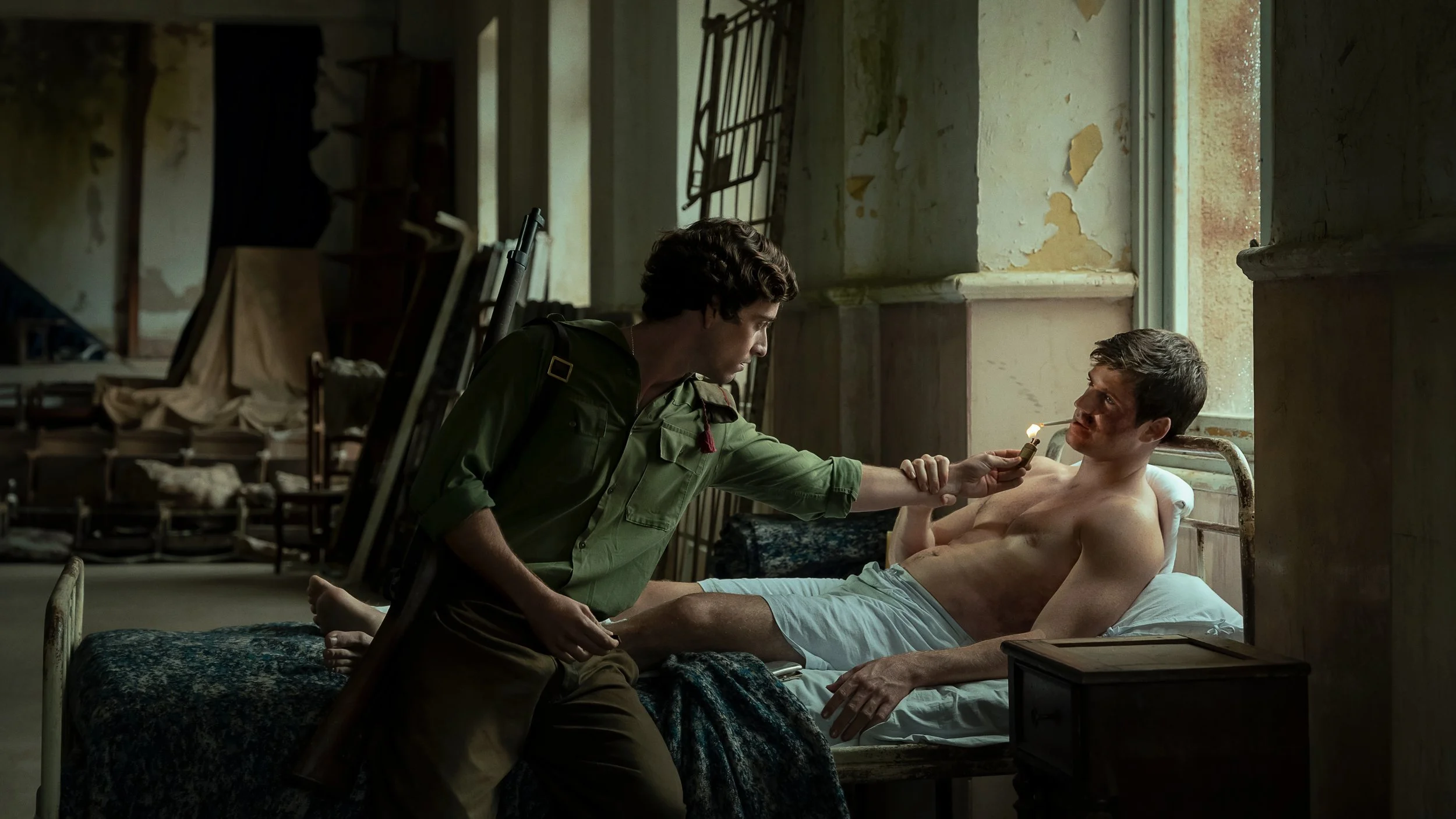
The second story follows Sebastián (played by the actor/musician known by the one name Guitarricadelafuente), who in 1937, during the Spanish Civil War, barely survives a massacre in his village at the hands of the Italian military. Sebastián ends up joining the side that killed his family, the Nationalists, the fascist side led by Generalissimo Francisco Franco and backed by Benito Mussolini. At a military garrison, he ends up guarding Rafael Rodriguez Rapún (Miguel Bernardeau), a former footballer who’s fighting on the side of the Republic, and is likely to be executed as soon as he heals from his combat injuries.
The third story is set in 2017, and centers on Alberto (Carlos González), a historian and former playwright who lives with his boyfriend, Juan Pablo (Julio Torres, from “Problemista”), and has an uneasy relationship with his cocaine-addicted mom (Lola Dueñas). Alberto gets a call and is surprised to learn that his mom’s father has just died — Alberto didn’t know he was alive — and that he is to receive an inheritance.
It takes Calvo and Ambrossi about an hour to start to show us the connections among these three stories. Without divulging too much, one of the connections is the work of the Spanish playwright Federico Garcia Lorca, who left behind four pages of a manuscript before he was assassinated during the Spanish Civil War — killed for being a Republican, and therefore branded a Communist, and possibly also because he was gay. (The movie suggests that Spain, like Germany in the Weimar era, had a flourishing pansexual cultural scene that was brutally suppressed by the totalitarian regime that followed.)
Calvo and Ambrossi pepper their story with lovely moments. There’s the “cupleista” Nené Romero (a sweet cameo by Penélope Cruz), a burlesque singer who entertains the troops and shows Sebastián the secret influence of drag. Or there’s the Lorca biographer (Glenn Close) whom Alberto shares the results of his inheritance, the importance of which she shows in three words in English: “Cancel my flight.”
Cruz and Close are the most recognizable faces in the cast, but some of the lesser-known performers won’t remain so for long. Most notable is Guitarricadelafuente, giving an electric performance in which he reveals Sebastián’s pent-up desire, confusion, shame and resolve as they unfold amid the bloodshed and cruelty of the war around him.
“La Bola Negra” is a movie that takes its time, but rewards the audience’s patience. By the end, we’ve experienced love and pain, loss and wisdom, regrets and victories — in short, we’ve lived the lives of these characters, something a playwright like Garcia Lorca would have loved.
——
‘La Bola Negra’
★★★1/2
Opens Friday, November 6, at several theaters. Rated R for violence/bloody images, graphic nudity, sexual content and language. Running time: 160 minutes; in Spanish and some English, with subtitles.