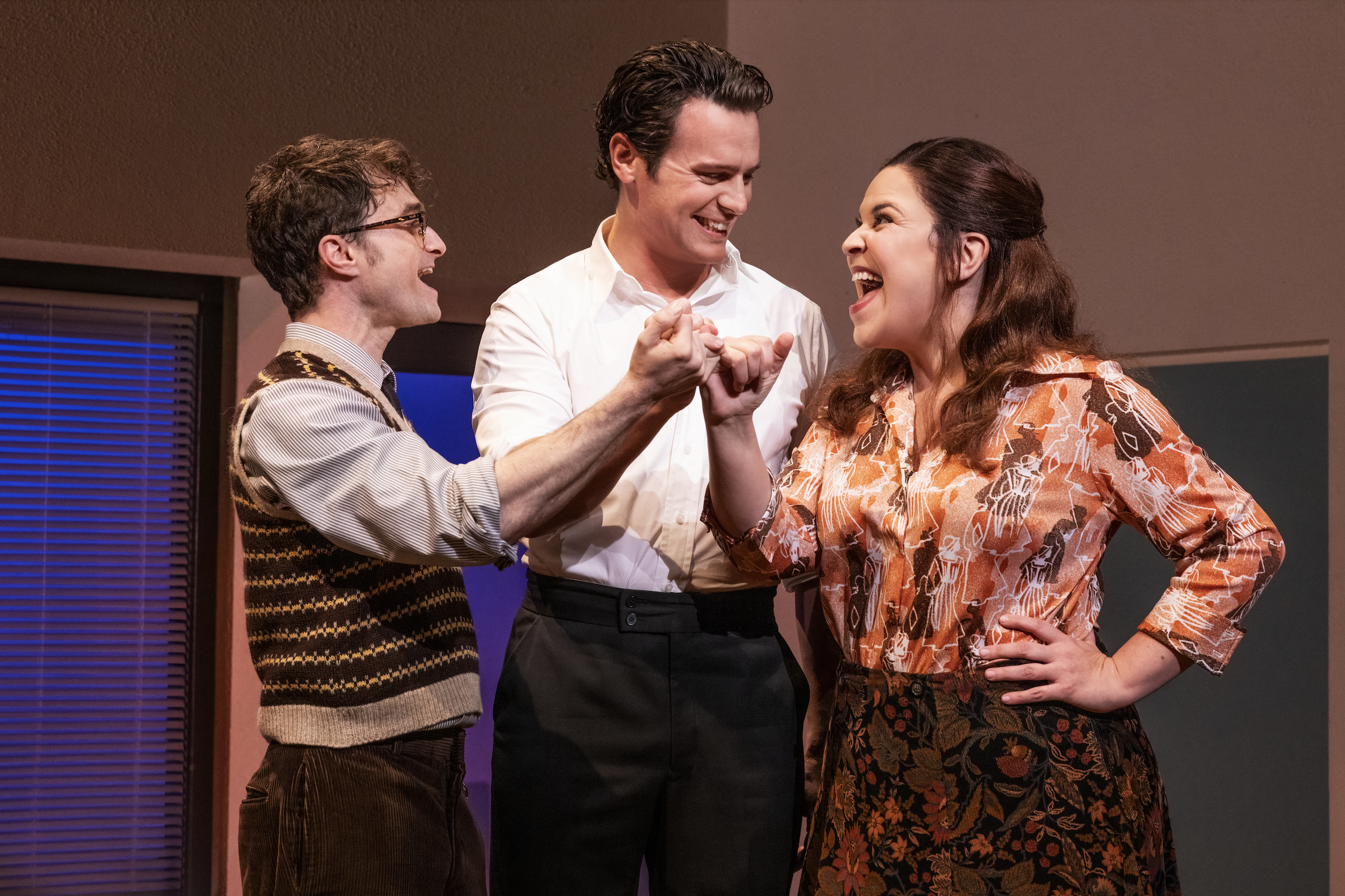
Review: 'Merrily We Roll Along' captures the joys of the Broadway revival — including Jonathan Groff's impossibly good looks and Daniel Radcliffe's neuroses
Since most of us don’t have the ready cash or proximity to New York to experience the magic of a Broadway musical, the next best thing is a movie like “Merrily We Roll Along,” which nicely captures the live show in a bottle.
Shot in June 2024 at New York’s Hudson Theatre, the movie features the Tony-winning revival of composer Stephen Sondheim’s smartly conceived musical about a playwright, Frank Shepard (played here by Jonathan Groff), and his two best friends, musician Charley Kringas (Daniel Radcliffe) and magazine writer-turned-novelist Mary Flynn (Lindsay Mendez).
When Sondheim and playwright George Furst initially wrote the musical in 1981, they kept the story structure from the source material, a 1934 Kaufman/Hart play: Telling the story in reverse chronology — showing Frank, Charley and Mary first as older and disillusioned, gradually catching them younger and more idealistic.
The opening scene is in Frank’s Hollywood home in 1977, when he’s a successful producer of lucrative but dumb movies. Director Maria Friedman, who also directed the stage version, starts by putting Groff’s impossibly handsome face in tight closeup, even when he’s not the one singing — and Frank’s feelings of self-loathing and self-centeredness play out on his face.
Mary is on the sidelines, drunkenly acting as Frank’s conscience, making acerbic comments about the hangers-on trying to get Frank’s attention. She’s also watching as Frank’s wife, Broadway actress Gussie Carnegie (Krystal Joy Brown), is figuring out that Frank is having an affair with the ingenue of his latest show (Talia Robinson, part of the play’s versatile ensemble). Charley is missing, because he and Frank haven’t spoken to each other in four years.
A musical transition takes the story back to 1973, and the last time Frank and Charley talked. It was on live TV, when the two, then a successful songwriting duo, were promoting their latest Broadway show. The interviewer lets slip something Frank hadn’t told Charley yet: Frank has signed a three-picture deal, which will mean a move to Hollywood. Charley unloads to the interviewer about his frustration with Frank’s pursuit of money over art. The song, “Franklin Shepard, Inc.,” is a fast-moving ball of lyrical rage, and Radcliffe knocks it out of the park.
Then it’s 1968, and Frank has a new apartment overlooking Central Park, welcoming his son, Frankie (Max Rackenberg), who he hasn’t seen since a bitter divorce from Beth (Katie Rose Clarke). The reason for the divorce: Frank’s affair with Gussie, then married to Joe (Reg Rogers), the producer of Frank and Charley’s breakout stage hit, “Musical Husbands.” Mary, who we figure out has long carried a torch for Frank, learns of the affair and takes up drinking.
Each step backwards in the timeline, the story shows us the friendships as they started, grew and grew apart. We also see how Frank and Charley’s youthful enthusiasm, and their desire to make art that means something, took the blows that life usually delivers — family responsibilities, financial survival and the messiness of having other people depend on you. And all of it is delivered through some of Sondheim’s best compositions, with complex rhyme schemes and intelligent wordplay.
All three leads are a joy to watch. Mendez builds a mask of sarcastic wit to hide the pain of loving Frank and not feeling that love returned. Radcliffe shows Charley to be a jittery ball of anxiety, a perfect foil for the glad-handing Frank. And Groff dominates as he portrays, in reverse, Frank’s slow slide into artistic compromise. Seeing all three together, in this time capsule of a movie, is sheer theatrical delight.
——
‘Merrily We Roll Along’
★★★1/2
Opens Friday, December 5, in theaters. Rated PG-13 for drug use, some strong language, and smoking. Running time: 149 minutes.