The Movie Cricket

Movie reviews by Sean P. Means.

  • The Movie Cricket
  • Sundance 2025
  • Reviews
  • Other writing
  • Review archive
  • About

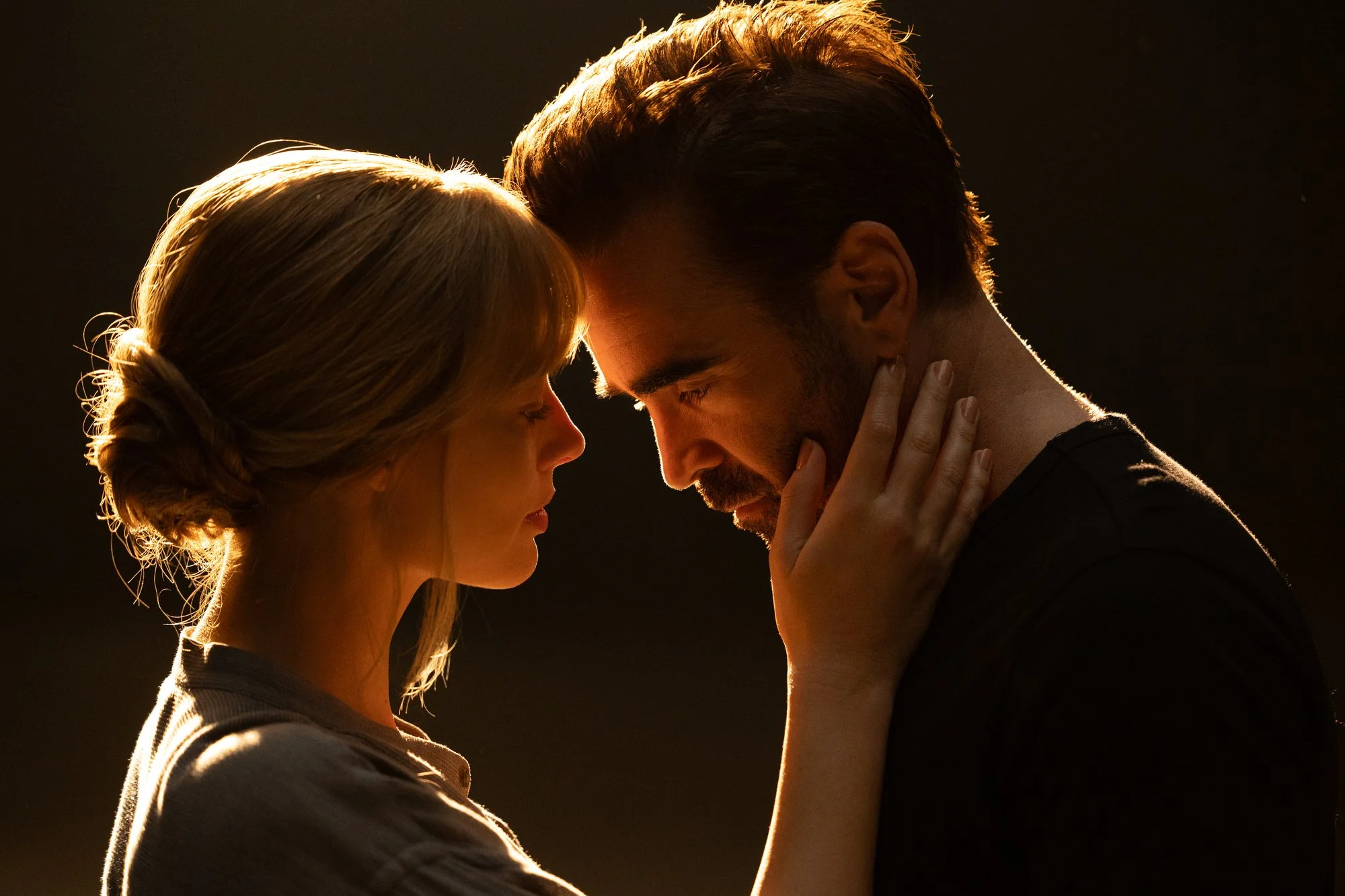
Sarah (Margot Robbie, left) and David (Colin Farrell) share a tender moment while on a fantasy of a road trip, in “A Big Bold Beautiful Journey,” directed by Kogonada. (Photo by Matt Kennedy, courtesy of Columbia Pictures.)

Review: 'A Big Bold Beautiful Journey' is a romance with fantasy, whimsy and a good pairing of Margot Robbie and Colin Farrell. Now if it figure out where it's going.

September 18, 2025 by Sean P. Means

The plodding fantasy-romance “A Big Bold Beautiful Journey” feels like it’s trying to channel the whimsy of Wes Anderson for the first half hour, then pivot to some darker emotional material — and neither move in this wobbly drama is successful.

Colin Farrell plays David, a big-city resident who finds himself in need of a car so he can drive to a wedding in the country. He finds a rental car company that’s peculiar for several reasons — starting with the clerk who’s overly amused with herself (and played by Phoebe Waller-Bridge, sporting a poorly chosen German accent) and her mechanic coworker (Kevin Kline). The clerk is insistent that David order the GPS option on the car, so he does.

During the wedding, David’s eyes meet those of Sarah (Margot Robbie), and the bride (Lucy Thomas) introduces them. Their small talk turns suddenly serious, with both informing the other that they are single by choice, and that seeing another couple get married isn’t likely to change it. Something else David discovers he has in common with Sarah: They’re both driving nearly 30-year-old Saturns, apparently from the same offbeat rental company. 

On the drive back, David’s GPS (voiced by Jodie Turner-Smith) asks David if he would like to take “a big bold beautiful journey.” After a moment of disbelief, David agrees and follows the bot’s instructions to pull over at a nearby Burger King and order a cheeseburger. As he starts eating, he notices that Sarah is also there, also eating a cheeseburger. Once back in their cars, Sarah’s won’t start, and David’s GPS tells him to give her a ride.

What follows in this sluggishly episodic script (by Seth Reiss, who co-wrote “The Menu”) is a series of stops where David and Sarah find a door in a place where doors normally would not be. Of course, they go through these doors, and find something that links back to the past of one or the other. These stops begin humorous, like when David relives a high school production of “How to Succeed in Business Without Really Trying,” but gradually turn melancholy, like taking Sarah back to the death of her mother (Lily Rabe). 

The single-named director Kogonada (“Columbus,” “After Yang”) should be able to navigate this premise well, but somehow the balance of whimsy and melancholy never feels right. It’s the same problem suffered by this year’s “The Life of Chuck,” which also tried to say something profound about the human condition and couldn’t find the right tone.

The biggest shame in “A Big Bold Beautiful Journey” is that we, as lovers of film romance, would love to see Farrell and Robbie in a movie where they gradually fall in love with each other. Here’s hoping they, and movie makers they meet, don’t give up on trying.

——

‘A Big Bold Beautiful Journey’

★★

Opens Friday, September 19, in theaters everywhere. Rated R for language. Running time: 108 minutes.
September 18, 2025 /Sean P. Means
Comment

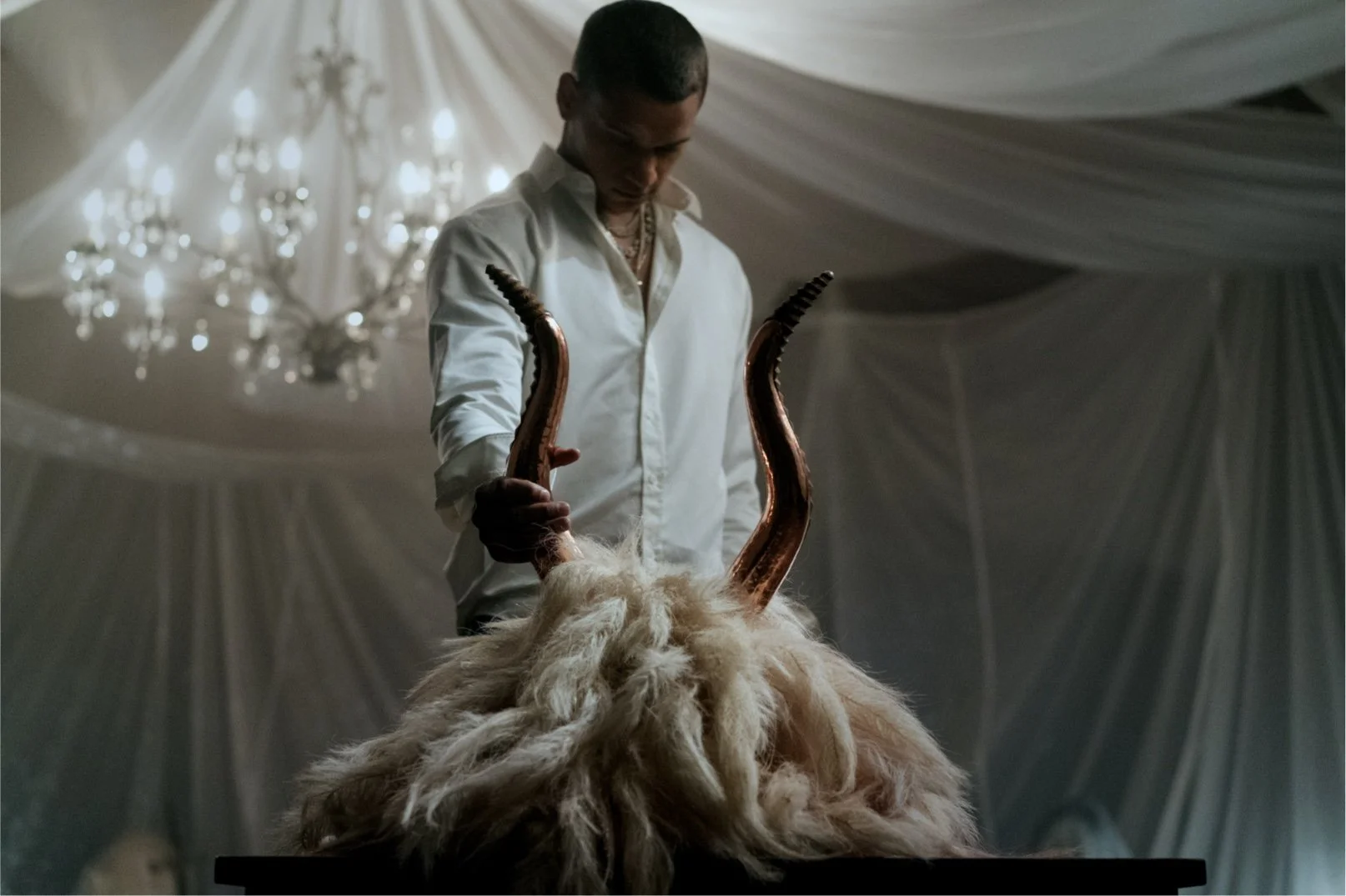
Cameron Cade (Tyriq Withers) is a college quarterback looking for a way into the pros, and finding a goat keepsake at the home of a veteran football champ (Marlon Wayans) in director Justin Tipping’s horror thriller “Him.” (Photo courtesy of Universal Pictures.)

Review: 'Him' tries to turn horror into satire of football's violence and excess, but the story spins ludicrously out of control

September 18, 2025 by Sean P. Means

Ambition and avarice collide in “Him,” a highly stylized and ultimately ridiculous horror movie that gives new meaning to the term “sacrificing a goat” (or, in this case, G.O.A.T.).

The protagonist here is Cameron Cade (played by Tyriq Withers), a phenomenal college quarterback who seems a likely top draft pick for the UFFL. (For reasons that become obvious very early, the actual NFL wouldn’t get within a mile of this movie.) Before the draft, though, he’s attacked and given a nasty skull fracture and a traumatic brain injury — jeopardizing his chances at the pros.

Cameron wants to show his determination, and he gets that chance when he receives a personal invite from his idol, legendary quarterback Isaiah White (Marlon Wayans). Isaiah has eight championship rings, and questions swirling around whether he will retire from his team, the San Antonio Saviors. Cameron has worshipped Isaiah since boyhood, and much of Cameron’s fractured relationship with his late father (played in flashbacks by Dom Benjamin) is centered on trying to emulate Isaiah.

Soon Cameron arrives at Isaiah’s compound in the desert, where Isaiah maintains a state-of-the-art practice facility, complete with a shady sports doctor (played by comic Jim Jefferies). Isaiah runs Cameron through some grueling training exercises, which tax the young QB physically and mentally — sometimes leaving him seeing hallucinations that may be a product of overwork, the residual effects of his brain injury, or something more demonic at work. 

Isaiah bans cellphones at his compound, to reduce distractions. But the place comes with its own distraction in Isaiah’s wife, Elsie (Julia Fox), a social media influencer and general-issue temptress.

Director Justin Tipping — who wrote the script with newcomers Zack Akers and Skip Bronkie — quick-cuts through several plot points, establishing the mentor-protege relationship between Isaiah and Cameron, as well as suggesting darker undercurrents. The suggestions aren’t particularly subtle, and it doesn’t take long to see the figurative devil’s bargain being offered between moments where Wayans’ Isaiah is yelling tough-coach insults at Withers’ young Cameron like a particularly brutal coaching session.

The problem with “Him” is that Tipping can’t maintain the thread as he bounces from jump-scare horror to testosterone-fueled commentary about someone has to do — and, more importantly, has to forfeit — to become the “Greatest of All Time.” This is particularly evident in the finale, which aims to be some kind of horror classic but just looks weirdly campy.

What nearly rescues “Him” is Wayans’ performance, a symphony of sports-driven rage masked by bro-code friendliness. Wayans seems to understand the tonal changes necessary here — outwardly charming and slightly humorous, but inwardly bubbling with murder and rage — better than Tipping does.

——

‘Him’

★★1/2

Opens Friday, September 19, in theaters everywhere. Rated R for strong bloody violence, language throughout, sexual material, nudity and some drug use. Running time: 96 minutes.

September 18, 2025 /Sean P. Means
Comment

Teen competitors — from left: Baker (Tut Nyuot), Olson (Ben Wang), Harkness (Jordan Gonzalez), Barkovitch (Charlie Plummer), Parker (Joshua Odjick), Garraty (Cooper Hoffman) and McVries (David Jonsson) — face long odds in “The Long Walk,” a dystopian thriller based on a Stephen King book. (Photo by Murray Close, courtesy of Lionsgate.)

Review: 'The Long Walk' is a brutally stripped-down 'Hunger Games,' with a squad of strong young actors in an authoritarian dystopia

September 11, 2025 by Sean P. Means

Bleak, brutal and brilliant, director Francis Lawrence’s “The Long Walk” is the authoritarian allegory these times require — a tale of bread and circuses in an oppressive regime and the lengths some people will go, literally, to fight back.

Based on a story Stephen King wrote under his pen name, Richard Bachman, “The Long Walk” imagines a near-future American wasteland, 19 years after a war that ended with a fascist government running the country. At the head is The Major (Mark Hamill), a gruff old soldier who rules by fear and violence. 

As a distraction, he oversees an annual contest in which young men from each of the 50 states, chosen by lottery, compete to walk nonstop longer than the others, keeping a steady pace of 3 mph. If one young man should stop or slow down for 10 seconds, he is given a warning. Ten more seconds, a second warning. Ten more seconds, and “you get your ticket” — a bullet in the head. The last man standing wins riches and a wish to do anything he wants.

The scenario is like a more dystopian, less stage-managed version of “The Hunger Games,” except Lawrence (who’s directed all but the first movie in that franchise) is holding back very little of the story’s viciousness. When we see the elimination of the first competitor (“Jojo Rabbit’s” Roman Griffin Davis), we’re convinced this movie is going dark early and often.

The main action is among the three dozen or so young walkers, and screenwriter JT Mollnar does an admirable job giving many of them moments to stand out. A solid supporting cast of young actors — including Ben Wang (“Karate Kid: Legends”), Charlie Plummer (“Spontaneous”), Tut Nyuot and Garrett Wareing among them — make the walking scenes pulsate with barely concealed terror.

At the heart of “The Long Walk” are Cooper Hoffman (“Licorice Pizza”) as Ray, who has a particular reason to be the last walker alive, and David Jonsson (“Alien: Romulus”) as Peter, for whom positivity has become a survival skill. Their twinned performances play well opposite Hamill’s intensely nasty Major, and find the soul within the savagery of a tyrannical America that we can only hope we won’t see outside the movie theater.

——

‘The Long Walk’

★★★★

Opens Friday, September 12, in theaters everywhere. Rated R for strong bloody violence, grisly images, suicide, pervasive language, and sexual references. Running time: 108 minutes.

September 11, 2025 /Sean P. Means
Comment

Lady Mary Talbot (Michelle Dockery, left) gets some counsel from her dresser, Anna Bates (Joanna Froggatt), in the film “Downton Abbey: The Grand Finale.” (Photo by Rory Mulvey, courtesy of Focus Features.)

Review: 'Downton Abbey: The Grand Finale' gives fans a last chance to luxuriate in 1930s wealth and privilege, and gentle soap-opera theatrics

September 11, 2025 by Sean P. Means

“Downton Abbey: The Grand Finale” is a charmingly instructive example of message discipline, since series creator and screenwriter Julian Fellowes repeats the same storyline with every character: This chapter of the lives of these characters is over, and the next one will happen off-camera.

This third and presumably final movie based on the popular British TV series focuses on transitions for the wealthy Crawley family and their staff of loyal servants. It’s 1930, and we’re told that the Crawley fortune — largely brought into the family by Lady Cora Grantham (Elizabeth McGovern), the American wife of Lord Grantham, aka Robert Crawley (Hugh Bonneville) — has largely survived the stock-market crash of 1929. However, when Cora’s brother, Henry (Paul Giamatti), visits the titular estate, he tells Cora that their late mother’s money is perilously close to vanishing, and with it the future of Downton Abbey.

Henry brings in tow Gus Sambrook (Alessandro Nivola, from “The Brutalist”), a handsome and seemingly wealthy investor, who has offered a plan to reinvest what’s left of Mama’s money to recoup Henry’s past losses. Gus is quite charming, as seen when over many gin cocktails, he and Lord Grantham’s daughter, Lady Mary Talbot (Michelle Dockery), end up sleeping together. 

Mary, you see, is finally unencumbered by a husband, having recently received her divorce from Lord Henry Talbot, the racing driver and cad. (Played by Matthew Goode in the series and the first movie, Henry Talbot is nowhere to be seen this time.) And while being single should be liberating, just as Mary is starting to take control of Downton Abbey’s operations, it’s also fodder for scandal. Mary experiences this at a society party, when the hostess, Lady Petersfield (Joely Richardson), ushers Mary out before royalty arrives.

Back at the mansion, the servants are going through some big changes. The imperious head butler, Carson (Jim Carter), has retired, but can’t quite give up the job to his successor, the former footman Andy Parker (Michael Fox). The head cook, Mrs. Patmore (Lesley Nicol), is more willing to hand over her post to her longtime assistant, Daisy Parker (Sophie McShera) — with the climax coming when Daisy and Andy, who are married, are put in charge of a big dinner party where the guests include the Crawley family’s old Hollywood friend, Guy Dexter (Dominic West), and a very famous acquaintance, continuing the show’s fascination with implanting real-life figures into the Crawleys’ orbit.

If you’re not familiar with the series or the previous two movies, some aspects of the characters may be lost on you — like why Mary’s tight bond with her sister, Lady Edith Hexham (Laura Carmichael), should be surprising; or why it’s weird to hear chauffeur-turned-relative Tom Branson (Allen Leech) talking like a capitalist. But for fans, reuniting with these folks is like a pleasant family reunion. 

Like a family reunion, though, one notices when a beloved relative isn’t there. The missing piece here is the family’s matriarch, Violet Crawley, who died in the last movie. She was played by Dame Maggie Smith, who herself died last year (and to whom the movie is dedicated) — and the absence of her acerbic humor is greatly missed, though her old friend, Lady Merton (Penelope Wilton), soldiers on admirably in trying to match it.

I found watching “Downton Abbey: The Grand Finale” to be a lesson in fan service. Since I’m not a diehard fan, I looked for context clues to spot the signifiers of what makes particular characters and relationships so beloved. And because I’m not invested the way a fan would be, I could appreciate the way Fellowes and director Simon Curtis (“My Week With Marilyn”) set up the storyline to cash in on the fans’ nostalgia for these rich folks and their ceaselessly loyal staff. If you love the series, “Downton Abbey: The Grand Finale” is a treat you’ll eat up with a spoon.

——

‘Downton Abbey: The Grand Finale’

★★★

Opens Friday, September 12, in theaters everywhere. Rated PG for suggestive material, smoking and some thematic elements. Running time: 123 minutes.

September 11, 2025 /Sean P. Means
1 Comment

Ashley (Adria Arjona, left) and Carey (Kyle Marvin) see something horrific on the freeway, which prompts Ashley to ask Carey for a divorce, in the comedy “Splitsville,” written by Marvin and Michael Angelo Covino, and directed by Covino. (Photo courtesy of Neon.)

Review: 'Splitsville' again lets the team of Michael Angelo Covino and Kyle Marvin find tension, and laughs, between bromance and romance.

September 04, 2025 by Sean P. Means

“Splitsville” is a sprightly and perfectly calibrated comedy of romance and bromance gone hilariously wrong, written by and starting real-life pals Michael Angelo Covino and Kyle Marvin — who are proving that they are quite adept at this kind of comedy of errors, between this and their 2019 debut “The Climb.”

The movie starts with Marvin’s character, Carey, driving with his wife, Ashley (Adria Arjona), on the way to visit Paul (Covino) and his wife, Julie (Dakota Johnson), at their beach house. Before they get there, though, they witness a horrible freeway crash — which prompts Ashley, a life coach, to think about what she’ll regret in life, and one of those regrets is not telling Carey before now that she wants a divorce.

Carey eventually arrives alone to Paul and Julie’s. (The way he gets to the house is the first of the movies many sustained sight gags.) Over wine, Paul and Julie tell Carey the secret of their long marriage: They have an open relationship, and each are OK if the other sleeps with someone else.

At least that’s what they tell themselves. When Paul returns to the city for business, Julie confides in Carey that she is sure he’s off having an affair with another woman — which bothers Julie more than she wants to admit when Paul’s there. Naturally, Julie decides the way to process this is to have sex with Carey.

After doing the deed with Juiie, Carey feels guilty and wants to get back together with Ashley. Unfortunately for him, Ashley already has moved on to her next lover, a hunky but dim bartender, Jackson (Charlie Gillespie). And while Ashley runs through a squad of new lovers (including a mentalist played by “Succession’s” Nicholas Braun), Julie decides she’s done with Paul’s lies — sexual and financial — and shows an interest in hooking up again with Carey.

As with “The Climb,” Covino (who directed both films) and Marvin demonstrate an uncanny ability to write precisely plotted comedies that feel improvisational. They also serve their material well in their performances, with Covino as the sniveling cad and Marvin as the good-natured heel. They also go for broke starring in one of the funniest fight scenes to be featured in a movie in ages.

The women with whom Covino and Marvin are paired deliver more than just glamorous looks. Johnson gives Julie a dry wit as she tries to rise above Paul’s duplicity and Carey’s lovelorn gazes. And Arjona steals the movie by capturing Ashley’s indecision over whether or not to win Carey back. 

Where Covino and Marvin get the most laughs are in a series of set pieces — particularly an 11th birthday party for Julie and Paul’s son, Russ (Simon Webster) — where Paul and Carey are confronted with the consequences of their romantic choices. Those moments, staged like an ensemble comedy at double speed, make “Splitsville” a singularly hilarious movie.

——

‘Splitsville’

★★★1/2

Opens Friday, September 5, in theaters. Rated R for language throughout, sexual content and graphic nudity. Running time: 104 minutes.

September 04, 2025 /Sean P. Means
Comment

Roman (Dylan O'Brien, left) and Dennis (James Sweeney) evoke “The Sims” at a Halloween party, in the dark comedy “Twinless," written and directed by Sweeney. (Photo by Greg Cotten, courtesy of Lionsgate / Roadside Attractions.)

Review: 'Twinless' is an outrageously dark comedy about death and loneliness, sent soaring by writer-director James Sweeney's unhinged performance

September 04, 2025 by Sean P. Means

How much enjoyment a viewer gets from “Twinless” is dependent on how much you can tolerate the character of Dennis — played by the film’s writer-director, James Sweeney, as what can best be described as a “Napoleon Dynamite” vibe, if Napoleon were gay and a bit psycho.

Sweeney’s character, Dennis, doesn’t open the movie. That place is held by Roman (Dylan O’Brien), a guy from Idaho who acknowledges that he’s “not the brightest tool in the shed.” We first see Roman at a funeral for his gay twin brother, Rocky (played by O’Brien in flashbacks), who died in an auto-pedestrian accident in Portland, Ore.

After the funeral, Roman and his scowling mom (Lauren Graham), are trying to go through Rocky’s things in his Portland apartment. Roman decides he’s going to stay in Portland awhile, get a job, and try to figure out life without his twin. Roman even joins a support group for people who have lost their twin — which is where he meets Sweeney’s Dennis, who tells the group about his twin, Dean.

That all happens n the first 15 minutes, before the film’s title appears on the screen. This is where Sweeney starts telling Dennis’ side of the story — about which I will try to say little, to keep from spoiling the twists of this sometimes bizarre comedy.

I will say that Roman and Dennis become friends through the support group, and start hanging out together — which is how Roman meets Dennis’ co-worker Marcie (Aisling Franciosi). A romance blooms, which is good news for Roman and Marcie but bad news for Dennis, who fears it will infringe on his friendship.

Sweeney creates a singular character whose insecurities and his talent for turning small problems into big ones will make you laugh and cringe, often at the same time. Crazy as some of the turns Sweeney navigates are, O’Brien doesn’t just hang on for the ride — but adds an underlying menace when Roman demonstrates his hot temper. 

“Twinless” may leave a few audience members out in the cold. For those with an appetite for a comedy that takes a few risks, “Twinless” is a challenge worth exploring.

——

‘Twinless’

★★★

Opens Friday, September 5, in theaters. Rated R for sexual content/nudity and language. Running time: 100 minutes

——

This review originally appeared on this site on January 24, 2025, when the movie premiered at the 2025 Sundance Film Festival.

September 04, 2025 /Sean P. Means
Comment

Alexander Hamilton (Lin-Manuel Miranda, left) woos his wife, Eliza (Phillipa Soo), in the original Broadway production of “Hamilton,” filmed in 2016 and being released in theaters for the first time. (Photo courtesy of Disney+.)

Review: 'Hamilton,' premiering on the big screen, demonstrates Lin-Manuel Miranda's genius — and the power of bold storytelling for the stage

September 04, 2025 by Sean P. Means

Like a Fourth of July firework, the movie version of “Hamilton” bursts forth with color and spectacle, bottling the emotional fire that made Lin-Manuel Miranda’s hip-hop history lesson a Tony- and Pulitzer-winning masterpiece and a cross-cultural hit.

Miranda’s collaborator Thomas Kail, who directed both the stage version and this movie, makes the smart move of rendering “Hamilton” in its purest, original form, from the stage of the Richard Rodgers Theatre on Broadway. Shot with multiple cameras during two performances in June 2016, with Miranda in the title role and with most of the original cast — and with close-ups and crane shots taken without an audience present — the movie harnesses the evocative lighting, surrealistic staging and hip-hop inventiveness.

The story, taken from Ron Chernow’s biography of America’s first Treasury secretary, follows Hamilton as he goes from a penniless rabble-rouser to Revolutionary War fighter, moving up as secretary to Gen. George Washington (Christopher Jackson) — then, after the war, becoming part of President Washington’s cabinet, where squabbles with rival Thomas Jefferson (Daveed Diggs) and his own hubris lead to his political downfall.

Hamilton’s life runs in parallel to that of Aaron Burr (Leslie Odom Jr.), whose reticence and hesitation contrasts with Hamilton’s brash, heart-on-his-sleeve passion. Their long rivalry ultimately brings them both to the dueling ground at Weehawken, N.J.

And the play chronicles the eternal love triangle of Hamilton, his wife Eliza (Phillipa Soo), and her older sister — and Hamilton’s intellectual foil — Angelica Schuyler (Renee Elise Goldsberry).

By capturing the play as performed, the movie gets so many details that would be otherwise lost: the physical comedy when Miranda’s Hamilton challenges a hapless orator to a debate; the swagger when Hamilton and Burr consider which Schuyler sister each might seduce; or the practical split-screen of Hamilton and Burr each contemplating new fatherhood during the lullaby “Dear Theodosia.”

Through the close-ups, Kail neatly dissects the play’s trickiest numbers, like the Act I finale “Non-Stop,” to weave through multiple characters without interrupting the flow of music and movement. The onstage camerawork also captures the sly dealing Hamilton must engage in in “The Room Where It Happens,” Jackson’s soulful gravity as Washington, and even the spittle coming out of the mouth of mad King George III (Jonathan Groff).

All that would have been lost in a conventional cinematic adaptation. Take any one of the three duels in the story. In a typical movie shoot, the production might have set up on location on some grassy hill, clothed the actors in expensive costumes, and deployed computer effects to show the bullets leaving the duelists’ pistols. And it would have been just a tenth as interesting, or emotionally compelling, as the choreography and lighting that crystallizes the moment in the stage version.

Also, if this were a regular movie, the producers may have disrupted the casting, for fear an audience would not accept a single actor playing multiple roles. And how would anyone make Diggs choose which show-stopping role to play — Lafayette in the first act or Jefferson in the second?

The choice to shoot after the cast had been working together for more than a year, off-Broadway and then at the Rodgers, let the audience see the performers in their stride. By then, they knew when to pause for a laugh and when to hit the emotional beats for maximum effect. There are moments that resonate here better than in the cast album, which was recorded just after the play’s Broadway premiere.

Seeing this “Hamilton,” in which people of color play the greatest rebels of American history, feels particularly resonant at this moment in our history. In this world turned upside-down by pandemic and civil unrest and endless political squabbles, an electrifying story about people arguing, fighting and loving passionately for freedom, family and legacy is just what we need.

——

‘Hamilton’

★★★★

Opens Friday, September 5, in theaters. Rated PG-13 for language and some suggestive material. Running time: 162 minutes (plus some new interview material). 

——

This review originally appeared in The Salt Lake Tribune on June 30, 2020, when the movie premiered on Disney+.

September 04, 2025 /Sean P. Means
Comment

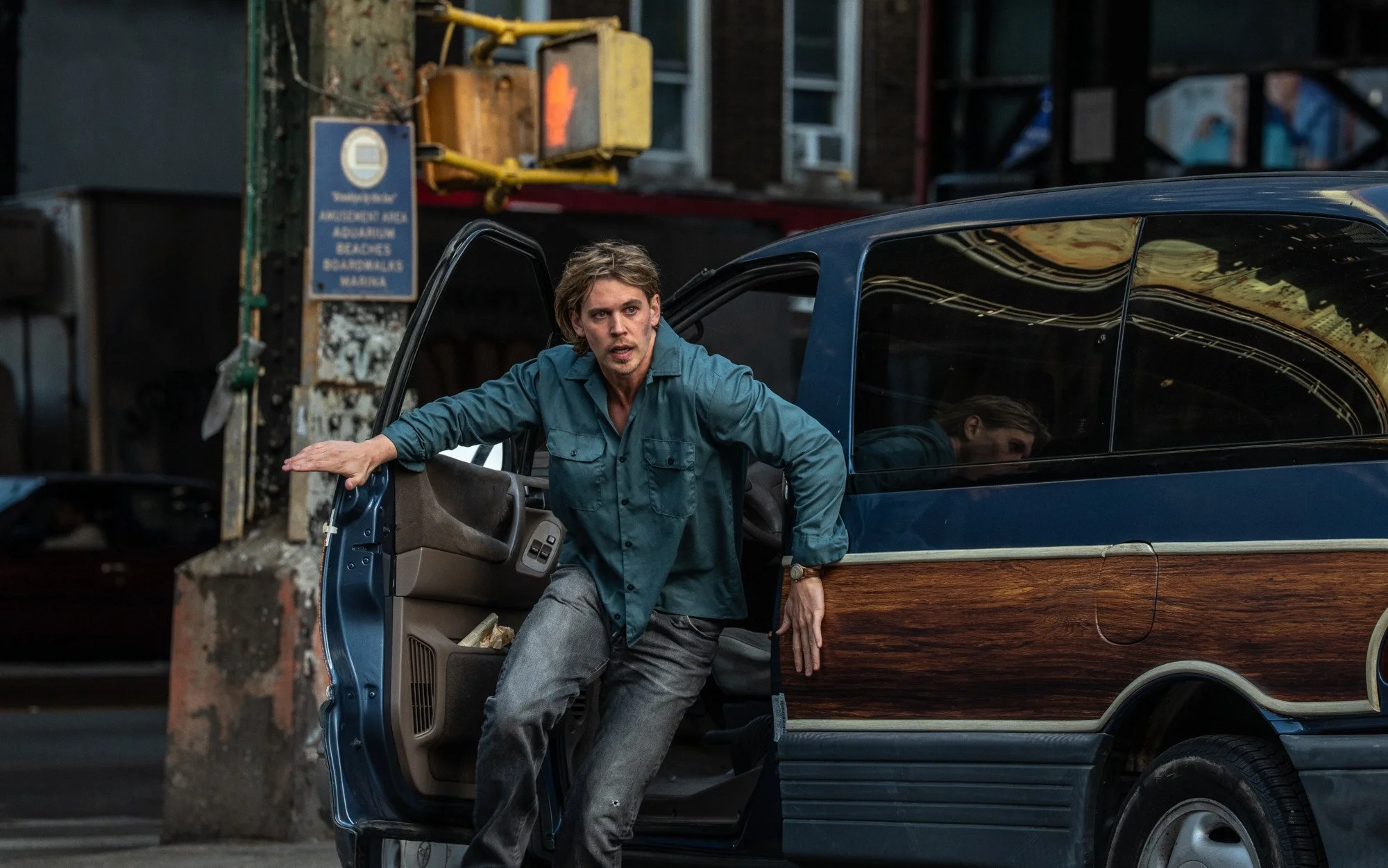
Austin Butler plays Hank Thompson, a New York bartender who gets bounced around by rival gangsters in director Darren Aronofsky’s crime caper movie “Caught Stealing.” (Photo by Niko Tavernise, courtesy of Columbia Pictures / Sony.)

Review: 'Caught Stealing' is a dark crime caper that shows Austin Butler's ability to adjust his charisma to fit the movie he's in

August 28, 2025 by Sean P. Means

After proving he can own a big movie, playing The King in Baz Luhrmann’s “Elvis,” actor Austin Butler shows in Darren Aronofsky’s dark crime caper “Caught Stealing” that he can scale his big personality down to fit the material — and still own every moment of the movie.

Butler plays Hank Thompson, a New York bartender, circa 1998, with an unhealthy obsession with the San Francisco Giants. He has a drinking problem, something his paramedic girlfriend, Yvonne (Zoë Kravitz), tries to get him to get under control. He also has a punk musician neighbor, Russ (Matt Smith), who asks Hank to look after his cat when he has to leave town suddenly. 

That’s where Hank’s problems start. Two Russian thugs (Yuri Kolkolnikov and Nikita Kukushkin) come looking for Russ, and when Hank intervenes, they beat the crap out of him — leaving him to wake up in the hospital, Yvonne at his bedside, with one fewer kidney than he started the week with. When he calls the cops, Detective Roman (Regina King), takes his statement and warns him against trying to learn too much on his own. This being the kind of noir crime drama this is, Hank can’t heed that warning.

Soon the trail of unsavory characters in Hank’s life include a gun-happy gangster named Colorado (played by Benito Martinez Ocasio, also known by his musical name, Bad Bunny), and a pair of Hasidic Jewish mobsters (Liev Schreiber and Vincent D’Onofrio) with a lethal reputation. 

Aronofsky puts aside his more surrealist tendencies (e.g. “Requiem for a Dream,” “Black Swan,” “Mother!”), playing Hank’s plight more in the gritty realism of “The Wrestler” and “The Whale.” The new wrinkle is that Charlie Huston’s script (adapted from his novel) injects some comedy, some of it on the morbid side, into the story, like when the mobsters take a captive Hank along to Shabbos, where we meet their bubbe (Carol Kane) and have some matzo ball soup.

Those tonal shifts can be a bit jarring at times, but Butler’s performance holds us steady throughout. In a story where he is playing the man caught up in other people’s intrigue, Butler doesn’t play Hank as a dupe or a fall guy, but as a man who is a step behind the story but capable of catching up and turning the tables. Hank also has a backstory, parceled out judiciously, to explain why his once-promising baseball career never came to fruition.

“Caught Stealing” is also the third movie this month (after David Mackenzie’s “Relay” and Spike Lee’s “Highest 2 Lowest”) to take advantage of a certain view of New York City — in this one, a roiling undercurrent of crime and disenchantment, three years before 9/11, where the city is fueled by attitude and a fondness for the Mets. By placing Butler in that sandbox, Aronofsky creates a sharp-elbowed crime thriller with a fascinating streak of melancholy. 

——

‘Caught Stealing’

★★★

Opens Friday, August 29, in theaters everywhere. Rated R for strong violent content, pervasive language, some sexuality/nudity and brief drug use. Running time: 107 minutes.

August 28, 2025 /Sean P. Means
Comment
  • Newer
  • Older

Powered by Squarespace