The Movie Cricket

Movie reviews by Sean P. Means.

  • The Movie Cricket
  • Sundance 2025
  • Reviews
  • Other writing
  • Review archive
  • About

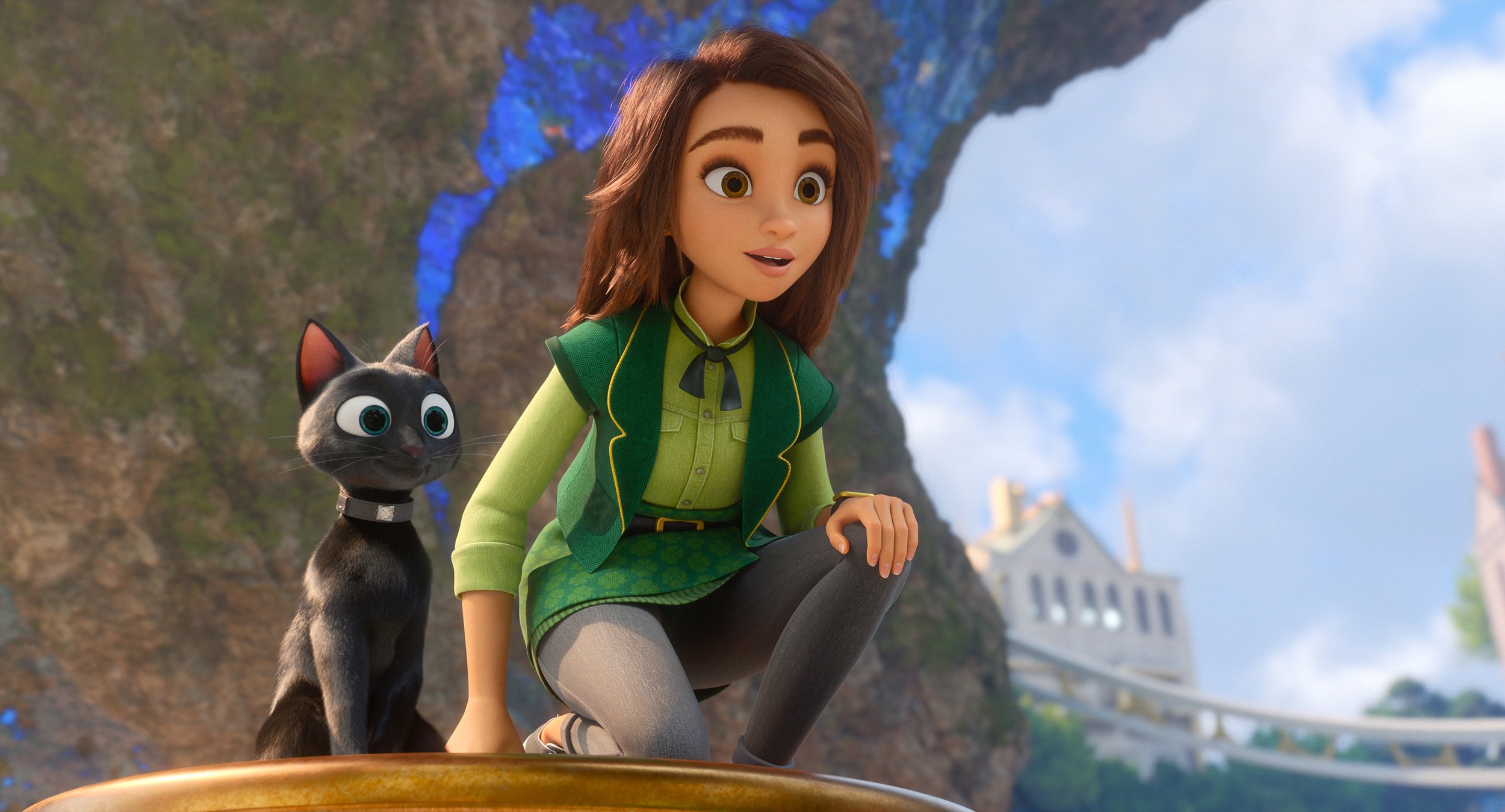
Sam Greenfield, at right (voiced by Eva Noblezada), is shown the Land of Luck by Bob (voiced by Simon Pegg), a black cat, in the animated adventure “Luck.” (Image courtesy of Skydance Animation and Apple TV+.)

Review: 'Luck,' even with John Lasseter involved, is a pale imitation of Pixar

August 05, 2022 by Sean P. Means

The all-ages animated adventure “Luck” is being touted, quite loudly in some quarters, as Apple TV+’s first major foray into the territory long held by Pixar Animation Studios — with much attention to the return of Pixar’s and Disney’s former rainmaker, John Lasseter, as a producer, after an industry exile due to reports of toxic behavior.

That backstage intrigue may be fascinating to some, and it’s certainly more intriguing than the bland imitation Pixar movie that is the eye of the marketing department’s media storm.

The story centers on Sam Greenfield (voiced by Eva Noblezada), a preternaturally unlucky young woman whose life is filled with flat bicycle tires, workplace mishaps and toast always landing jelly side down. Her life, as the movie begins, has been spent in a foster home, which she is aging out of as she turns 18, with a long list of families who looked her over and decided not to adopt her.

But Sam remains a kind person, feeding her panini to a black cat, or encouraging young Hazel (voiced by Adeline Spoon), a younger denizen of the foster home, when it’s her turn to meet potential parents. When she finds a lucky penny, she’s determined to give it to Hazel — but before that happens, Sam loses the penny.

The key to getting the penny back, Sam quickly realizes, involves that cat. Turns out the cat, Bob, can speak (with the voice of Simon Pegg), and leads Sam to a secret portal to the Land of Luck. It’s a land of lucky pennies, leprechauns, ladybugs and other symbols of good luck — all overseen by a lucky dragon (voiced by Jane Fonda), who is determined to stamp out any traces of bad luck she encounters.’

What’s absent from the Land of Luck, Bob tells Sam in his most agitated voice, are humans — especially ones as unlucky as Sam. And Bob’s efforts to get Sam her own penny, and then get her home, without risking an entrance into the Land of Luck’s polar opposite, a land of bad luck.

Director Peggy Holmes and writer Kiel Murray get so into the details of luck — from Japanese waving cats to how the Scots think a black cat is good luck — that they don’t see how derivative the story is. There’s a distinct vibe of “Monsters, Inc.” another tale of a human girl infiltrating a secret supernatural world hidden from humankind.

Some of the gags — like a unicorn (voiced by comic Flula Borg) who collects bad luck — are engaging, but there’s a distinct lack of hills and valleys in Murray’s script, and it all chugs along to a predictable conclusion. The one kind of luck missing for Apple TV+ in “Luck” is beginner’s luck. 

——

‘Luck’

★★1/2

Starts streaming Friday, August 5, on Apple TV+. Rated G. Running time: 106 minutes.

August 05, 2022 /Sean P. Means
Comment

Singer-songwriter Leonard Cohen, seen here performing late in his career, is the subject of the documentary “Hallelujah: Leonard Cohen, a Journey, a Song.” (Photo courtesy of the Leonard Cohen Family Trust.)

Review: 'Hallelujah' reveals the secrets behind 'the secret chord,' and the highs and lows of Leonard Cohen's singular career

August 05, 2022 by Sean P. Means

Yes, we’ve all heard there was a secret chord that David played and it pleased the Lord — but the really good stories in the documentary “Hallelujah: Leonard Cohen, a Journey, a Song” are the ones about the man who wrote that much-loved and sometimes overused song, the Canadian singer-songwriter Leonard Cohen.

The story of Leonard Cohen starts as a kid in Montreal, Quebec, and moves to New York, where he starts working as a songwriter. Pitching one of his early songs, “Suzanne,” to Judy Collins, already a star, Collins’ response is that she’ll record the song the next day. She did and it was a hit. Collins is one of the numerous admirers of Cohen interviewed in the film.

Soon, Cohen is recording his own songs, and getting a reputation as the kind of songwriter other songwriters admire. Oddly, though, the song that would ultimately become his signature, “Hallelujah” — which took Cohen years to write — was on an album that his label, Columbia Records, refused to release in the United States.

The movie takes a circuitous route at this point, to delve into how “Hallelujah” became an iconic song. Firstly, Cohen started performing it live with a different set of lyrics, trading in the spiritual references for an earthier, more carnal flavor. Standing before the Lord of Song was out, replaced by “I remember when I moved in you / And the holy dove she was moving too.”

And soon other performers took up the song. John Cale, of the Velvet Underground, recorded a stunning cover. So did Jeff Buckley, which became so recognizable that many people — particularly after Buckley died tragically young — thought he had written it. Then, in 2001, the makers of “Shrek” put some of Cale’s cover (minus the naughty bits) in the movie, and it soon became a go-to song for stuffing a soundtrack with added emotion. (Fun fact: The “Shrek” soundtrack album used Rufus Wainwright’s cover rather than Cale’s, because Wainwright was signed to DreamWorks’ record label.)

The husband-and-wife directing team of Daniel Seller and Dayna Goldfine — whose past films include “Ballets Russes” and “The Galapagos Affair: When Satan Came to Eden” — got access to a wealth of information and footage of Cohen. They use it beautifully, including a sequence toward the end that seamlessly fuses a dozen late-career live performances of “Hallelujah,” after he had overcome his ambivalence about the song’s success, into a single sterling rendition.

If you hate the song “Hallelujah,” you won’t like this movie, because it plays Cohen’s version repeatedly, along with some striking covers — Cale and Buckley and Wainwright, of course, but also Brandi Carlile (who talks about how the song came along as she was reconciling her faith with her homosexuality) and k.d. lang, who sang the song at the Canadian memorial service after Cohen’s death in 2016. (It’s even better than her rendition during the opening ceremonies of the 2010 Vancouver Winter Olympics, which was amazing.)

If you’re not a fan of Cohen, “Hallelujah” the documentary could turn you into one, as it depicts him as a incredibly thoughtful and introspective writer, who considered songwriting a craft that improved with practice and hard work. It’s clear that Cohen could stand before that Lord of Song with a lot more on his tongue than simply “Hallelujah” — but that one song would be enough.

——

‘Hallelujah: Leonard Cohen, a Journey, a Song”

★★★1/2

Opens Friday, August 5, at several theaters. Rated PG-13 for brief strong language and some sexual material. Running time: 118 minutes.

August 05, 2022 /Sean P. Means
Comment

Ben (B.J. Novak, left) and Ty (Boyd Holbrook) visit a memorial for Abilene (Lio Tipton), whom Ben dated and was Ty’s sister, in the darkly comic thriller “Vengeance,” written and directed by Novak. (Photo by Patti Perret, courtesy of Focus Features.)

Review: 'Vengeance,' B.J. Novak's directing debut, is a smart culture-clash drama but falls apart as a murder mystery

July 28, 2022 by Sean P. Means

In the darkly comic thriller “Vengeance,” B.J. Novak — who also wrote and directed the film — plays a writer out to “find America” by reporting on and narrating a true-crime podcast deep in the heart of Texas.

And if you’ve ever listened to a true-crime podcast, you’re going to appreciate how Novak’s directing debut comes out: Often thrilling, occasionally insightful, and with an ending that can’t neatly wrap what has led up to it.

Novak plays Ben Manalowitz, a Brooklyn-based writer who tells his friend, Eloise (Issa Rae), that he wants to tell a story that’s meaningful, that says something about America in the 21st century. “America isn’t divided by space; it’s divided by time,” Ben declares, to which Eloise, a radio producer, responds, “That’s a theory. It’s not a story.”

Then Ben gets a call from someone he doesn’t know, Ty Shaw (Boyd Holbrook), with news that Ty’s sister, Abilene (Lio Tipton), has died. Ben used to hook up with Abilene a time or two when she lived in New York,  but, apparently, her family thinks their relationship was more serious. So Ty insists that Ben fly to Texas — not Austin or Dallas or Houston, but “real” Texas — for her funeral.

Ben lands in the Lone Star State, and Ty is there to drive him to meet the rest of the Shaw family. Riding shotgun in Ty’s truck (which has a shotgun and a rifle in the gun rack behind Ben’s head), Ben hears Ty’s theory that Abilene didn’t die of an accidental drug overdose, as then not-too-bright local law enforcement has said, but was killed. And Ty wants to enlist Ben in finding her killer and avenging her death.

Ben decides this is the story he wants to tell, and immediately calls Eloise to pitch it. She’s on board, and ships him a pro-grade recorder to capture every voice.

Soon, Ben is meeting the rest of the Shaw family: Abilene’s mom, Sharon (J. Smith-Cameron, from “Succession”); Abilene’s fame-hungry sisters, Paris (Isabella Amara) and K.C. (Dove Cameron), and her little brother, nicknamed El Stupido (Eli Bickel); and Abilene’s salty grandma, Carole (Louanne Stephens, from “Longmire”). They all express astonishment that Abilene died of a drug overdose, with each of them saying with suspicious regularity that “she didn’t take so much as an Advil.”

Ben tries to plumb the depths of Texas culture, such as going to the rodeo, pouring chili in a bag of Frito’s, and grabbing dinner at the Shaw family’s favorite place, Whataburger. He also tries to investigate the mystery of Abilene’s death, away from a well-known weekend party site in the scrub lands, in an oil field with no cellphone service in an area conveniently split among four jurisdictions. And Ben seeks clues to the type of person Abilene, whom he barely knew, was — a would-be musician who confided in a suave record producer, Quentin Sellers (Ashton Kutcher), and befriended the town drug lord, Sancholo (Zach Villa).

Novak mines a fair amount of humor from the culture clash between Ben’s urban vibe and the Texas setting — though he’s careful not to be too condescending to the Texas side, deriding the Brooklyn pomposity with equally acerbic barbs. He also captures the glossy sterility of Eloise’s public-radio offices, where the gritty humanity of Abilene’s death is sanded down to just another story about America. (Bonus points for casting “Fresh Air” host and radio icon Terry Gross as the voice of Eloise’s boss, seemingly dialing in from the radio equivalent of Mount Olympus.)

Unfortunately, Novak can’t stick the landing. All the set-up and sharp observational details he plants throughout “Vengeance” pay off when Ben and the Shaw family finally get real with each other about what each thinks about the other’s geographically centered worldviews. But then there’s the mystery-thriller part of the story, which fizzles when it should explode, leaving audiences wanting to seek their own vengeance for being led down a path to nowhere.

——

‘Vengeance’

★★★

Opens Friday, July 29, in theaters everywhere. Rated R for language and brief violence. Running time: 107 minutes.

July 28, 2022 /Sean P. Means
Comment

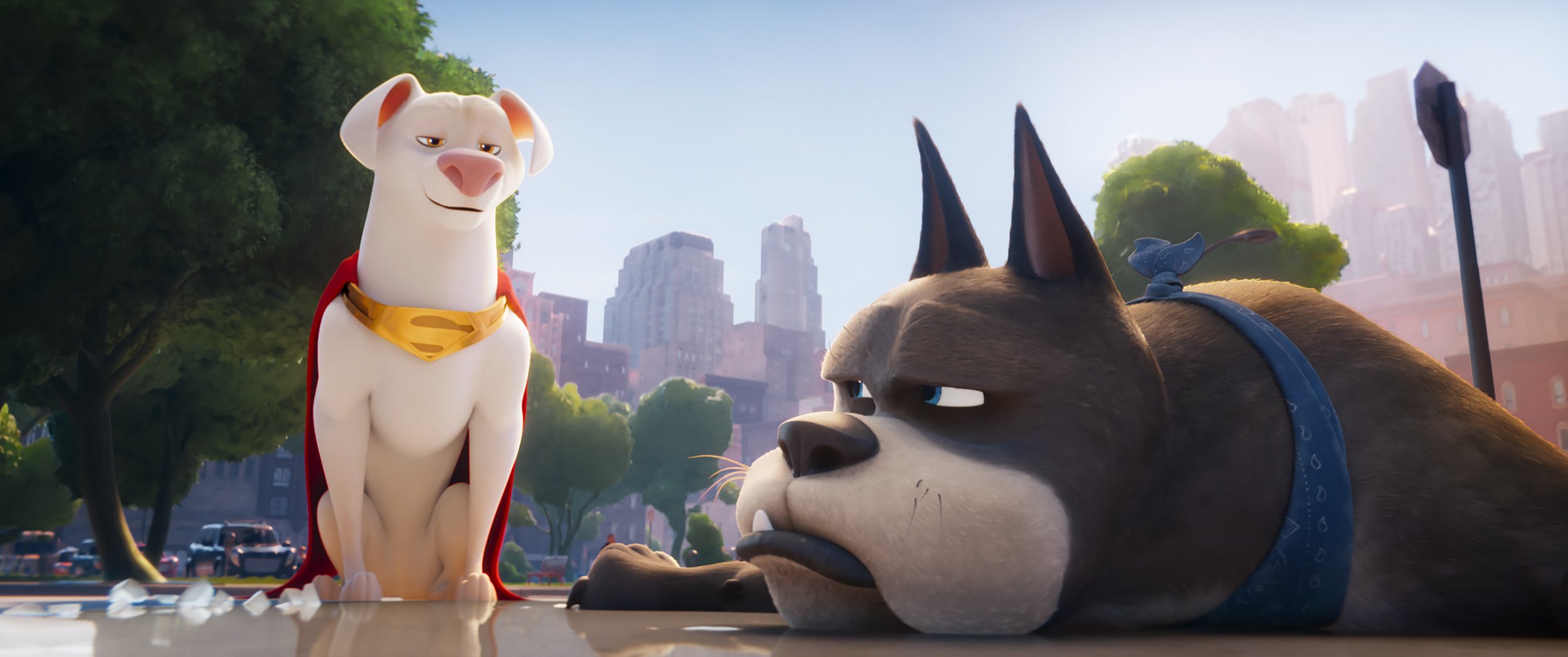
Krypto, left (voiced by Dwayne Johnson), encounters Ace (voiced by Kevin Hart), in a scene from the animated “DC League of Super-Pets.” (Image courtesy of Warner Bros. Pictures.)

Review: 'DC League of Super-Pets' is purely an intellectual property exercise, but the jokes have some bite

July 28, 2022 by Sean P. Means

The animated, mostly kid-friendly “DC League of Super-Pets” is what it is: a sporadically entertaining jaunt through Warner Bros.’ Intellectual property, a starter kit for little ones who haven’t yet been exposed to Superman, Batman and their friends in tights.

The two-legged superheroes aren’t the stars of this adventure. Instead, the character at the center is Krypto, the stalwart companion of Superman, aka Clark Kent. (A flashback scene shows the puppy Krypto stowing away in baby Kal-El’s capsule when his parents, Jor-El and Lara, send him away from the soon-to-be-destroyed planet Krypton.) Krypto, voiced by Dwayne Johnson, is super-strong, super-loyal, and super-jealous when Clark (voiced by John Krasinski) starts spending less time with his favorite dog and more time with Lois Lane (voiced by Olivia Wilde). 

Clark and Lois go to a Metropolis pet shelter, seeking a potential new playmate for Krypto. It’s there that we meet a motley collection of rescue animals, led by a scruffy terrier named Ace (voiced by Kevin Hart). Ace takes an instant dislike to Krypto, judging the super-dog to be too goody-goody, and not in touch with his dog side. (Johnson and Hart previously paired up in the “Jumanji” movies and the action-comedy “Central Intelligence,” so the banter comes off as quite familiar.)

Also living in the shelter is Lulu (voiced by Kate McKinnon), a guinea pig who once lived in a laboratory run by supervillain Lex Luthor (voiced by Marc Maron). Luthor was experimenting with different colors of kryptonite, and Lulu discovered that orange kryptonite gave animals superpowers. Lulu has telekinesis, and pieces of the orange stuff give the other shelter animals powers, too. 

When Lulu plots to capture Superman, Batman, Wonder Woman and the rest of the Justice League, it’s up to Ace and his friends — and the temporarily depowered Krypto (thanks to a shard of green kryptonite Lulu stashed in a cheese snack) — to save the day.

Director Jared Stern (who worked on the scripts of “The LEGO Batman Movie” and “The LEGO Ninjago Movie”) and writing partner John Whittington take the often stodgy superhero characters and pump up the humor level. Many of the jokes are squarely aimed at the kid audience, while some — like when Clark, getting dressed for a date with Lois, sings to himself R.E.M.’s “I Am Superman” — are winkingly self-referential and will fly over the children’s heads like a bat-rang.

Adults also will be impressed with the massive voice cast. Among the animals, besides Johnson, Hart and McKinnon, there’s Vanessa Bayer as a pig that can go giant or small; Diego Luna as a squirrel that throws electrical bolts; Natasha Lyonne as a turtle that, of course, acquires super-speed. The superheroes are represented by Krasinski as Superman, Keanu Reeves as Batman, Jameela Jamil as Wonder Woman, Jemaine Clement as Aquaman, and more. (In a post-credit scene that confirms the purpose of post-credit scenes as advertising for the next IP product, Johnson also voices another character.)

An adult watching “DC League of Super-Pets” (after realizing the title is a bit of a spoiler, and the movie is actually an origin story) may wonder whether kids, not versed in decades of DC lore, will understand enough to make sense of this assembly of superheroes and their soon-to-be pets. Fret not, grown-ups — the action and silliness is bright and breezy, and the young audience will have fun even if they don’t know all the references.

——

‘DC League of Super-Pets’

★★1/2

Opens Friday, July 29, in theaters everywhere. Rated PG for action, mild violence, language and rude humor. Running time: 106 minutes.

July 28, 2022 /Sean P. Means
Comment

OJ Haywood (Daniel Kaluuya) feels something strange happening on his rural California horse farm, in writer-director Jordan Peele’s science-fiction thriller “Nope.” (Photo courtesy of Universal Pictures.)

Review: 'Nope' is an emphatic yes, as Jordan Peele experiments with the elements that make up a thriller

July 21, 2022 by Sean P. Means

This is an attempt at a spoiler-free review of “Nope,” writer-director Jordan Peele’s latest experiment in twisting genres into new shapes — though I could probably describe the first 45 minutes of the movie in great detail and still not spoil anything, because of the way Peele expertly sets his traps and patiently waits to spring them.

The story starts with a family of horse trainers in a remote valley in California. The Haywoods — Otis Sr. (Keith David), son Otis Jr, aka OJ (Daniel Kaluuya), and daughter Emerald (Keke Palmer) — have spent years training horses for work in the movies. The business has been struggling, ever since Otis Sr. died in a freak accident (shown in the movie’s early moments).

To keep afloat, OJ has been selling or loaning horses to the neighbors, a Wild West amusement park operated by Ricky Park (Steven Yuen), known to all as “Jupe” because of a role he performed in the 1980s as a child actor. Jupe — who harbors memories of a bloody tragedy on a sitcom set — hosts the park’s biggest attraction: An arena show with a very surprising finish.

Something’s happening in the skies above the ranch and the amusement park, and OJ and Emerald are determined to find out what it is — with some audiovisual help from Angel Torres (Brandon Perea), a camera tech from the nearby Fry’s Electronics, and Antlers Holst (Michael Wincott), a cinematographer obsessed with getting the perfect shot.

Love of the movies permeates “Nope,” as Peele revels in movie history. He gives Emerald a great monologue at the beginning, where she describes how her great-great-great-grandfather rode the horse that Eadweard Muybridge photographed in motion, creating the first series of moving images. The common thread of the disparate characters is a shared obsession for movies, and for getting the shot at all costs.

Peele also seems to channel early Steven Spielberg, specifically “Jaws” and ‘Close Encounters of the Third Kind,” in a rousing adventure of people chasing and being chased. Peele eases back on the bloody horror of “Get Out” and “Us,” but there are moments that are truly — with elements of bloody horror — that are authentically upsetting.

“Nope” may not be Peele’s most perfectly calibrated movie, but it’s one that gives the audience things it never knew to expect. Peele is experimenting with the audience’s very notions of what makes a good thriller, as he delivers one that thrills in gloriously unexpected ways.

——

‘Nope’

★★★1/2

Opens Friday, July 22, in theaters everywhere. Rated R for language throughout and some violence/bloody images. Running time: 131 minutes.

July 21, 2022 /Sean P. Means
Comment

Volcanologist Maurice Krafft stands dangerously close to the spewing lava of a volcano, an image captured by his wife, Katia, in a scene from “Fire of Love,” directed by Sara Dosa. (Photo courtesy of Neon and National Geographic Documentary Films.)

Review: 'Fire of Love' is a blazing documentary, capturing two scientists' love for each other and their dangerous love for volcanoes

July 21, 2022 by Sean P. Means

Director Sara Dosa’s “Fire of Love” is one of those movies that had to be a documentary — because no one would believe a narrative film with such a strange story and such compelling characters.

Maurice and Katia Krafft were in love, though the details of their first meeting have fallen into the level of myth. It might have been on a park bench at their college, or at a movie screening, or a blind date. Whichever it was, the subject of volcanoes came up at some point, and the two realized they were kindred spirits.

The two became inseparable from then on. They conducted their first expedition in 1968, getting grant money and a donated car to check out volcanoes in Iceland. Two years later, they were married in a small ceremony in their home province of Alsace, France — and vowed not to have children, because they would be too busy traveling the globe to study volcanoes.

The timing was perfect. The Kraffts started their joint career just as the theory of plate tectonics — the idea that the Earth’s crust is a series of interlocking plates, and the seams are where volcanoes and earthquakes occur — was becoming accepted science. Though Maurice espoused his belief that every volcano was different, he and Katia broke down volcanoes into two main groups: “Red” volcanoes that produce lava flows, and “gray” volcanoes that explode with torrents of ash and rocks.

Maurice and Katia said the color designations could be explained by plate tectonics. “Red” volcanoes occurred when two plates pulled apart, allowing magma to rise to the surface as lava. “Gray” volcanoes were the opposite, the result of two plates pushing against each other, forcing material upward explosively.

At first, the Kraffts mostly studied the “red” volcanoes, and did so by getting breathtakingly close to the lava. They called it a “calculated risk,” but invaluable for getting good data and, more importantly, great footage — and it’s that footage that makes “Fire of Love” such a beautiful and intense movie.

The couple switched to studying “gray” volcanoes after Mt. St. Helens blew in 1980, killing 57 people nearby and spewing ash for hundreds of miles (including on my house in Spokane when I was a sophomore in high school). It was Katia’s ambition to create a warning system for active volcanoes, something that could save lives if people evacuate in time.

Dosa has pored through hundreds of hours of the Kraffts’ footage, much of it astonishing in its beauty and danger level. She also compiles the couple’s writings and TV appearances — their daring exploits made them stars in France — into a running narrative, written by Dosa, Shane Boris, Erin Casper and Jocelyne Chaput. The narration, delivered by filmmaker and performance artist Miranda July, is tender and poetic.

Dosa’s film paints an aching portrait of two people who adored each other and the adventure their lives had taken. “Fire of Love” is among the most passionate, and most tragic, love stories you’re likely to see in a long time.

——

‘Fire of Love’

★★★1/2

Opens Friday, July 22, at the Broadway Centre Cinemas (Salt Lake City). Rated PG for thematic material including some unsettling images, and brief smoking.. Running time: 93 minutes; partly in French, with subtitles.

——

This review originally ran on this site on January 21, 2022, when the film premiered at the 2022 Sundance Film Festival.

July 21, 2022 /Sean P. Means
Comment

Marcel, voiced by Jenny Slate, is an inch-high mollusk with one eye, and a lot of big dreams, in the animated/live-action hybrid “Marcel the Shell With Shoes On.” (Image courtesy of A24.)

Review: 'Marcel the Shell With Shoes On' delivers humor, wisdom and tears — all from an adorable one-inch mollusk

July 15, 2022 by Sean P. Means

For a shell who’s only an inch tall, Marcel — the title character of the charming and deceptively light comedy “Marcel the Shell With Shoes On” — contains a whole lot of emotion, as he carries the weight of his tiny world.

In this cleverly conceived mix of live-action and stop-motion animation, we meet Marcel — voiced by Jenny Slate, who created the character with her now-ex-husband, Dean Fleischer Camp, the film’s director. Marcel is a shell with one googly eye on the right side of what, for lack of a better word, is his face. Marcel is mostly face, except for his shoes. 

Marcel lives in a usually empty house, an Airbnb, with his Nana Connie, who is voiced by Isabella Rossellini — it’s explained that “her people came over from the garage,” which is why she has an accent. They make do with what the house provides, augmented by Marcel’s many contraptions, such as the tennis ball he uses to roll quickly from room to room.

The current human occupant of the house, Dean (played by Fleischer Camp), is a soon-to-be-divorced filmmaker who decides to interview Marcel and post videos of the shell’s life on YouTube. It’s in these interviews that we see Marcel and Connie’s favorite TV show is “60 Minutes” — Connie just calls it “the show,” and can make the stopwatch sound really well — and learn bits of wisdom, like when Marcel says, “My cousin fell asleep in a pocket, and that’s why I don’t like the saying ‘everything comes out in the wash,’ because sometimes it doesn’t.”

The videos get only a handful of viewers at first — but then they become a viral sensation, with millions of views, instant memes, and mentions on TV. Internet fame has its pitfalls, Marcel learns, particularly when his fans find the house and show up at all hours to take selfies and wreak havoc on the lawn.

Marcel worries that his life will change with his new fame — and he’s already suffered through one horrible change in life, when his entire family disappeared on the same night that the house’s original occupants, referred to as “the man” and “the woman,” moved out. But Dean convinces Marcel that maybe he can help find his missing family.

It’s a small squad that makes “Marcel the Shell With Shoes On” go. Slate, Fleischer Camp and Nick Paley wrote the screenplay, and share story credit with Elisabeth Holm, who’s one of the producers. Fleischer Camp and Paley edited the film. The legendary Chiodo Bros. studio handled the animation, which is both whimsical and profound.

Fleischer Camp, in his feature directing debut, handles both the technical challenges and the emotional ups and downs of Marcel’s story with appropriate tenderness. It’s weird to be chuckling at a one-inch mollusk, then being moved to tears by that same shell a few minutes later. But when a movie tackles fame, loneliness, family dynamics and grief — and can pause for a Philip Larkin poem — and does it as serenely and humorously as this movie does, you give in to the weirdness and let this perfect little movie work its wonders.

——

‘Marcel the Shell With Shoes On’

★★★★

Opens Friday, July 15, at the Broadway Centre Cinemas (Salt Lake City) and Century 16 (South Salt Lake). Rated PG for some suggestive material and thematic elements. Running time: 90 minutes.

July 15, 2022 /Sean P. Means
Comment

Kya (Daisy Edgar-Jones) hides in the marsh and trees outside her North Carolina house, in the drama “Where the Crawdads Sing.” (Photo courtesy of Columbia Pictures.)

Review: 'Where the Crawdads Sing' is a Southern Gothic train wreck, but Daisy Edgar-Jones' performance is captivating

July 15, 2022 by Sean P. Means

I have never read Delia Owens’ best-selling novel “Where the Crawdads Sing” — I’m not a book-club person — so I can’t tell you if the many problems of the movie version are engrained in the source material or in the adaptation. But it’s a Southern-fried mess.

The movie starts in fall 1969, and a young man is dead at the base of a fire tower overlooking a marsh in coastal North Carolina. The deceased is Chase Andrews (Harris Dickinson), the golden boy of the nearby town, Barkley Cove. The sheriff (Bill Kelly) only has one suspect in mind: Kya Clark (Daisy Edgar-Jones), called “the marsh girl” by the folks in town, who know only folk tales about how she lives alone in a rundown home at the edge of the marsh.

The story — with Lucy Alibar, co-writer of “Beasts of the Southern Wild,” adapting Owens’ novel — goes off on two divergent paths. The less interesting one is a courtroom procedural, with Kya on trial for Chase’s murder, represented by the folksy lawyer Tom Milton, played by David Straithairn, who deserves better. These scenes aim for “To Kill a Mockingbird” resonance, but land closer to “Matlock” territory.

The better parts of the movie are the flashbacks, showing how Kya got to this point. Kya (played as a little girl by Jojo Regina) was taunted by the kids in school, while struggling to survive at home with an abusive, alcoholic father (Garret Dillahunt) after her mother (Ahna O’Reilly) and siblings abandoned her. She often retreated to the marsh, finding in nature a refuge that family couldn’t provide — along with lessons about how creatures in nature do what they must to survive.

It’s an older Kya, now played by Edgar-Jones (who portrayed the doomed Brenda Lafferty in the “Under the Banner of Heaven” miniseries), who meets Tate Walker (Taylor John Smith), a nice boy who offers to teach Kya to read and write — and encourages her to collect her nature drawings into a book. They also share a romance, though Kya’s heart is broken when Tate leaves for college and doesn’t return. This is when Chase enters the picture.

The thinly realized characters in this love triangle are one problem with the film. Another is the bizarrely ahistorical way the story dances around race in the South in the ‘50s and ‘60s; the only Black characters the movie shows us are the saintly store operators, Jumpin’ (Sterling Macer Jr.) and Mabel (Michael Hyatt), who assist the young Kya when she’s left alone in the marsh. 

Is there anything that can salvage this movie? No, but Edgar-Jones’ exploration of Kya, facing loneliness and longing on one side and holding on to her fierce independence on the other, captures an emotional resonance deeper than what’s on the page. Director Olivia Newman assembles a solid creative team, including cinematographer Polly Morgan and production designer Sue Chan, that gives the marsh setting an ethereal glow.

The most telling sign of the movie’s problems comes at the end, and the much-publicized Taylor Swift song, “Carolina,” that plays over the final credits. Swift understands the assignment, and channels more dark currents in five minutes than “Where the Crawdads Sing” does in two hours.

——

‘Where the Crawdads Sing’

★★

Opens Friday, July 15, in theaters everywhere. Rated PG-13 for sexual content and some violence including a sexual assault. Running time: 125 minutes.

July 15, 2022 /Sean P. Means
Comment
  • Newer
  • Older

Powered by Squarespace