The Movie Cricket

Movie reviews by Sean P. Means.

  • The Movie Cricket
  • Sundance 2025
  • Reviews
  • Other writing
  • Review archive
  • About

OJ Haywood (Daniel Kaluuya) feels something strange happening on his rural California horse farm, in writer-director Jordan Peele’s science-fiction thriller “Nope.” (Photo courtesy of Universal Pictures.)

Review: 'Nope' is an emphatic yes, as Jordan Peele experiments with the elements that make up a thriller

July 21, 2022 by Sean P. Means

This is an attempt at a spoiler-free review of “Nope,” writer-director Jordan Peele’s latest experiment in twisting genres into new shapes — though I could probably describe the first 45 minutes of the movie in great detail and still not spoil anything, because of the way Peele expertly sets his traps and patiently waits to spring them.

The story starts with a family of horse trainers in a remote valley in California. The Haywoods — Otis Sr. (Keith David), son Otis Jr, aka OJ (Daniel Kaluuya), and daughter Emerald (Keke Palmer) — have spent years training horses for work in the movies. The business has been struggling, ever since Otis Sr. died in a freak accident (shown in the movie’s early moments).

To keep afloat, OJ has been selling or loaning horses to the neighbors, a Wild West amusement park operated by Ricky Park (Steven Yuen), known to all as “Jupe” because of a role he performed in the 1980s as a child actor. Jupe — who harbors memories of a bloody tragedy on a sitcom set — hosts the park’s biggest attraction: An arena show with a very surprising finish.

Something’s happening in the skies above the ranch and the amusement park, and OJ and Emerald are determined to find out what it is — with some audiovisual help from Angel Torres (Brandon Perea), a camera tech from the nearby Fry’s Electronics, and Antlers Holst (Michael Wincott), a cinematographer obsessed with getting the perfect shot.

Love of the movies permeates “Nope,” as Peele revels in movie history. He gives Emerald a great monologue at the beginning, where she describes how her great-great-great-grandfather rode the horse that Eadweard Muybridge photographed in motion, creating the first series of moving images. The common thread of the disparate characters is a shared obsession for movies, and for getting the shot at all costs.

Peele also seems to channel early Steven Spielberg, specifically “Jaws” and ‘Close Encounters of the Third Kind,” in a rousing adventure of people chasing and being chased. Peele eases back on the bloody horror of “Get Out” and “Us,” but there are moments that are truly — with elements of bloody horror — that are authentically upsetting.

“Nope” may not be Peele’s most perfectly calibrated movie, but it’s one that gives the audience things it never knew to expect. Peele is experimenting with the audience’s very notions of what makes a good thriller, as he delivers one that thrills in gloriously unexpected ways.

——

‘Nope’

★★★1/2

Opens Friday, July 22, in theaters everywhere. Rated R for language throughout and some violence/bloody images. Running time: 131 minutes.

July 21, 2022 /Sean P. Means
Comment

Volcanologist Maurice Krafft stands dangerously close to the spewing lava of a volcano, an image captured by his wife, Katia, in a scene from “Fire of Love,” directed by Sara Dosa. (Photo courtesy of Neon and National Geographic Documentary Films.)

Review: 'Fire of Love' is a blazing documentary, capturing two scientists' love for each other and their dangerous love for volcanoes

July 21, 2022 by Sean P. Means

Director Sara Dosa’s “Fire of Love” is one of those movies that had to be a documentary — because no one would believe a narrative film with such a strange story and such compelling characters.

Maurice and Katia Krafft were in love, though the details of their first meeting have fallen into the level of myth. It might have been on a park bench at their college, or at a movie screening, or a blind date. Whichever it was, the subject of volcanoes came up at some point, and the two realized they were kindred spirits.

The two became inseparable from then on. They conducted their first expedition in 1968, getting grant money and a donated car to check out volcanoes in Iceland. Two years later, they were married in a small ceremony in their home province of Alsace, France — and vowed not to have children, because they would be too busy traveling the globe to study volcanoes.

The timing was perfect. The Kraffts started their joint career just as the theory of plate tectonics — the idea that the Earth’s crust is a series of interlocking plates, and the seams are where volcanoes and earthquakes occur — was becoming accepted science. Though Maurice espoused his belief that every volcano was different, he and Katia broke down volcanoes into two main groups: “Red” volcanoes that produce lava flows, and “gray” volcanoes that explode with torrents of ash and rocks.

Maurice and Katia said the color designations could be explained by plate tectonics. “Red” volcanoes occurred when two plates pulled apart, allowing magma to rise to the surface as lava. “Gray” volcanoes were the opposite, the result of two plates pushing against each other, forcing material upward explosively.

At first, the Kraffts mostly studied the “red” volcanoes, and did so by getting breathtakingly close to the lava. They called it a “calculated risk,” but invaluable for getting good data and, more importantly, great footage — and it’s that footage that makes “Fire of Love” such a beautiful and intense movie.

The couple switched to studying “gray” volcanoes after Mt. St. Helens blew in 1980, killing 57 people nearby and spewing ash for hundreds of miles (including on my house in Spokane when I was a sophomore in high school). It was Katia’s ambition to create a warning system for active volcanoes, something that could save lives if people evacuate in time.

Dosa has pored through hundreds of hours of the Kraffts’ footage, much of it astonishing in its beauty and danger level. She also compiles the couple’s writings and TV appearances — their daring exploits made them stars in France — into a running narrative, written by Dosa, Shane Boris, Erin Casper and Jocelyne Chaput. The narration, delivered by filmmaker and performance artist Miranda July, is tender and poetic.

Dosa’s film paints an aching portrait of two people who adored each other and the adventure their lives had taken. “Fire of Love” is among the most passionate, and most tragic, love stories you’re likely to see in a long time.

——

‘Fire of Love’

★★★1/2

Opens Friday, July 22, at the Broadway Centre Cinemas (Salt Lake City). Rated PG for thematic material including some unsettling images, and brief smoking.. Running time: 93 minutes; partly in French, with subtitles.

——

This review originally ran on this site on January 21, 2022, when the film premiered at the 2022 Sundance Film Festival.

July 21, 2022 /Sean P. Means
Comment

Marcel, voiced by Jenny Slate, is an inch-high mollusk with one eye, and a lot of big dreams, in the animated/live-action hybrid “Marcel the Shell With Shoes On.” (Image courtesy of A24.)

Review: 'Marcel the Shell With Shoes On' delivers humor, wisdom and tears — all from an adorable one-inch mollusk

July 15, 2022 by Sean P. Means

For a shell who’s only an inch tall, Marcel — the title character of the charming and deceptively light comedy “Marcel the Shell With Shoes On” — contains a whole lot of emotion, as he carries the weight of his tiny world.

In this cleverly conceived mix of live-action and stop-motion animation, we meet Marcel — voiced by Jenny Slate, who created the character with her now-ex-husband, Dean Fleischer Camp, the film’s director. Marcel is a shell with one googly eye on the right side of what, for lack of a better word, is his face. Marcel is mostly face, except for his shoes. 

Marcel lives in a usually empty house, an Airbnb, with his Nana Connie, who is voiced by Isabella Rossellini — it’s explained that “her people came over from the garage,” which is why she has an accent. They make do with what the house provides, augmented by Marcel’s many contraptions, such as the tennis ball he uses to roll quickly from room to room.

The current human occupant of the house, Dean (played by Fleischer Camp), is a soon-to-be-divorced filmmaker who decides to interview Marcel and post videos of the shell’s life on YouTube. It’s in these interviews that we see Marcel and Connie’s favorite TV show is “60 Minutes” — Connie just calls it “the show,” and can make the stopwatch sound really well — and learn bits of wisdom, like when Marcel says, “My cousin fell asleep in a pocket, and that’s why I don’t like the saying ‘everything comes out in the wash,’ because sometimes it doesn’t.”

The videos get only a handful of viewers at first — but then they become a viral sensation, with millions of views, instant memes, and mentions on TV. Internet fame has its pitfalls, Marcel learns, particularly when his fans find the house and show up at all hours to take selfies and wreak havoc on the lawn.

Marcel worries that his life will change with his new fame — and he’s already suffered through one horrible change in life, when his entire family disappeared on the same night that the house’s original occupants, referred to as “the man” and “the woman,” moved out. But Dean convinces Marcel that maybe he can help find his missing family.

It’s a small squad that makes “Marcel the Shell With Shoes On” go. Slate, Fleischer Camp and Nick Paley wrote the screenplay, and share story credit with Elisabeth Holm, who’s one of the producers. Fleischer Camp and Paley edited the film. The legendary Chiodo Bros. studio handled the animation, which is both whimsical and profound.

Fleischer Camp, in his feature directing debut, handles both the technical challenges and the emotional ups and downs of Marcel’s story with appropriate tenderness. It’s weird to be chuckling at a one-inch mollusk, then being moved to tears by that same shell a few minutes later. But when a movie tackles fame, loneliness, family dynamics and grief — and can pause for a Philip Larkin poem — and does it as serenely and humorously as this movie does, you give in to the weirdness and let this perfect little movie work its wonders.

——

‘Marcel the Shell With Shoes On’

★★★★

Opens Friday, July 15, at the Broadway Centre Cinemas (Salt Lake City) and Century 16 (South Salt Lake). Rated PG for some suggestive material and thematic elements. Running time: 90 minutes.

July 15, 2022 /Sean P. Means
Comment

Kya (Daisy Edgar-Jones) hides in the marsh and trees outside her North Carolina house, in the drama “Where the Crawdads Sing.” (Photo courtesy of Columbia Pictures.)

Review: 'Where the Crawdads Sing' is a Southern Gothic train wreck, but Daisy Edgar-Jones' performance is captivating

July 15, 2022 by Sean P. Means

I have never read Delia Owens’ best-selling novel “Where the Crawdads Sing” — I’m not a book-club person — so I can’t tell you if the many problems of the movie version are engrained in the source material or in the adaptation. But it’s a Southern-fried mess.

The movie starts in fall 1969, and a young man is dead at the base of a fire tower overlooking a marsh in coastal North Carolina. The deceased is Chase Andrews (Harris Dickinson), the golden boy of the nearby town, Barkley Cove. The sheriff (Bill Kelly) only has one suspect in mind: Kya Clark (Daisy Edgar-Jones), called “the marsh girl” by the folks in town, who know only folk tales about how she lives alone in a rundown home at the edge of the marsh.

The story — with Lucy Alibar, co-writer of “Beasts of the Southern Wild,” adapting Owens’ novel — goes off on two divergent paths. The less interesting one is a courtroom procedural, with Kya on trial for Chase’s murder, represented by the folksy lawyer Tom Milton, played by David Straithairn, who deserves better. These scenes aim for “To Kill a Mockingbird” resonance, but land closer to “Matlock” territory.

The better parts of the movie are the flashbacks, showing how Kya got to this point. Kya (played as a little girl by Jojo Regina) was taunted by the kids in school, while struggling to survive at home with an abusive, alcoholic father (Garret Dillahunt) after her mother (Ahna O’Reilly) and siblings abandoned her. She often retreated to the marsh, finding in nature a refuge that family couldn’t provide — along with lessons about how creatures in nature do what they must to survive.

It’s an older Kya, now played by Edgar-Jones (who portrayed the doomed Brenda Lafferty in the “Under the Banner of Heaven” miniseries), who meets Tate Walker (Taylor John Smith), a nice boy who offers to teach Kya to read and write — and encourages her to collect her nature drawings into a book. They also share a romance, though Kya’s heart is broken when Tate leaves for college and doesn’t return. This is when Chase enters the picture.

The thinly realized characters in this love triangle are one problem with the film. Another is the bizarrely ahistorical way the story dances around race in the South in the ‘50s and ‘60s; the only Black characters the movie shows us are the saintly store operators, Jumpin’ (Sterling Macer Jr.) and Mabel (Michael Hyatt), who assist the young Kya when she’s left alone in the marsh. 

Is there anything that can salvage this movie? No, but Edgar-Jones’ exploration of Kya, facing loneliness and longing on one side and holding on to her fierce independence on the other, captures an emotional resonance deeper than what’s on the page. Director Olivia Newman assembles a solid creative team, including cinematographer Polly Morgan and production designer Sue Chan, that gives the marsh setting an ethereal glow.

The most telling sign of the movie’s problems comes at the end, and the much-publicized Taylor Swift song, “Carolina,” that plays over the final credits. Swift understands the assignment, and channels more dark currents in five minutes than “Where the Crawdads Sing” does in two hours.

——

‘Where the Crawdads Sing’

★★

Opens Friday, July 15, in theaters everywhere. Rated PG-13 for sexual content and some violence including a sexual assault. Running time: 125 minutes.

July 15, 2022 /Sean P. Means
Comment

Former congresswoman Gabby Giffords speaks at a rally, in a moment from the documentary “Gabby Giffords Won’t Back Down.” (Photo courtesy of CNN Films and Time Studios.)

Review: 'Gabby Giffords Won't Back Down' is a warm-hearted portrait of a political fighter and a survivor of gun violence

July 15, 2022 by Sean P. Means

The documentary directing team of Julie Cohen and Betsy West have created a strong niche for themselves, profiling strong, smart, determined women — Supreme Court Justice Ruth Bader Ginsburg (“RBG”), legal thinker Pauli Murray (“My Name Is Pauli Murray”), celebrity chef Julia Child (“Julia”), and now former congresswoman and advocate Gabby Giffords, the subject of the inspiring “Gabby Giffords Won’t Back Down.”

In the latter half of the aughts, Giffords was known in her home state of Arizona, and maybe a few policy wonks and Democratic Party leaders (such as President Barack Obama, who’s interviewed here) as an up-and-coming young member of Congress. If she had a national profile, it was because she married an astronaut, Mark Kelly.

Giffords was considered a moderate in her conservative Tucson district; she even touted that she owned firearms and knew how to use them for hunting and target-shooting. Only the most wingnut of Republicans really loathed her, or thought she was dangerous.

Everything changed on Jan. 8, 2011, when Giffords was appearing at a “meet your congressperson” event outside a supermarket in her district. A gunman with a 9mm semiautomatic pistol, equipped with a 33-round magazine, started shooting. Nineteen people were hit, and six died — including a federal judge, a 9-year-old girl, and one of Giffords’ senior staffers. Giffords was shot, at close range, in the forehead; the bullet went through the left side of her brain, and exited through the back of her skull.

Much of what Cohen and West employ to tell the story of Giffords’ recovery stems from a decision her husband, Kelly, made in the hospital: To document the long, painful therapy and rehabilitation process, so Giffords could watch it when she was better. 

Giffords suffered partial paralysis from the brain damage, and still walks with a cane. She also was unable to speak — a condition called aphasia, caused when the bullet damaged the language centers of her brain. Even today, as the movie shows, she has difficulty expressing some words and concepts, and often will prepare days in advance for interviews (including the ones in the film).

The shooting may have slowed Giffords, but it didn’t stop her. The movie captures her on the move today, advocating for gun safety, campaigning against the National Rifle Association (remember to hiss when Wayne LaPierre appears on the screen), and hitting the trail in support of Kelly, who ran for the U.S. Senate in 2020.

It’s unlikely that “Gabby Giffords Won’t Back Down” will win over any Republicans who stereotype her as another lefty Democrat. But for people on the Democratic side of the political tug-of-war, Giffords is a hero and a survivor, and the movie gives that audience plenty of reasons to cheer.

——

‘Gabby Giffords Won’t Back Down’

★★★1/2

Opens Friday, July 15, at the Broadway Centre Cinemas (Salt Lake City); will air later this year on CNN. Rated PG-13 for thematic material involving gun violence and some disturbing images. Running time: 95 minutes.

July 15, 2022 /Sean P. Means
Comment

Hank, left (voiced by Michael Cera), is a dog getting lessons in being a samurai from Jimbo (voiced by Samuel L. Jackson), a cat, in the animated comedy “Paws of Fury: The Legend of Hank.” (Image courtesy of Paramount Pictures.)

Review: 'Paws of Fury' is a fast and furry comedy about cats and dogs — and old-timers won't believe the source material

July 15, 2022 by Sean P. Means

Mel Brooks’ 1974 Western send-up “Blazing Saddles” is one of the funniest movies ever made — so a movie that borrows from that one, it stands to reason, can’t help but be funny, right? 

The animated “Paws of Fury: The Legend of Hank” — which takes from the plot of “Blazing Saddles” enough that the original screenwriters (Brooks, Norman Steinberg, Andrew Bergman, Richard Pryor and Alan User) get credit here — manages to be quite funny, and only old movie lovers who remember a 48-year-old movie will notice what’s missing.

Instead of the Old West, the story is transferred to feudal Japan, though a Japan where everyone is a cat. The greedy warlord Ika Chu (voiced by Ricky Gervais) is fulfilling his plans of an opulent castle where he can wield power snd impress the Shogun (voiced by Brooks, of course). Ika Chu has one last step in his plan: Getting rid of the podunk town of Kakamucho. He’s been sending in bandits to terrorize the townsfolk and scare off the town’s samurai protector.

The Shogun tells Ika Chu that the town must have a samurai, so Ika Chu sends one he knows the town will never accept: A dog, Hank, voiced by Michael Cera. Sure enough, the townsfolk hate Hank, who has to retreat to the town jail — which is where Hank meets Jimbo (voiced by Samuel L. Jackson), a washed-up former samurai who’s been hitting the catnip a little too hard. 

Can Hank learn from Jimbo about how to be a samurai? Can he win over the people of Kakamucho by defeating the giant-sized cat Sumo (voiced by Djimon Hounsou)? Anyone who saw “Blazing Saddles,” or understands how movies generally work, can answer those questions.

For old-timers like me, it’s fun to see how some jokes — like when the bad guys eat beans — still provoke laughs. It’s also fun to watch how directors Rob Minkoff, Chris Bailey and Mark Koetsier can take some of the ideas from the old movie, such as the breaking-the-fourth-wall references to how this is all a movie, and spruce them up for a new audience, who won’t know “Blazing Saddles” but might confuse this with a “Kung Fu Panda” entry.

Of course, since this is a kid-friendly movie, some of the saltier parts of “Blazing Saddles” don’t make the cut — such as any character to approximate the double entendres Madeline Kahn brought to Lilly von Schtupp. But the ragged, laugh-seeking spirit of the original is alive and well, and gives “Paws of Fury” more than enough laughs to make the effort worth it.

——

‘Paws of Fury: The Legend of Hank’

★★★

Opens Friday, July 15, in theaters everywhere. Rated PG for action, violence, rude and suggestive humor, and some language. Running time: 97 minutes.

July 15, 2022 /Sean P. Means
Comment

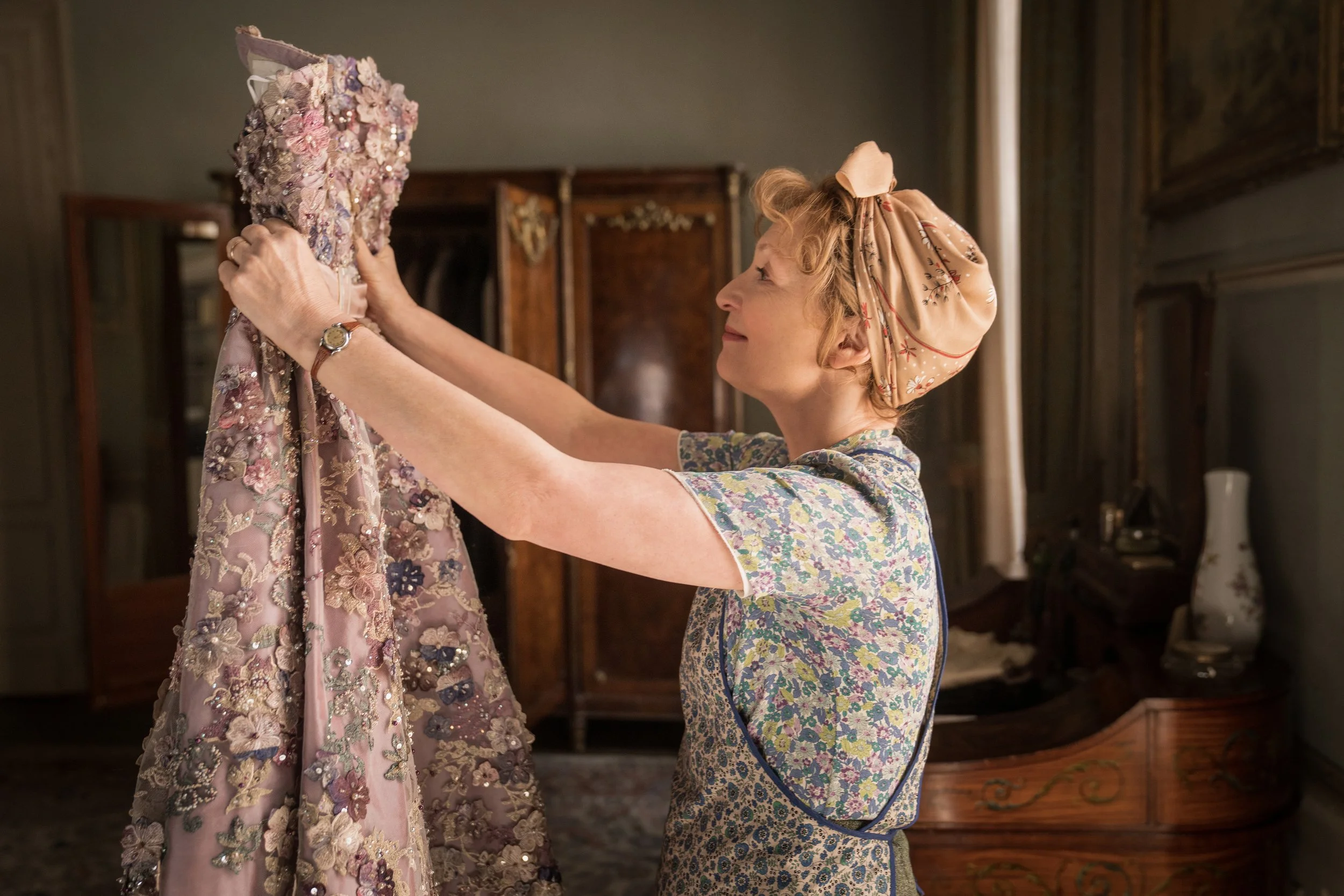
English cleaning woman Ada Harris (Lesley Manville) admires her client’s Dior gown, in a scene from the comedy “Mrs. Harris Goes to Paris.” (Photo by Dávid Lukács, courtesy of Focus Features.)

Review: 'Mrs. Harris Goes to Paris' is a sweet, light French bonbon, and a showcase for the great Lesley Manville

July 15, 2022 by Sean P. Means

A working-class Englishwoman has a French adventure in “Mrs. Harris Goes to Paris,” a whimsical confection of cross-cultural disagreements that would fly off into a hundred directions if not for the justly acclaimed actor Lesley Manville keeping it all together.

Manville plays Ada Harris, a war widow who cleans other people’s homes in London, circa 1957. One day, she sees something in a wardrobe of one of her clients: A beautiful gown, designed by Christian Dior. The client tells Mrs. Harris the dress cost 500 pounds — and even though it’s a pipe dream for a woman of Mrs. Harris’ social standing, it becomes her dream to go to Paris and buy a dress at the House of Dior.

A few lucky coincidences later, and Mrs. Harris has the money to travel to Paris and buy a Dior dress. She arrives just as Monsieur Dior is about to show his newest line, for the company’s 10th anniversary. The house’s imperious director, Mme. Colbert (Isabelle Huppert), wants to throw Mrs. Harris — but she’s stopped by André Fauvel (Lucas Bravo), the studio’s accountant, who notices Mrs. Harris has something the upper-crust clients almost never have: Wads of cash, a commentary on the super-rich’s ability to get away without paying for things.

A kind nobleman, Marquis de Chassagne (Lambert Wilson, from the “Matrix” franchise), escorts Mrs. Harris into the exhibition. There, she becomes enraptured by the dozens of gorgeous gowns Monsieur Dior has designed. She picks her dream dress, then finds out that a snooty rich woman, Mme Avallon (Guilaine Londez), has snapped up exclusive rights to it. Undaunted, Mrs. Harris selects her second favorite — then is surprised to learn she can’t just buy a Dior off the rack, but must stay in Paris a week for fittings.

Extending her visit, Mrs. Harris finds that Paris is for lovers. For starters, that Marquis keeps buying her roses. To distract herself from that, Mrs. Harris works to pair up André with Natasha (Alba Baptista), Dior’s top model and, like Andre, a reader of Jean-Paul Sartre. 

Unlike Sartre, though, there’s nothing in director Anthony Fabian’s frothy confection to be taken too seriously. With three co-writers working with him on the screenplay, adapting Paul Gallico’s novel, Fabian presents a luminous fantasy version of Paris of a certain time, when a woman with enough pluck could cut through the class and national barriers that are keeping her from following her dreams.

The story has all the earmarks of a silly made-for-TV movie — and, in fact, it was that on CBS in 1992, as a vehicle for Angela Lansbury, cashing in her “Murder, She Wrote” chip with the network.

The casting is what puts this movie into more refined territory. Huppert is perfectly imperious as Mme. Colbert, the last bastion of Dior’s tradition of elegance. And Mrs. Harris has a strong supporting section back in London, led by Jason Isaacs as a kind-hearted bookie.

In the end, though, “Mrs. Harris Goes to Paris” is a showcase for Manville, who has earned a shot at being a leading lady after years of great supporting performances in Mike Leigh movies, as well as Paul Thomas Anderson’s “Phantom Thread.” Manville radiates all the late-in-life hopes and dreams of this no-nonsense cleaning lady, turning an “invisible” person into someone everyone has to stop to admire.

——

‘Mrs. Harris Goes to Paris’

★★★

Opens Friday, July 15, in several theaters. Rated PG for suggestive material, language and smoking. Running time: 115 minutes.

July 15, 2022 /Sean P. Means
Comment

Thor (Chris Hemsworth, right) finds his ex-girlfriend, Dr. Jane Foster (Natalie Portman), has taken on the powers of Mjolnir, becoming Mighty Thor, in “Thor: Love and Thunder.” (Image courtesy of Marvel Studios.)

Review: 'Thor: Love and Thunder' plays up the comedy of the Norse god — but why can't Marvel's standalone movies stand alone more?

July 05, 2022 by Sean P. Means

In the fourth movie where the Norse god Thor is the title superhero, “Thor: Love and Thunder,” director Taika Waititi has found the genre most appropriate for our muscular hammer-thrower: A sitcom.

More overtly comical than Chris Hemsworth’s eight past appearances as Thor in the Marvel Cinematic Universe, this installment lets our thunder god get introspective, considering where he fits in a universe where his father Odin and brother Loki are dead, his Asgard has relocated to Earth and is ruled benevolently by his friend Valkyrie (Tessa Thompson), and he’s currently helping out beleaguered planets alongside the Guardians of the Galaxy. (The whole crew — Chris Pratt, Dave Bautista, Karen Gillan, Pom Klementieff, Sean Gunn, and the voices of Bradley Cooper and Vin Diesel — are on hand for brand maintenance more than actual story.)

Meanwhile, back on Earth, Thor’s ex-girlfriend, Dr. Jane Foster (Natalie Portman), feels the urge to visit New Asgard. The urge is coming from the shattered remnants of Thor’s hammer, Mjolnir — which rebuilds itself and imprints on Jane. When Thor returns to New Asgard, which is under attack, he’s surprised to find Jane has taken on the powers of Mjolnir, along with a new working name: Mighty Thor.

Thor doesn’t have much time to take in his ex’s new situation — or learn what the audience knows about a secret Jane is holding — because of what’s attacking New Asgard. That would be a new villain, Gorr the God-Butcher (Christian Bale), who’s on a mission to destroy all gods. Gorr kidnaps the children of New Asgard, and Thor, Jane, Valkyrie and Asgard’s resident rock creature, Korg (voiced by Waititi) go in hot pursuit.

First, though, they head to the planet where all the different gods live, a side trip for comic relief purposes that culminates in an audience with the big kahuna of godhood, Zeus (played by Russell Crowe, who deploys an accent that’s aiming for Greek and lands near Mario and Luigi. 

And therein lies the major problem with this new “Thor” adventure: It doesn’t feel like there are any real stakes — even with the kidnapped children, or major characters facing the prospect of death in different ways. But when you’ve got a director like Waititi, who finds a humorous way to depict Hitler (as he did in “Jojo Rabbit,” for which he won a screenwriting Oscar), why should you expect a serious approach to comic-book godhood?

The movie also shows the pitfalls of relying too much on the MCU canon, or trying to pull more characters from Marvel’s deep comic-book library. There’s enough in the script, by Waititi and Jennifer Kaytin Robinson, to keep us invested in Thor’s post-Thanos spirit journey, his rekindled relationship with Jane, and his recurring dilemma of being his conflicted feelings for Mjolnir and his current axe, Stormbreaker. 

Some have complained about Marvel characters crossing over without purpose before, but “Thor: Love and Thunder” is the most clearcut case of Marvel bloat. If Thor can lose the dad bod he gained in “Avengers: Endgame,” the Marvel franchise can trim down the excess from movie to movie.

——

‘Thor: Love and Thunder’

★★★

Opens Friday, July 8, in theaters everywhere. Rated PG-13 for intense sequences of sci-fi violence and action, language, some suggestive material and partial nudity. Running time: 119 minutes.

July 05, 2022 /Sean P. Means
Comment
  • Newer
  • Older

Powered by Squarespace