The Movie Cricket

Movie reviews by Sean P. Means.

  • The Movie Cricket
  • Sundance 2025
  • Reviews
  • Other writing
  • Review archive
  • About

Elvis Presley (Austin Butler, left) prepares to take the stage, after getting a warning about his behavior from his manager, Col. Tom Parker (Tom Hanks), in Baz Luhrmann’s biographical drama “Elvis.” (Photo courtesy of Warner Bros. Pictures.)

Review: With 'Elvis,' director Baz Luhrmann finds a subject worthy of his rhinestone-studded vision

June 23, 2022 by Sean P. Means

If ever a biographical movie’s subject matched its director, the life of Elvis Presley — marked with gaudy excess, musical epiphanies and buckets of rhinestones — and the carnival-like filmmaking style of Australian director Baz Luhrmann seem like an inevitable pairing.

Sure enough, the movie “Elvis” — a cradle-to-grave chronicle of the king of rock ’n’ roll’s 42 years on Earth — is much like Luhrmann’s most successful movies, “Moulin Rouge!” and “Romeo + Juliet.” It’s big and bold and brassy. It’s not perfect, and at 2 hours and 39 minutes still doesn’t deliver everything you’d expect in a telling of Elvis’s life story. But it’s always holding your attention.

The narrator of this tale could be considered the villain of the piece: Col. Tom Parker, the sideshow promoter and con man who heard a skinny white kid from Tupelo, Mississippi, and saw the dollar signs. Parker is played by Tom Hanks, who digs deep into the portrayal, with old-age makeup, a distinctive walk, and an accent of unclear origin (though, as the story unfolds, that accent makes sense). Hanks revels in the role, as he gives us a lot to take in — as most everyone and everything else here does in Luhrmann’s detail-heavy dive into Elvis’s eventful life.

Luhrmann starts with a boy Elvis (Chaydon Jay), lured by the blues music of the Tupelo gin joints, and by the gospel music of the revival tent. The movie doesn’t shy from those influences, and how Elvis’s respect for them was more homage than appropriation. In these passages, much credit goes to bluesman Gary Clark Jr. (as Arthur “Big Boy” Crudup) and the singer Yola (as Sister Rosetta Thorpe), bringing this generation’s voices to tackle the classics.

From his teen years to his death in 1977, Elvis is played by Austin Butler, and damn if the man doesn’t capture that compelling mix of small-town innocence and animal ferocity that made Presley a star. In an early scene, when Elvis first takes the stage and his gyrations start making the young women in the audience get hot and bothered, you can feel how Luhrmann has captured that sensual electricity that made him a sensation.

It also got him in trouble, with prudish officials (embodied by the segregationist Sen. James O. Eastland, played by Nicholas Bell) wanting him banned from the airwaves or arrested. Parker, fearful his meal ticket is about to be torn up, convinces Elvis to leave his parents, Gladys (Helen Thomson) and Vernon (Richard Roxburgh), to enlist in the Army. He’s stationed in Germany, where he meets an American girl: Priscilla Beaulieu (played by Olivia DeJonge), who would become his wife. (The movie omits that when they met, she was 14 and he was 24.)

Back in the States, Parker’s influence again held sway, and the “new” Elvis was a performer in a series of bad movies, his face and name emblazoned on all manner of merchandise. (Parker licensed “I Love Elvis” pins, and also licensed “I Hate Elvis” pins — on the theory that somebody would do it, and he might as well make money on it.) As the industry that had moved on to the Beatles and Bob Dylan, Elvis wanted to speak out about civil rights and other issues, particularly after the deaths of John F. Kennedy, Martin Luther King Jr. and Robert F. Kennedy. But Parker keeps his eyes on the money, telling Elvis that King’s death “has nothing to do with us.”

In 1968, in what might be the movie’s signature sequence, Elvis recorded his landmark comeback TV special for NBC. (Nice detail: The hallways in the studio are filled with posters from another NBC show, “Star Trek.”) What Luhrmann and his co-screenwriters depict is a secret revolt, by Elvis and TV producers Steve Binder (Dacre Montgomery) and Tom Diskin (Leon Ford), against Parker’s plans for a cheesy Christmas special. Once the show became a hit, Parker claimed it was his idea.

The movie’s third act delivers Vegas Elvis, as the star was yoked to a long-term contract to the International Hotel — a deal brokered to pay off Parker’s gambling debts, the movie tells us. The movie gives us glimpses of Elvis’s declining health and his substance abuse, but gives equal attention to his work backstage creating the most entertaining show Las Vegas ever saw.

Luhrmann keeps Elvis’s story moving at a rapid pace, and layers it with a ton of music — both Elvis’s classic songs (performed well by Butler, or deploying the King’s original cuts) and updated remixes that use hip-hop, dance and other genres. The sonic assault serves as a reminder that Elvis formed the baseline for so much of the last 60-plus years of music, without forgetting that Elvis himself built his career on other people’s sounds.

Through all of the flourishes — which Presley, I think, would have appreciated — Luhrmann deftly captures the tension between Elvis and Col. Parker, the artistry that grew out of it, and the price Elvis paid for his fame. “Elvis” does something we haven’t seen since 1977: It makes the King feel alive again.

——

‘Elvis’

★★★1/2

Opens Friday, June 24, in theaters everywhere. Rated PG-13 for substance abuse, strong language, suggestive material and smoking. Running time: 159 minutes.

June 23, 2022 /Sean P. Means
Comment

Ethan Hawke plays The Grabber, a serial kidnapper and killer of boys in 1970s Colorado, in director Scott Derrickson’s “The Black Phone.” (Photo courtesy of Universal Studios.)

Review: 'The Black Phone' is a lean, muscular and highly efficient horror movie, with strong work by Ethan Hawke and two young performers

June 23, 2022 by Sean P. Means

A horror-thriller that works with terrifying efficiency, “The Black Phone” is a return to form for director Scott Derrickson, who reunites with two of his key collaborators on his 2012 fright-fest “Sinister”: His writing partner, C. Robert Cargill, and his star, Ethan Hawke.

Derrickson doesn’t show Hawke’s face too much in “The Black Phone,” putting him in a face-hugging mask that looks like a whitewashed version of Jack Nicholson’s Joker. Hawke’s character is called The Grabber, a serial kidnapper and killer of boys in a Colorado town in the mid-1970s.

At first, The Grabber appears as a dark figure in the distance, as we meet his next potential victim. That’s Finney (played by Mason Thames), a Little League pitcher who’s small but has a cannon for an arm. He’s often picked on by the bullies in his school, but has a defender in Robin (Miguel Cazarez Mora), who learned his fighting skills from Bruce Lee movies. Finney’s other champion is his little sister, Gwen (Madeleine McGraw), whose most formidable weapon is her foul mouth.

Finney and Gwen share some secrets at home. For starters, their dad (Jeremy Davies) is an alcoholic and abusive — especially when Gwen shows signs of her gift: Dreaming about things that haven’t happened yet, in chilling detail. That’s why the cops are curious when they hear Gwen talking about The Grabber and mentioning that she’s dreamed about black balloons, a crime-scene detail the police haven’t shared with the public.

It isn’t long, after some of Finney’s friends disappear, that Finney himself is kidnapped by The Grabber. He wakes in a basement room with soundproofed walls, a bare bed on the floor, and an old black telephone on the wall. The phone, Finney discovers, is not connected to an outside line. So it’s unnerving, to both Finney and The Grabber, when the phone rings.

Derrickson (who started this film when he parted with Marvel for “creative differences” on “Doctor Strange in the Multiverse of Madness”) and Cargill, adapting a Joe Hill short story, devise a script that moves like clockwork. Every detail dropped early in the film is a puzzle piece that comes into play in the third act, placed precisely for maximum impact.

Hawke is frighteningly charismatic as the methodical kidnapper, running through his deadly routine and slightly upset that it’s not going the way it usually does. But the breakout talents of “The Black Phone” are young Thames and McGraw, as the siblings who are bonded by the supernatural forces helping them, in different ways, to survive and solve the mystery.

——

‘The Black Phone’

★★★

Opens Friday, June 24, in theaters everywhere. Rated R for violence, bloody images, language and some drug use. Running time: 102 minutes.

June 23, 2022 /Sean P. Means
Comment

Mark Rylance stars as Maurice Flitcroft, who holds the record for the worst round of golf ever played in a British Open qualifier, in the biographical film “The Phantom of the Open.” (Photo by Nick Wall, courtesy of Sony Pictures Classics.)

Review: 'The Phantom of the Open' is a one-note biopic that makes a joke out of its subject

June 23, 2022 by Sean P. Means

For most of its two-hour run, the comical biopic “The Phantom of the Open” has trouble deciding whether it’s laughing at its protagonist or laughing with him — which makes it difficult for we, the audience, to laugh along with the film.

The protagonist is Maurice Flitcroft, a crane operator in the English port city of Barrow-in-Furness, who seemed to live an unremarkable life, except for a footnote in sports history: In 1976, Flitcroft indulged his recently acquired passion for golf by entering the British Open — and shooting 121 strokes, a 49-over-par, in a qualifying round, then and now the worst round of golf in the Open’s history.

Director Craig Roberts (“Eternal Beauty”) and screenwriter Simon Farnaby (who co-wrote “Paddington 2”) re-enact what led up to that remarkable round, and what followed. Flitcroft is depicted, by Academy Award winner Mark Rylance, as an unperturbed optimist, seeing the best in every situation and urging everyone to follow their dreams. When he courts his future wife, Jean (Sally Hawkins), she surprises him with the news that she has a son, Michael — and Maurice, without a moment’s hesitation, agrees to be the boy’s stepfather.

Flash-forward a few years, and Michael (Jake Davies) has taken an office job at the same shipyard where Maurice operates a crane. Meanwhile, Maurice’s and Jean’s twin sons, James and Gene (Jonah and Christian Lees), are pursuing their teen dreams of being champion disco dancers. So it’s a perfect time, Jean tells him, to do what he wants to do for a change.

What Maurice wants to do is golf, even though he’s got no clue how — and not enough money to get the right shoes or play at the county golf course. Undaunted, he enters the British Open, and because he doesn’t know his handicap, he checks the box that says “professional.”

The infamous 1976 golf round happens midway through the film. What follows is a farcical look at Maurice’s odd 15 minutes of fame — which get stretched when the humorless British golf establishment (embodied by a character played by Rhys Ifans) has Maurice barred from every course in the country, leading Maurice to take on various pseudonyms to skirt the ban.

Rylance’s performance is oddly forced, going for sympathy and mockery at different points and never earning either in the appropriate measure. It doesn’t help that Farnaby’s script descends into family conflict without earning the Flitcroft family the emotional connection needed to make such melodrama work.

The end of “The Phantom of the Open” aims to show Maurice’s eventual triumph — attending an American golf tourney named for him, where the worst score wins — but it feels like another opportunity to mock him. I found myself feeling sorry for Maurice Flitcroft, and for Rylance for portraying him, which I’m sure wasn’t the emotion an underdog sports movie was trying to evoke.

——

‘The Phantom of the Open’

★★

Opens Friday, June 24, in some Utah theaters. Rated PG-13 for some strong language and smoking. Running time: 117 minutes.

June 23, 2022 /Sean P. Means
Comment

Andrew (Cooper Raiff, left) helps out Domino (Dakota Johnson), in a scene from the comedy-drama “Cha Cha Real Smooth,” written and directed by Raiff. (Photo courtesy of Apple TV+.)

Review: 'Cha Cha Real Smooth' gives triple threat Cooper Raiff a venue to shine, opposite Dakota Johnson at her best.

June 16, 2022 by Sean P. Means

If writer-director-actor Cooper Raiff’s name wasn’t already in your mental list of up-and-coming filmmakers after his 2020 college comedy “Shithouse,” his new semi-romantic comedy “Cha Cha Real Smooth” should be your wake-up call to this guy’s extraordinary talent and big heart.

Raiff plays Andrew, 22, a recent college graduate who isn’t sure what to do next. He wants to go to Barcelona, where his college girlfriend Maya (Amara Pedroso) is studying on a Fulbright scholarship. Instead, he’s moved back home to New Jersey — living with his mom, Lisa (Leslie Mann), his 13-year-old brother David (Evan Assante), and mom’s gruff new husband, Greg (Brad Garrett) — and has a job selling hot dogs at the mall.

Since David is 13, he’s been invited to a lot of bar and bat mitzvahs this summer and fall. Andrew ends up at one, having drinks with college friend Macy (Odeya Rush), when he notices a beautiful woman sitting across the room. This is Domino (Dakota Johnson), who is sitting with her autistic daughter, Lola (Vanessa Burghardt), who is too nervous to join her classmates on the dance floor.

David urges Andrew to energize the boring bat mitzvah, and he’s got the natural charm and reckless energy to do it. He also manages to convince Lola to dance, which impresses Domino. By the end of the night, the other Jewish mothers are wanting to hire David to be a “party starter,” which becomes a semi-professional gig.

At the next bar mitzvah, Andrew shows his temper — getting in the face of the parents of a kid bullying Lola — and his reliance on vodka to keep himself entertaining. He also shows resourcefulness when he helps Domino with a bathroom emergency. Soon, even though Domino is engaged to a lawyer, Joseph (Raúl Castillo), who’s working on a case in Chicago, a tentative relationship starts to blossom between Andrew and Domino. (Older women are a pattern for Andrew; in a prologue, Raiff shows us a 14-year-old Andrew, played by Javien Mercado, getting his heart broken when he falls for someone in her 20s.)

When not falling for Domino, Andrew is trying to understand his mom’s attraction to the grumpy Greg, and working to impart some romantic wisdom to David, who is building up to a first kiss with his crush, Margaret (Brooklyn Ramirez).

Raiff has a knack for off-kilter dialogue, and for staging intimate conversations between characters where much is both spoken and unspoken. Raiff’s scenes with Johnson crackle with romantic possibilities, and he’s quite charming as babysitter and friend to Lola, whose guileless honesty is a refreshing change in a world where people guardedly hide their feelings. (Burghardt is making her movie debut here, and she’s a tremendous find.)

“Cha Cha Real Smooth” has a few narrative bumps along the way, but even those come through as earnest efforts to let the characters connect. The movie makes me want to look up “Shithouse,” and look forward to what Raiff does next. 

——

‘Cha Cha Real Smooth’

★★★1/2

Opens Friday, June 17, in theaters and streaming on Apple TV+. Rated R for language and some sexual content. Running time: 109 minutes.

——

This review ran previously on this site on January 23, 2022, when the movie premiered at the 2022 Sundance Film Festival.

June 16, 2022 /Sean P. Means
Comment

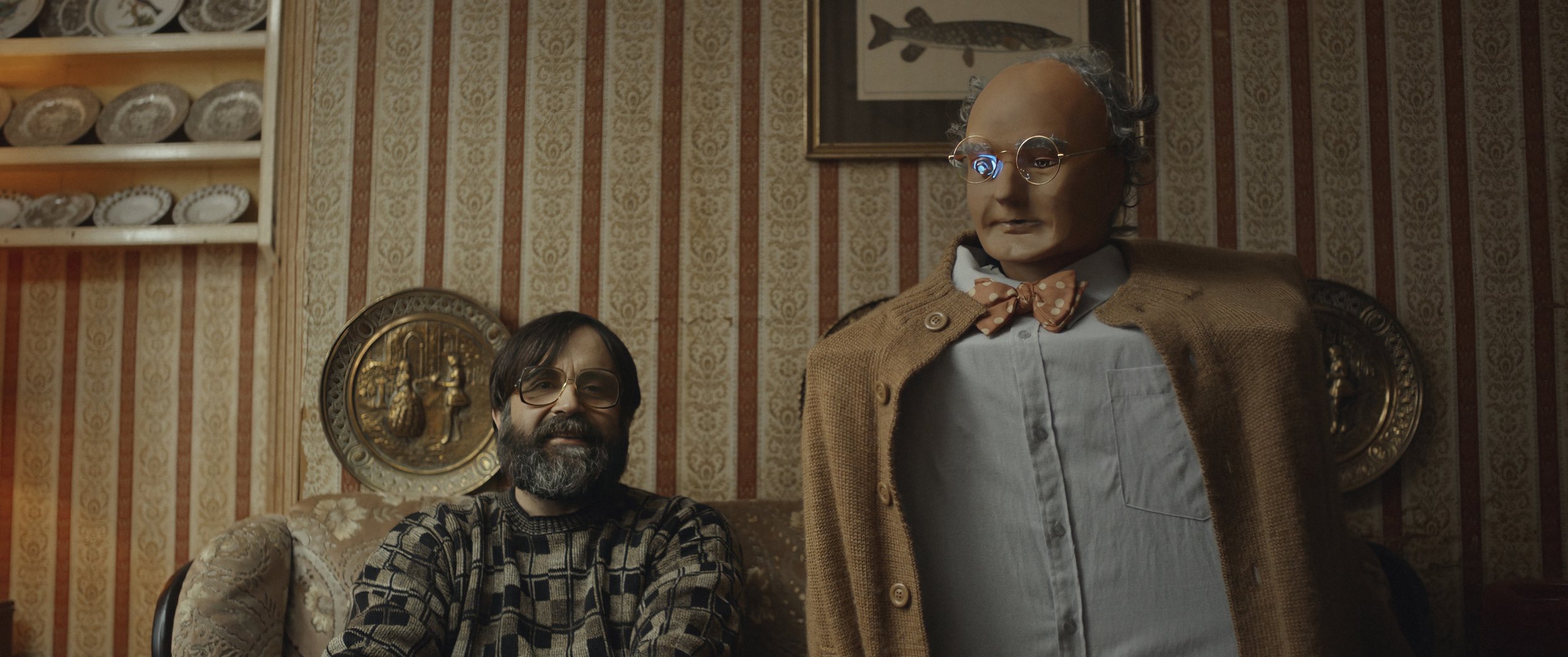
Brian (David Earl, left) sits with the robot he created, Charles (Chris Hayward), in the comedy “Brian and Charles,” which Earl and Hayward wrote. (Photo courtesy of Focus Features.)

Review: 'Brian and Charles' is a charmingly deadpan comedy about a lonely man and his robot

June 16, 2022 by Sean P. Means

Like the robot who is one-half of the titular duo, “Brian and Charles” is a whimsical and winning blend of a lot of spare parts — including the low-key charm of the Ealing Studios comedies, the absurdist wit of Monty Python, the deadpan timing of “The Office,” and the stout heart of “The Wizard of Oz’s” Tin Woodsman.

Brian (played by David Earl) lives a lonely existence near a small Welsh village, where he’s left alone through a gloomy winter with his mind, which is always coming up with odd inventions. He goes into the village, where he runs into the painfully shy Hazel (Louise Brealey, known to Americans as coroner Molly Hooper on “Sherlock”), on whom he’s rather sweet.

One day, Brian comes up with an invention that he’s sure will cure his loneliness: A robot companion. With a washing machine for a body, a mannequin’s head, and a spare pair of legs, Brian builds his robot — and is rather surprised, after a few false starts, to see it’s actually functioning. Brian tries a few names for his new robot, and the one to which he responds most positively is Charles.

Charles is played by Chris Hayward, and Earl and Hayward are the film’s screenwriters — though it’s apparent that a fair chunk of that writing is happening in front of the camera, as the two performers throw off seemingly ad-libbed lines at each other. 

There is a progression in Brian and Charles’ relationship, as Charles goes from childlike wonder at everything in Brian’s world to teenage rebellion when he realizes there’s more outside the gate — namely, an exotic paradise he sees on TV, called Honolulu. But what’s outside the gate is also dangerous, particularly Brian’s neighbors, town bully Eddie (Jamie Michie), his hard-ass wife Pam (Nina Sosanya), and their bratty teen twins (Lowri and Mari Izzard). 

Jim Archer, a TV guy making his feature directing debut, and the movie’s writer/performers begin with a mock-documentary format, the jokes gently muted by the deadpan delivery but still hilarious. There’s also a strong emotional current, as Brian feels both parental and fraternal bonds with Charles — as the robot also inspires Brian to stand up to Eddie and show his feelings for Hazel. “Brian and Charles” is that rare comedy that carries the spark of something wonderful.

——

‘Brian and Charles’

★★★1/2

Opens Friday, June 17, in theaters. Rated PG for language, mild violence and smoking. Running time: 91 minutes.

June 16, 2022 /Sean P. Means
Comment

Space Ranger Buzz Lightyear (voiced by Chris Evans) goes on a mission, accompanied by his robot cat, Sox (voiced by Peter Sohn), in Pixar’s “Lightyear.” (Image courtesy of Pixar Animation Studios and Disney.)

Review: 'Lightyear,' taking inspiration from 'Toy Story,' gives us a hero any kid would want to play with

June 13, 2022 by Sean P. Means

I’ve got no problem with Pixar Animation Studios digging through its intellectual property, as long as the filmmakers there can create something as well-constructed and outright fun as “Lightyear.”

The title cards at the beginning of the movie set up the premise perfectly: In 1995, the cards say, a boy named Andy got a toy for his birthday that was based on his favorite movie. “This is that movie,” the last card says.

No, the movie is not the further adventures of the plastic toy that got over his ego and learned how to be a good toy. Instead, director Angus MacLane (a 25-year Pixar veteran) and the team are highlighting the character on which that toy was based — and, being “real” rather than a toy, is rather more complex.

Buzz Lightyear (voiced by Chris Evans) is one of the best pilots in the Space Ranger corps. He knows it, too, which prompts his patrol partner and best friend, Alisha Hawthorne (voiced by Uzo Aruba), to note that Buzz needs to learn not to take on the galaxy all by himself.

The Rangers’ ship lands on a planet they soon learn is quite hostile — and in trying to lift off, Buzz takes the controls, but can’t get the ship into orbit. Instead, the crew has dodge the carnivorous vines to create a colony on the planet, until they can concoct an energy source to get the ship off the planet and back on course. 

Buzz volunteers to be the test pilot for the new “crystalic fusion” (one of the many “Toy Story” references embedded in the script, by Jason Headley and MacLane), accompanied by a robot cat named Sox (voiced by “The Good Dinosaur” director Peter Soho). When Buzz and Sox take off on a four-minute mission, they learn that four years have passed on the planet. Buzz is determined to try again and again, as decades pass by.

Finally, Buzz and Sox find the human colony fending off not only the vines but a new enemy: A ship hovering overhead, led by a mysterious character called Zurg. Buzz must rely on a small squad of misfits — including Izzy Hawthorne (voiced by Keke Palmer), Alisha’s grand-daughter — to defeat Zurg.

MacLane and crew have devised exactly the kind of movie a kid like Andy would have loved when he was a kid. Kids will eat this up, but I think the adults who were kids back in 1995 or earlier — and grew up on the science-fiction themes this movie understands like a second language — will enjoy it even more. 

“Lightyear” is loaded with exciting moments and charming characters — like Buzz’s new crewmates, nervous Mo (voiced by Taika Waititi) and gruff Darby (voiced by Dale Soules from “Orange Is the New Black”), and especially the scene-stealing Sox. Best of all, the movie gives us a worthy Buzz Lightyear, someone who’s both heroic and human, and the sort of character a kid would want to take on imaginary adventures to infinity and beyond.

——

‘Lightyear’

★★★1/2

Opens Friday, June 17, in theaters everywhere. Rated PG for action/peril. Running time: 100 minutes.

June 13, 2022 /Sean P. Means
Comment

Swamy Rotolo plays Chiara, a 15-year-old girl in Calabria who discovers some dark secrets about her father, in Jonas Carpignano’s drama “A Chiara.” (Photo courtesy of Neon.)

Review: 'A Chiara' is a raw and vital coming-of-age story, of a teen girl in Calabria discovering the dark truth about her father

June 09, 2022 by Sean P. Means

It’s true that the best movies are very specific to the details of their place and their characters — and that’s particularly true of Italian writer-director Jonas Carpignano’s coming-of-age drama “A Chiara.”

The place is Giola Tauro, a seaside town in Calabria, the region that forms the “toe” of Italy’s “boot.” It’s here where 15-year-old Chiara (Swamy Rotolo) lives with her family — who are played by Rotolo’s real family: Claudio (Claudio Rotolo), her father; Carmela (Carmela Fumo), her mother; her little sister, Giorgia (Giorgia Rotolo); and her 18-year-old sister Giulia (Grecia Rotolo).

The movie starts with the preparations for Giulia’s 18th birthday, a big party with all of their family and friends in attendance. This includes a lot of Claudio’s male relations, who huddle together somewhat menacingly.

As the party breaks up, something startling happens: Claudio’s car explodes. No one is in the car, but Claudio goes off with some of his male relations. And Chiara doesn’t see him again for a long time.

Chiara, being 15 and considering herself invincible, starts asking questions about her father’s disappearance, and whether Dad is involved in the Calabrian mafia — which, the movie shows us, is so tight-knit it makes the Sicilian mafia of “The Godfather” look like a group of random strangers.

Everyone around Chiara — Mom, Giulia, her cousin Giusi (Giuseppina Rotolo) — tells her to stop asking questions. Eventually, her uncle Antonio (Antonio Rotolo Uno) gives her some information, but it’s hardly comforting.

In the mean time, Chiara starts skipping school and acting rashly — so much so that the school and the authorities want to take her from her family and live with a foster family in the north, under an Italian law designed to give teens a chance break free from Mafia ties.

“A Chiara” is the third movie Carpignano has made set in Calabria, but it stands alone as an engrossing story of a young woman having to grow up in a big hurry. That said, I want to find and watch “Mediterranea,” his 2015 movie about African migrants making the trek to Italy, and his 2017 follow-up “A Ciambra,” which centers on Calabria’s Roma community — both of which center on characters that we see on the fringes of “A Chiara.”

Carpignano’s pacing is a slow-burn at first; we spend an awfully long time at Giulia’s birthday party. But once the movie revs up, the story really takes off — mostly on the strength of Swamy Rotolo’s intense performance as Chiara, her long thoughtful stares showing a mind piecing together what she must do to survive and sever her family’s criminal ties. “A Chiara” is a gut-punch of a movie, one that holds your attention from the start and doesn’t let go.

——

‘A Chiara’

★★★1/2

Opens Friday, June 10, at the Broadway Centre Cinemas (Salt Lake City). Rated R for some language and drug content. Running time: 121 minutes; in Italian, with subtitles.

June 09, 2022 /Sean P. Means
Comment

Poet Siegfried Sassoon (Jack Lowden, right) goes out with his sometime lover, the actor Ivor Novello (Jeremy Irvine), in the biographical drama “Benediction,” written and directed by Terence Davies. (Photo by Laurence Cendrowicz, courtesy of Roadside Attractions.)

Review: 'Benediction' tells a poet's life story, with moments of graceful beauty and a lot of downtime

June 09, 2022 by Sean P. Means

Like most movies directed by the British filmmaker Terence Davies, “Benediction” is a perfectly beautiful, graceful and heartbreaking depiction of a life — in this case, the poet and peace activist Siegfried Sassoon — and it also can be, depending on your mood and patience, something of a slog.

Sassoon — played in his younger days by Jack Lowden (“Slow Horses”) and in his old age by Peter Capaldi — is best remembered, where he is remembered, for his candid and stirring poetry based on his experiences as a lieutenant in World War I. Davies doesn’t show Sassoon directly in wartime, perhaps because there’s no budget for it, but uses documentary footage of the era and Sassoon’s words to convey the horrors of that war.

After writing a letter to protest the war, Sassoon is sent to a military psychiatric hospital — thanks to some backroom maneuvers by an old friend, Robbie Ross (Simon Russell Beale), to keep Sassoon from facing a court martial and a firing squad. There, he confides in a psychiatrist (Ben Daniels), and finds companionship with a younger officer, Wilfred Owen (Matthew Tennyson), who writes a poem that Sassoon declares to be “magnificent.”

Davies’ narrative bounces around a bit, merging young Sassoon’s grief over his younger brother’s death in the war with his older self’s late-in-life conversion to Roman Catholicism. After that, Sassoon’s story travels mostly in chronological order. 

At the end of the war and for years after, Davies’ script tells us, Sassoon engaged on a string of affairs with men — most notably the English actor and vaudeville singer Ivor Novello (Jeremy Irvine), who is as gorgeous as he is self-centered. Years later, he meets Hester Gatty (Kate Phillips), and they marry and have a son, but Sassoon’s hopes for a happy life are regularly thwarted by his memories of the war.

Davies (whose last movie, “A Quiet Passion,” featured Cynthia Nixon as Emily Dickinson), is incapable of making a movie that doesn’t feature some transcendent beauty, and some of Sassoon’s moments thinking back on his past — with Lowden reciting Sassoon’s poems in voice-over — hit that mark. But there’s a lot of downtime, and catty bickering among Sassoon and several of his boyfriends, in between those moments of graceful wonder.

——

‘Benediction’

★★1/2

Opens Friday, June 10, at the Broadway Centre Cinemas (Salt Lake City). Rated PG-13 for disturbing war images, some sexual material and thematic elements. Running time: 137 minutes.

June 09, 2022 /Sean P. Means
Comment
  • Newer
  • Older

Powered by Squarespace