The Movie Cricket

Movie reviews by Sean P. Means.

  • The Movie Cricket
  • Sundance 2025
  • Reviews
  • Other writing
  • Review archive
  • About

Maxine (Mia Goth) has dreams of porn-film stardom in the 1979-set horror movie “X,” written and directed by Ti West. (Photo courtesy of A24 Films.)

Review: Ti West's 'X' pokes fun at porn cliches and cinema pretense, before settling into down-and-dirty horror mode

March 16, 2022 by Sean P. Means

Writer-director Ti West’s “X” is a horror flick that deftly walks the line between art and exploitation, while commenting on how that line gets drawn.

The bloody prologue, where a Texas sheriff (James Gaylyn) surveys a bloodbath in a remote farmhouse, promises the carnage to come. But after that, West takes nearly an hour setting up the premise: A group of people in 1979 leave Houston for the farm, where they plan to make a porno film that will earn as much money as “Debbie Does Dallas” — if the hopes of its producer, Wayne (Martin Henderson), come true. 

Wayne’s young, coke-snorting girlfriend, Maxine (Mia Goth), has hopes of becoming a star by performing for the camera. The other stars of the film are the more experienced Bobby-Lynne (Brittany Snow) and the self-confident Jackson (Scott Mescudi, aka Kid Cudi). In the back of the van are R.J. (Owen Campbell), the film student Wayne has hired to direct his porno, and Lorraine (Jenna Ortega), R.J.’s mousy girlfriend and boom operator.

The farm owner, Howard (Stephen Ure) — after first greeting Wayne with a raised shotgun — lets the visitors rent out a boarding house on his property. But Howard warns Wayne to stay away from the farmhouse, and away from his fragile wife, Pearl.

As the crew gets to work on their porno film, West makes some not-so-subtle commentary about the creative spirit — with R.J. spouting pretentious nonsense about making not just porn but “independent cinema.” (West also stages a skinny-dipping scene for Goth’s Maxine, which introduces what only can be called “Chekhov’s alligator.”) 

But making an artful horror movie is like making an avant-garde porno film: Whatever creative touches you want to include in it, ultimately the filmmaker has to show the people what they came to see. West (“The Innkeepers”) does deliver those gory, blood-drenched scenes, which show a mastery of visual effects and a love for the classics, from “Friday the 13th” to “Psycho.” If deep-red horror is your taste, “X” will hit the spot.

——

‘X’

★★★

Opens Friday, March 18, 2022, in theaters. Rated R for strong bloody violence and gore, strong sexual content, graphic nudity, drug use, and language. Running time: 105 minutes. 

March 16, 2022 /Sean P. Means
Comment

Keke Palmer stars as a woman who discovers her world is not what it seemed to be, in "Alice," directed by Krystin Ver Linden. (Photo by Kyle Kaplan, courtesy of Vertical Entertainment)

Review: 'Alice' does an impressive flip from exploitation to blaxploitation, bolstered by Keke Palmer's fierce performance

March 16, 2022 by Sean P. Means

This is a (mostly) spoiler-free review her for writer-director Krystin Ver Linden’s debut feature, “Alice” — which is tricky, because how much one grooves to the movie depends on how one reacts to what happens at the 39-minute mark.

Ver Linden starts this “inspired by true events” drama with the title character, played by Keke Palmer, in a slave-quarters wedding to Joseph (Gaius Charles), on a Georgia plantation in an unnamed year sometime before the Civil War. The preacher recites their vows carefully: “… in sickness and in health, until distance do you part.” The clear message is that their choice to marry is severely limited by their circumstance as enslaved people.

The plantation owner, Paul Bennett (played by Jonny Lee Miller), treats the Black population on this plantation cruelly. In one moment, he whips Joseph savagely for a seemingly minor violation of the rules — and, later, when Joseph fights Bennett’s overseer, Aaron (Craig Stark), and then tries to escape, he’s brought back almost dead. That spurs Alice’s decision to try to make a break for freedom, too.

That gets us to that 39-minute mark. What happens after? I’ll say this much: Common appears as a major character, and the look of the final hour owes less to strict historical accuracy and more to blaxploitation movies and, specifically, Pam Grier.

I’ll also say that Ver Linden’s film packs a wallop, with intense visuals and a dynamic soundtrack (to which Common contributed). And I’ll say that Palmer gives a fierce and emotionally grounded performance as Alice, whose helplessness and fear transforms into rage and empowerment.

And that event at the 39-minute mark of “Alice”? People are going either love it or hate it. I loved it, and was impressed with Ver Linden’s talent for keeping audiences on their toes.

——

‘Alice’

★★★1/2

Opens Friday, March 18, in theaters. Rated R for some violence and language. Running time: 100 minutes.

——

This review originally appeared on this site on January 23, when the movie premiered at the 2022 Sundance Film Festival.

March 16, 2022 /Sean P. Means
Comment

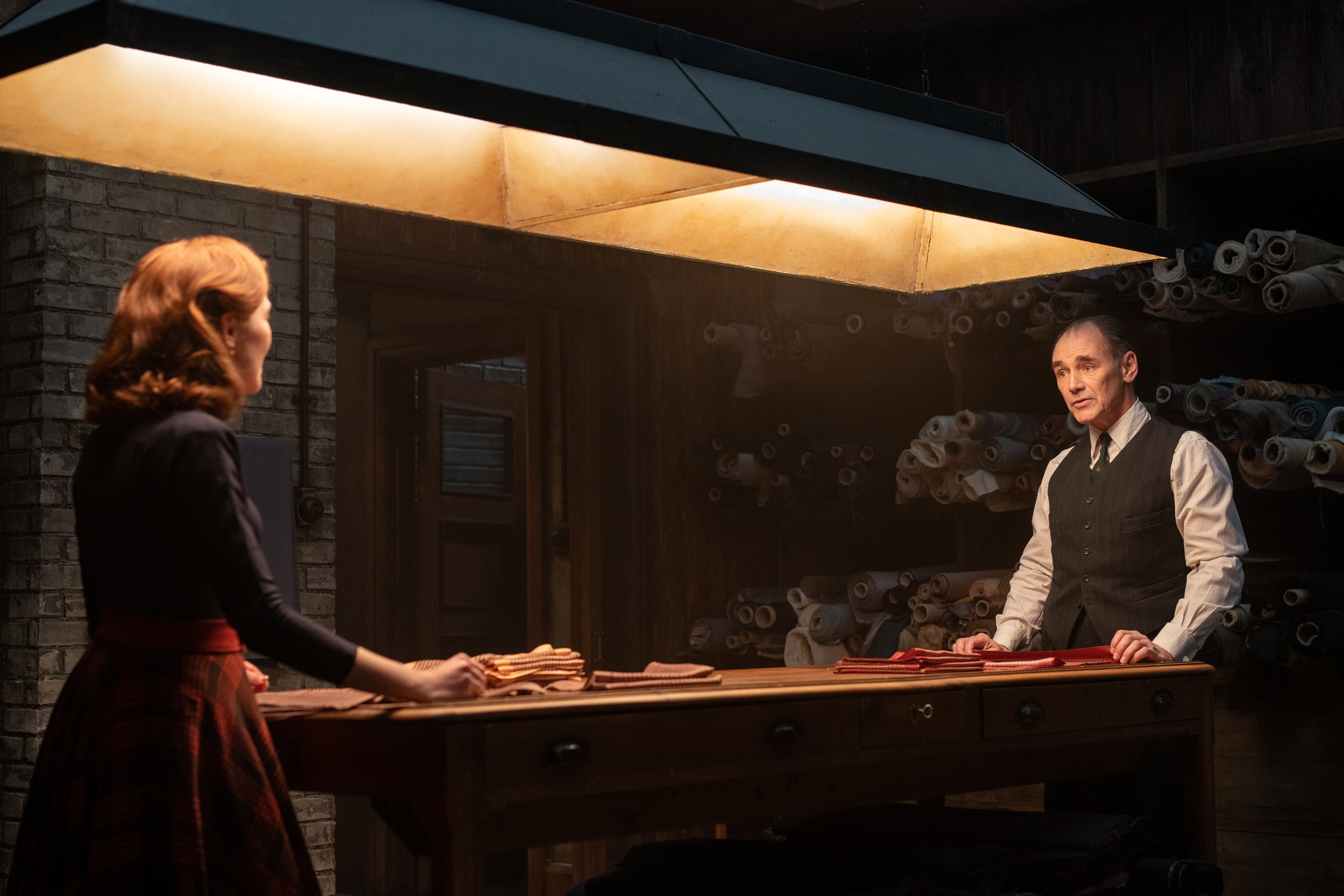
Leonard (Mark Rylance, right), a maker of suits, talks to his receptionist, Mable (Zoey Deutch), in a scene from director Graham Moore’s crime drama “The Outfit.” (Photo by Nick Wall, courtesy of Focus Features.)

Review: Mark Rylance gives a tight performance in 'The Outfit,' a thriller that feels too much like a stage play

March 16, 2022 by Sean P. Means

Learning that “The Outfit” is an original screenplay and not based on a stage play is at first surprising and ultimately disappointing — because a viewer might be more forgiving of the movie’s contrivances if one were experiencing it with live actors.

The story takes place in Chicago, 1956, all in one place: The tailoring shop of Leonard Bunting (played by the great British actor Mark Rylance). We don’t know much about Bunting at first — just that he came to Chicago from Britain, where he once worked on the famed Savile Row. His only regular companionship is his receptionist, Mable (Zoey Deutch).

Like any businessman in Chicago in this era, Bunting must make peace with the Mob. He does this by allowing mobsters to put a dropbox in the back of his shop, where two young gangsters — 

Richie (Dylan O’Brien) and Francis (Johnny Flynn) — pick up their daily payments. Richie, we’re told, is the son of the local mob boss, and he’s dating Mable.

One night, while Bunting is puttering away, Richie and Francis barge into the store in a panic. Richie has a bullet in his abdomen, and Francis has a pistol pointed at Bunting, demanding he help stitch Richie up. Francis also finds something important in the dropbox: A package from “the outfit,” the shadowy network of underworld organizations around the country. Francis, who wants to ingratiate himself to Richie’s father, Roy (Simon Russell Beale) — and delivering that package would be his ticket to getting between Roy and Richie.

Bunting finds himself caught in the middle of these gangland machinations. Both Francis and Roy are concerned about their crosstown enemies, the LaFontaines — and the possibility of a rat within their midst.

All of this should be a scissor-sharp thriller, and a great showcase for Rylance to play a complex character trying to puzzle out his path to surviving the night. But first-time director Graham Moore, who won an Oscar for his adapted screenplay of “The Imitation Game,” doesn’t have the confidence to pull off that kind of tense, nail-biting suspense.

Certainly Moore and co-writer Jonathan McClain get a lot out of their single setting, though not enough to shake the feeling that this is a barely adapted stage production. Unfortunately, those stagy limitations extend to some of the performances, particularly from British actors Flynn and especially Beale, a rightly acclaimed theater actor. On a West End stage, a live audience would forgive those forced Chicago accents, and would share the claustrophobic tension within Bunting’s shop. On film, “The Outfit” is a threadbare garment that doesn’t hold up in the wash.

——

‘The Outfit’

★★1/2

Opens Friday, March 18, 2022, in theaters. Rated R for some bloody violence, and language throughout. Running time: 105 minutes.

March 16, 2022 /Sean P. Means
15 Comments

Regina Hall plays a college official who finds something sinister happening on her campus, in writer-director Marianne Diallo’s “Master.” (Photo courtesy of Amazon Studios.)

Review: In 'Master,' horror meets social commentary, as microaggressions build along with the tension

March 16, 2022 by Sean P. Means

Microaggressions gradually turn macro in “Master,” which melds elements of horror thriller and social commentary about subtle and not-so-subtle racism on a prestigious college campus.

At Ancaster College, Gail Bishop (Regina Hall) has just taken the position of house master (an unfortunate title that writer-director Mariama Diallo says only recently was altered at her alma mater, Yale) for one of the dormitories — the first Black woman to hold the post. Moving into this dorm is Jasmine Moore (Zoe Renee), a Black freshman from Tacoma who is eager to get good grades and fit in with the mostly white student body, including her roommate Amelia (Talia Ryder).

Jasmine and Amelia have been assigned to what upperclassmen refer to ominously as “The Room.” Room 302, we’re told, is where young women have either jumped out the window or hanged themselves — always at 3:33 a.m. on December 4. That date is significant, as it’s when a woman in the town, Margaret Millet, was hanged as a witch in the 1700’s.

Jasmine starts seeing things, and hearing things, that make her think the legend of the witch has some validity. Away from home and struggling in school and socially, Jasmine feels increasingly isolated — a problem exacerbated when she challenged a grade given by her literature professor, Liv Beckman (Amber Gray). Prof. Beckman, who is Black and one of Gail’s only friends on campus, has her own problems, as she’s up for tenure and battling the entrenched all-white faculty (led by Talia Balsam).

Diallo sets up her film beautifully, as the three Black women — Gail, Jasmine and Liv — try to deflect the small instances of insensitivity dealt to them by the college’s predominantly white populace. As those microaggressions grow larger, and for Jasmine and Gail take on a menacing supernatural element, Diallo builds the tension to a peak. But that peak hits a bit early, and the finale stumbles a bit as subtext becomes the text.

Renee is a welcome discovery, hitting every step perfectly in Jasmine’s descent into possible madness. Gray (who appeared on Barry Jenkins’ “The Underground Railroad”) brings a spiky edge as Liv challenges the college’s status quo. And Hall (“The Hate U Give,” “Girls Trip”) gives a powerful, yet neatly internalized, performance as a woman whose battles haven’t produced the victory she sought. That trio of performances gives “Master” the emotional punch that stays with viewers well after the credits roll.

——

‘Master’

★★★

Opens Friday, March 18, in theaters, and streaming on Prime. Rated R for language and some drug use.  Running time: 102 minutes.

March 16, 2022 /Sean P. Means
Comment

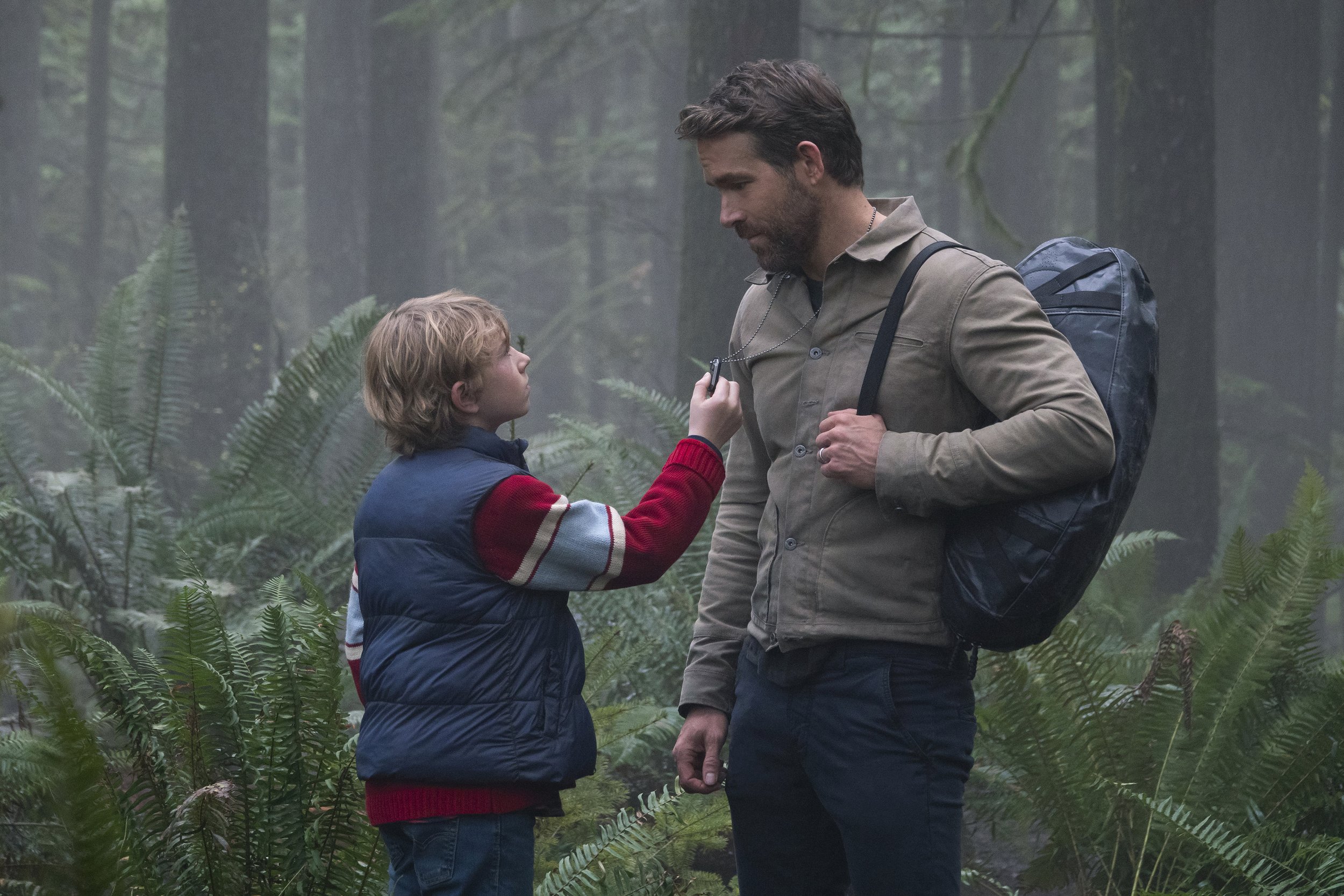
Adam (Ryan Reynolds, right) tries to explain the intricacies of time travel to his 12-year-old self (Walter Scobell), in a scene from “The Adam Project.” (Photo courtesy of Netflix.)

Review: 'The Adam Project' delivers Ryan Reynolds in wise-cracking mode, but can't deliver on its own time-travel premise

March 09, 2022 by Sean P. Means

As a lifelong lover of science fiction — and a dedicated watcher of time-travel stories, who has enjoyed years of “Doctor Who” and repeated viewings of “Back to the Future” — the one thing I know about time-travel stories is this: They have to set up the rules, and then follow them.

This is what makes director Shawn Levy’s “The Adam Project” so disappointing: It doesn’t follow its own rules.

The movie begins in 2050, when time travel is a reality — though, as we’re told, it’s tightly regulated. So when hotshot time pilot Adam Reed (Ryan Reynolds) tries to steal his time-jumping jet, it naturally draws a crowd of other jets trying to shoot him out of the sky. He escapes narrowly, and lands in 2022, where he goes in search of his 12-year-old self (played by Walter Scobell).

Young Adam is a handful, a pint-sized smart-mouth regularly getting bullied, and talking back to his harried mom, Ellie (Jennifer Garner). Ellie has been flying solo as a parent for more than a year, since her mathematician husband, Louis (Mark Ruffalo), died in a car accident.

Big Adam needs young Adam so he can pilot his jet; there’s some mumbo-jumbo about a DNA signature, and the ship being able to detect that Big Adam is injured. (Just roll with it.) Big Adam is looking for his wife, Laura (Zoe Saldaña), another time traveler who was trying to get back to 2018. Her mission — which soon becomes the Adams’ mission — is to stop time travel before it starts by stopping Louis from developing the algorithm that makes time travel possible, and has been taken over by Louis’s business partner, Maya Sorian (Catherine Keener).

Director Shawn Levy is coming off a career high with “Free Guy,” but here he’s wallowing in the creative doldrums that allowed him to make “Real Steel” and three “Night at the Museum” movies. Working with a script credited to four writers, and showing the marks of many wrenches trying to tighten things up, Levy falls back on the most reliable tool in any action director’s arsenal: Ryan Reynolds’ ability to be charming and sarcastic at the same time.

It works, to a point, and certainly having Reynolds’ character bicker with his younger self is a comic goldmine. But when Levy tries to get serious and introspective, as little Adam forces Big Adam to confront the psychological pain of losing his father, the movie discovers a new kind of cinematic time travel — by making the film slow to a crawl.

The supporting cast — Keener the face of exasperated bureaucratic evil, young Scobell as a pint-sized Reynolds, and Garner and Ruffalo staging a small “13 Going on 30” reunion — is solid, but abandoned by inferior material.

The worst of that material is how the writers take pains to explain how time travel works in this story’s reality — then tossing the rules out the window when they prove inconvenient to finishing the story. “You never understood the science,” Louis says at one point, and it’s as if he’s talking to Levy on behalf of all of us.

——

‘The Adam Project’

★★

Starts streaming Friday, March 11, on Netflix. Rated PG-13 for violence/action, language and suggestive references. Running time: 106 minutes.

March 09, 2022 /Sean P. Means
Comment

Zac Efron plays a man guarding a horde of gold in the desert, in the dystopian thriller “Gold.” (Photo courtesy of Screen Media.)

Review: 'Gold' is a barebones attempt at a survival thriller, but Zac Efron sacrifices glamour for a gritty role

March 09, 2022 by Sean P. Means

Watching “Gold,” one notices two things right away: 1) It’s not so much a movie as it is the skeletal framework for a movie, and, 2) Zac Efron deserves points for trying to shake off his pretty-boy image to do something dark and gritty, even if it doesn’t hold together.

Efron’s character is heading to someplace called The Compound, in this near-future desert dystopia that feels about five years away from full Mad Max apocalypse. (Like George Miller’s classics, this movie is also filmed in Australia on a shoestring budget.) His plan — as he tells the guy (played by the film’s director and co-screenwriter, Anthony Hayes) he’s paid to give him a ride — is to make money performing hard labor at The Compound, enough to secure his future.

Somewhere on the way, their car breaks down, and Efron’s character goes exploring. (One of the pretentious of the script Hayes and co-writer Polly Smyth devise is not giving any character a name, so I’ll use to the actors’ names from here on.) Efron finds something in the dirt: A coffee-table-sized nugget of gold. After testing it to make sure It’s real, the two come up with a plan: Efron will stand guard over the gold, while Hayes drives across the desert to a town to get an excavator.

The questions the movie poses from this point are simple: Can Efron stay alive, with limited water and food, baking in the hot sun and trying to avoid snakes, scorpions and wild dogs? And can he survive without going crazy, either hallucinating or becoming paranoid that Hayes won’t return?

When a nomadic woman (Susie Porter) comes across Efron as he guards his treasure, it seems the second question answers itself — and, within moments, the first question becomes a topic for discussion.

Hayes’s film becomes a showcase for Efron to play solitary survivalist. In a few scenes, Efron is quite effective, like when he gets wild-eyed while waving a torch in the pitch-black night, fending off wild dogs who he hears but doesn’t see. Efron also goes for the glam-free look, with makeup designer Jennifer Lamphee layering on simulated sunburned skin to his face.

Even with Hayes’ bag of directing tricks, and with Efron’s go-for-broke performance, there’s no covering up the barebones state of the screenplay. The plot of “Gold,” ngoes everywhere a viewer expects it to go, and takes enough time getting there that it drains whatever suspense might have been wrung from it.

——

‘Gold’

★★1/2

Opens Friday, March 11, in some theaters. Rated R for language and some violent content. Running time: 97 minutes.

March 09, 2022 /Sean P. Means
Comment

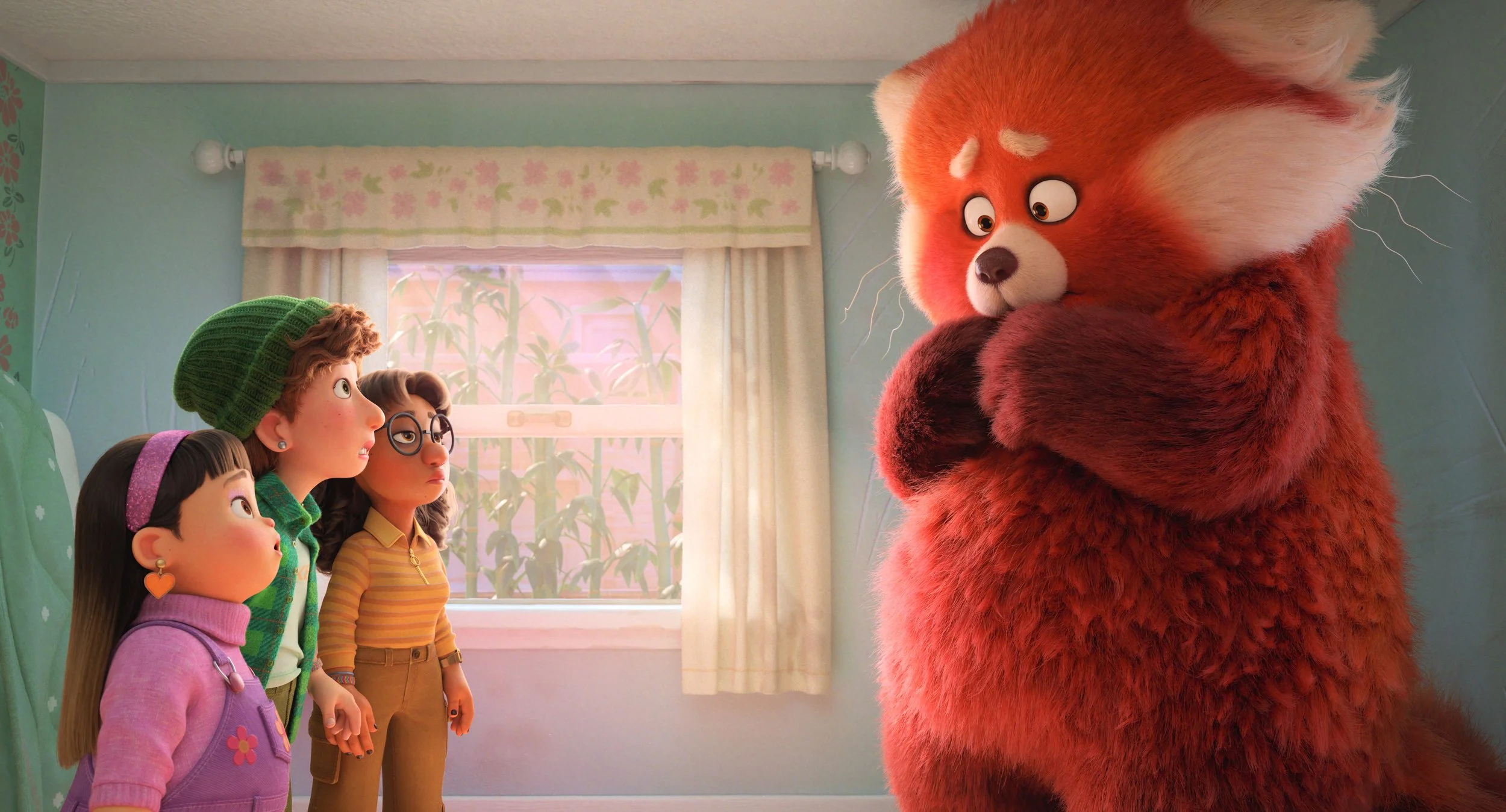
Meilin Lee (voiced by Rosalie Chiang), left, shows her red panda form to her best friends — from left: Abby (voiced by Hyein Park), Miriam (voiced by Ava Morse) and Priya (voiced by Maitreyi Ramakrishnan) — in Pixar’s “Turning Red.” (Image courtesy of Pixar Animation Studios / Disney.)

Review: Pixar's 'Turning Red' is a funny, warm-hearted take on a 13-year-old girl's journey growing up

March 07, 2022 by Sean P. Means

Even with the fantastical element at the center of its plot, a viewer will be hard-pressed to find a coming-of-age story that can match the wit, empathy and honesty of “Turning Red,” Pixar Animation Studios’ newest gem. 

The specificity of director Domee Shi’s story has the air of autobiography. Meilin Lee (voiced by Rosalie Chiang) is a 13-year-old girl of Chinese ancestry, living in Toronto, Canada, in 2002. She is a devoted daughter to her perfectionist mom, Ming (voiced by Sandra Oh), working her afternoons in the family’s temple, dedicated to their ancestor Sun Yee. At school, though, Meilin hangs out with her besties — Miriam (voiced by Ava Morse), Priya (voiced by Maitreyi Ramakrishnan) and Abby (voiced by Hyein Park) — crushing on their favorite boy band, 4*Town, and trying to figure out how to attend their upcoming concert in the Rogers SkyDome.

One morning, caught up in her adolescent emotions from her mother embarrassing her in front of a boy on whom her daughter has a crush, Meilin wakes up to find she’s changed. No, not “the red peony,” as her mother puts it (recording, for the first time in Pixar history, a mention of menstrual cycles and maxi pads). Meilin finds that she has become an 8-foot-tall red panda — and she’s desperate to hide this from her parents.

What happens next? It’s best for viewers to find that out for themselves. Though, like another Pixar story of a young woman with red hair — “Brave” — the story takes off in a fascinating and surprising direction.

Shi (who directed the Oscar-winning Pixar short “Bao”), who wrote the screenplay with Julie Cho (a playwright and former story editor on “Big Love,” making a strong movie debut), finds in Meilin’s panda transformations a perfect metaphor for adolescence and the ever-shifting emotions of discovering one’s own path — and, in particular, figuring out whether that path is parallel to or away from one’s parents.

Somehow, by whatever alchemy of animation wizardry and storytelling magic, Pixar nearly always manages to find that sweet spot of smart humor and tear-inducing honesty. That’s no different with “Turning Red,” which is as clever with its visuals as with its story. 

My favorite touch is the anime-inspired look of the teenage characters, where their big grins and eyes that shine when they smile. Another great detail comes from 4*Town’s songs, written by musical siblings Billie Eilish and Finneas O’Connell, which play just like anything you remember from the Backstreet Boys or your other favorite boy bands.

“Turning Red” is perhaps the best take on adolescence since Bo Burnham’s “Eighth Grade.” It’s a funny, charming and emotional ride through a 13-year-old girl’s journey, and it’s a pleasure to take that ride with her.

——

‘Turning Red’

★★★1/2

Starts streaming Friday, March 11, on Disney+. Rated PG for thematic material, suggestive content and language. Running time: 100 minutes.

March 07, 2022 /Sean P. Means
Comment

A Chinese factory worker checks out her handiwork on a lifelike sex doll, in a moment from Jessica Kingdon’s documentary “Ascension.” (Photo courtesy of MTV Documentary Films.)

Review: 'Ascension' is a thoughtful, impressionistic look at the 'Chinese dream' of consumerism and capitalism

March 02, 2022 by Sean P. Means

What does it look like when millions of people try to dive into consumer culture and capitalist acquisition all at the same time? It looks a lot like China in the 21st century, as captured by filmmaker Jessica Kingdon in the endlessly fascinating documentary “Ascension.”

Kingdon spent two years, 2018 and 2019, filming at more than 50 locations around China, getting an close look at an economy of making and selling, buying and earning, playing and working. It’s called the “Chinese Dream,” and it’s as elusive and difficult to define as the “American Dream.”

The first scenes show recruiters on the street of a big city, trying to get workers to sign up to work in one of the different factories that are manufacturing goods for the rest of the world. The come-ons involve wage hikes, bonuses, and the perks of cafeterias, dormitories and other amenities. 

Then the recruits board buses to the factories, where they make spray-bottle tops, processed poultry, blue jeans, plastic Christmas trees, Ralph Lauren jackets, “Keep America Great” merchandise and — in one unsettling and weirdly appealing sequence — life-sized and lifelike sex dolls.

But for many Chinese people Kingdon features are striving to sell another product: Themselves. Kingdon follows social-media influencers as they teach seminars on how to turn one’s personality into a brand. At other corporate workshops, people are picking up the tricks of “business etiquette” or being a security guard.

At every step, Kingdon depicts an economy in which nearly everyone is striving to make money, buy stuff, and fill up high-tech amusement parks. They are trying to unlock the secret of capitalism through the trappings of Western business. They follow Thomas Edison’s maxim about invention being 1% inspiration and 99% perspiration; they’ve worked up the perspiration, and are just waiting for the inspiration.

Kingdon doesn’t apply a particular narrative to what she’s showing; her snapshots are more observational, like a Frederick Wiseman documentary that strings together moments to examine system processes. The result is an eye-popping mosaic portrait of a nation on the move, though unsure of what exactly it’s moving toward.

——

‘Ascension’

★★★1/2

Opens Friday, March 4, at the Broadway Centre Cinemas (Salt Lake City). Not rated, but probably PG-13 for images of sex dolls being manufactured. Running time: 98 minutes; in Mandarin, with subtitles.

March 02, 2022 /Sean P. Means
Comment
  • Newer
  • Older

Powered by Squarespace