The Movie Cricket

Movie reviews by Sean P. Means.

  • The Movie Cricket
  • Sundance 2025
  • Reviews
  • Other writing
  • Review archive
  • About

Climber Alex Lowe is one of the subjects of “Torn,” a documentary directed by his oldest son, Max Lowe, that examines how the climber’s life — and his death in 1999 — affected his family. (Photo courtesy of National Geographic Documentary Films.)

Review: With 'Torn,' a climbing legend's son explores how his dad's death changed the family

January 06, 2022 by Sean P. Means

For those familiar with mountain climbing, the story of Alex Lowe and Conrad Anker falls somewhere between legend and soap opera — and Lowe’s oldest son, Max Lowe, does a lot to look behind those facile judgments in his documentary “Torn,” digging deep into his dad’s archives and his family’s still-raw emotional issues.

Lowe was considered one of the best and most enthusiastic climbers in the world. He climbed everything — rocks, glaciers, mountains, anything that went up more than it went down. He was also a rarity in the sport because he was a family man, as he and his wife Jenni raised three boys — Max, Sam and Isaac — in their home in Bozeman, Mont.

It all ended on October 5, 1999, on a mountain in the Tibetan Himalayas called Shishapangma, which Lowe and Anker were climbing so they could ski down the side. Lowe, Anker and cameraman David Bridges got caught in an avalanche — Anker survived, Lowe and Bridges did not.

As Max Lowe, who was 10 at the time, tells it in his film, what happened next was Anker visited the Lowe family in Bozeman, and vowed to Jenni that he would do everything he could to look out for Lowe’s sons. He moved into the Lowes’ house, took the family to Disneyland (something Alex always wanted to do for his kids), and became part of the household. Just over a year after Lowe’s death, Jenni and Anker got married.

Max Lowe’s film examines how the family coped with Alex’s death, then and now. In some of the early interviews, Isaac asks his big brother why he wants to make this movie, and possibly reopen old wounds. What the film reveals — through archival footage, Jenni reading Alex’s letters, and interviews with his mom, his brothers and Anker — is that some wounds never heal until they are opened up and examined.

“Torn” becomes, in the end, less a movie about mountain climbing and more about the seemingly insurmountable obstacles that trauma and grief placed in this family’s path, and what it took to get around them.

——

‘Torn’

★★★

Opens Friday, January 7, at Broadway Centre Cinemas (Salt Lake City). Not rated, but probably PG-13 for language and mature themes. Running time: 92 minutes.

Director Max Lowe will appear in person for a live Q&A after the 7:10 p.m. screening on Friday, January 7, at the Broadway Centre Cinemas.

January 06, 2022 /Sean P. Means
Comment

Denzel Washington, left, and Frances McDormand play Macbeth and Lady Macbeth in director Joel Coen’s “The Tragedy of Macbeth.” (Photo courtesy of A24 and Apple TV+.)

Review: 'The Tragedy of Macbeth' strips down Shakespeare's dialogue, but Denzel Washington and Frances McDormand deliver the emotions with passion

December 28, 2021 by Sean P. Means

’Tis a daunting task to make a movie out of William Shakespeare’s “Macbeth,” if only because so many filmmakers have tested their mettle on it, mostly with powerful results.

Orson Welles did it in 1948. Roman Polanski made a version in 1971, shortly after his wife Sharon Tate’s murder. Akira Kurosawa adapted it into “Throne of Blood” (1957), considered one of the master’s finest. It was turned into black comedy for 2001’s “Scotland, PA,” set in an American fast-food restaurant. And just six years ago, director Justin Kurzel served up a traditional version with Michael Fassbender and Marion Cotillard as the murderous seekers of the throne.

With “The Tragedy of Macbeth,” director Joel Coen screws his courage to the sticking-place and delivers — without the aid of his brother, Ethan, for the first time in his career — a movie that is as starkly ambitious and  brutally effective as the title character himself.

Coen and cinematographer Bruno Delbonnel (who worked with the Coen brothers on “Inside Llewyn Davis”) go for a cool look — black and white, in the old 4:3 screen ratio (as Welles did), with spartan sets that are striking but never get in the way of the show. The overall effect makes a viewer think of ‘40s film noir, ‘50s TV anthology dramas and Ingmar Bergman movies, and raises the stakes for the high-wire acting work. It’s funny to realize the movie was filmed on a soundstage at the Warner Bros. Studios in Burbank — because the look is so otherworldly it’s strange to think they could step out the door and go find an In-and-Out Burger. 

Denzel Washington plays Macbeth, the Scottish general who has designs on taking the throne, spurred by a trio of witches who foretell of Macbeth’s glory. Kathryn Hunter, the English stage actor, plays the witches and another character — contorting her body and her voice into an eerie Gollum — and nearly steals the movie.

Macbeth invites the king, Duncan (Brendan Gleeson), for a visit at his castle, to make the act of assassination all the more convenient. And when Macbeth starts to doubt the plan, it’s Lady Macbeth, played by Frances McDormand, who prods him into action and, after the fact, frames Duncan’s servants for the crime. As a neighboring thane, Macduff (Corey Hawkins), arrives to find the king murdered, Macbeth’s newly gained crown becomes a weight on his mind — until the fear of being found out leads him to murder his closest friend, Banquo (Bertie Carvel).

Coen’s script cuts Shakespeare’s text down to what’s absolutely necessary. Some of the flowery poetry is lost, but what’s gained is an intense, and surprisingly quick, rendition that gets to the core of Macbeth’s greed and paranoia and Lady Macbeth’s spiraling madness. What Coen’s trims leave room for are the rich and stirring performances by Washington and McDormand, who make even truncated Shakespeare sing.

“The Tragedy of Macbeth” may rankle the Shakespeare purists, who want every damn line of iambic pentameter left where Will put it. But Coen’s approach gives us some breathtaking visuals – the depiction of Birnam Wood coming to Dunsinane is worth a standing ovation on its own — and an emotional depth that cuts like a dagger.

——

‘The Tragedy of Macbeth’

★★★1/2

Opens Friday, December 31, at the Broadway Centre Cinemas (Salt Lake City), and Saturday, January 1, at Century 16 (South Salt Lake City); available for streaming, starting January 14, on Apple TV+. Rated R for violence. Running time: 105 minutes.

December 28, 2021 /Sean P. Means
Comment

Gary Valentine (Cooper Hoffman, left) and Alana Kane (Alana Haim) get in over their heads delivering a hot tub, in a scene from director Paul Thomas Anderson’s “Licorice Pizza.” (Photo by Melinda Sue Gordon, courtesy of MGM.)

Review: In 'Licorice Pizza,' rookie performers Cooper Hoffman and Alana Haim give this '70s hangout movie its bite

December 23, 2021 by Sean P. Means

I’m not usually a great fan of hangout movies — meandering stories of offbeat characters, with a plot that doesn’t particularly go anywhere — unless the characters, like those in “Licorice Pizza,” are really compelling and worth spending the time to know.

Writer-director Paul Thomas Anderson introduces his two main characters in this story, set in the San Fernando Valley in 1973, in a charmingly prosaic way: Gary Valentine (played by Cooper Hoffman) is a high-schooler in line to get his school picture taken, and Alana Kane (played by rocker Alana Haim), in her mid-20s, is working as the photographer’s assistant. On little more than a brief meeting, Gary declares to a buddy, “I met the girl I’m going to marry one day.”

Gary, even though he’s only 15, is ridiculously self-confident, maybe because he got an early start as a child actor; there’s a hilarious early scene where Gary tries to upstage the diva star (Christine Ebersole) in a reunion performance of a musical they once did together. This attitude allows him to walk into his favorite restaurant, an old-school Hollywood haunt, and be treated like a regular. It also prompts him to start a business selling waterbeds — which is how he ends up meeting Jon Peters (Bradley Cooper), a tightly wound celebrity hairdresser who never fails to mention that he’s dating Barbra Streisand.

Alana could use a little of Gary’s self-regard in her life. She’s a bit aimless, so becoming Gary’s top saleswoman and marketing consultant seems like a logical step. The question of whether Alana is letting Gary indulge in his fantasies of striking up a romance, or whether she’s secretly attracted to this kid, is one Anderson leaves open-ended for most of the movie’s run. 

Only in the last couple of minutes is the audience forced to consider the unconquerable 10-year age gap. (If the guy was 25 and the girl was 15, we wouldn’t find this nearly so charming, but in fact really creepy.) But Anderson allows us to ignore that disparity by diverting us with other moments — like when Alana becomes the arm candy for an aging action star (Sean Penn) or volunteers for a political campaign and develops a crush on the candidate (Benny Safdie).

Anderson grew up in the San Fernando Valley, and it’s also where he set his late-‘90s masterpieces “Boogie Nights” and “Magnolia.” He has a clear nostalgic love for this maligned suburb of Los Angeles, and that rose-colored view permeates “Licorice Pizza,” thanks to Anderson’s precision with period detail and the lush cinematography, credited to Anderson and Michael Bauman. 

In this well-rendered re-creation of a ‘70s suburb, Anderson serves up two of the fiercest, funniest, and most heartbreaking debut roles, and his young stars nail their performances perfectly. Hoffman has the shlubby looks of his late father, and Anderson’s frequent collaborator, Philip Seymour Hoffman — Gary’s waterbed pitches made me, for a moment, flash back to his dad’s “mattress king” character from “Punch-Drunk Love” — but with a sunnier disposition. And Haim, in her first movie role, is a revelation, capturing with sharp intensity the sensation of being on the cusp of maturity but not quite ready to leave childhood behind. (Haim’s real-life sisters, her bandmates in the group Haim, play her sisters here, and their parents portray their parents.)

The narrative wanders frequently in “Licorice Pizza,” but Anderson lets it go to so many interesting places and meet so many interesting people that you don’t mind. “Licorice Pizza” becomes like a long-playing record that you want to listen to again, every track in order.

——

‘Licorice Pizza’

★★★1/2

Opens Friday, December 24, at the Broadway Centre Cinemas (Salt Lake City) and elsewhere. Rated R for language, sexual material and some drug use. Running time: 133 minutes.

December 23, 2021 /Sean P. Means
Comment

Olivia Colman plays Leda, an American professor whose vacation in Greece leads her to confront her past, in writer-director Maggie Gyllenhaal’s “The Lost Daughter.” (Photo courtesy of Netflix.)

Review: In 'The Lost Daughter,' rookie director Maggie Gyllenhaal and stars Olivia Colman and Jessie Buckley conspire to depict an intriguingly flawed character

December 23, 2021 by Sean P. Means

Maggie Gyllenhaal makes a shattering debut as a writer and director in “The Lost Daughter,” a quietly intense drama about a woman on vacation who learns the old lesson that no matter where you go, there you are.

Leda (Olivia Colman) is a professor of English from Cambridge, Mass., trying to have a nice, quiet vacation in a seaside town in Greece, reading her books and relaxing. Her calm is broken when a boisterous Italian family takes up residence around her on her favorite beach spot. Despite her annoyance, she makes conversation with a couple of the women, Callie (Dagmara Dominczyk) and her sister Nina (Dakota Johnson), who has a young daughter.

Watching Nina with her little girl sets Leda to thinking about her two now-adult daughters, and soon we’re seeing flashbacks of young Leda (Jessie Buckley) raising those girls, Bianca (Robyn Elwell) and Martha (Ellie Blake). Leda, we see, was uncomfortable in motherhood, sometimes losing her temper at her girls for interrupting her literature studies. The flashbacks also show Leda’s tempestuous relationship with the girls’ father, Joe (Jack Farthing), and an affair with an academic (Peter Sarsgaard) who complimented her work.

While befriending Nina, Leda makes a rash decision — not her first, as the flashbacks show — that has dire consequences.

In adapting Laura Ferrente’s novel, Gyllenhaal creates an emotionally raw portrait of a woman haunted by her past deeds, and facing a choice of running from them or defiantly standing up to what she’s done with her life.

(It’s worth noting that Gyllenhaal’s dad, Stephen, is a movie director, and her mother, Naomi Foner, is a screenwriter with one Oscar nomination.)

It’s difficult to think of anyone other than Colman to tackle such a tricky character, which she does with equal measures of irritation and remorse. If anyone else could, it’s Buckley, whose prickly intelligence sets up the young Leda that Colman’s older Leda must confront. Together, Colman, Buckley and Gyllenhaal create an emotionally raw but tightly contained portrait of a complicated, contradictory woman.

——

‘The Lost Daughter’

★★★1/2

Opens Friday, December 24, in theaters; available to stream December 31 on Netflix. Rated R for sexual content/nudity and language. Running time: 121 minutes.

December 23, 2021 /Sean P. Means
Comment

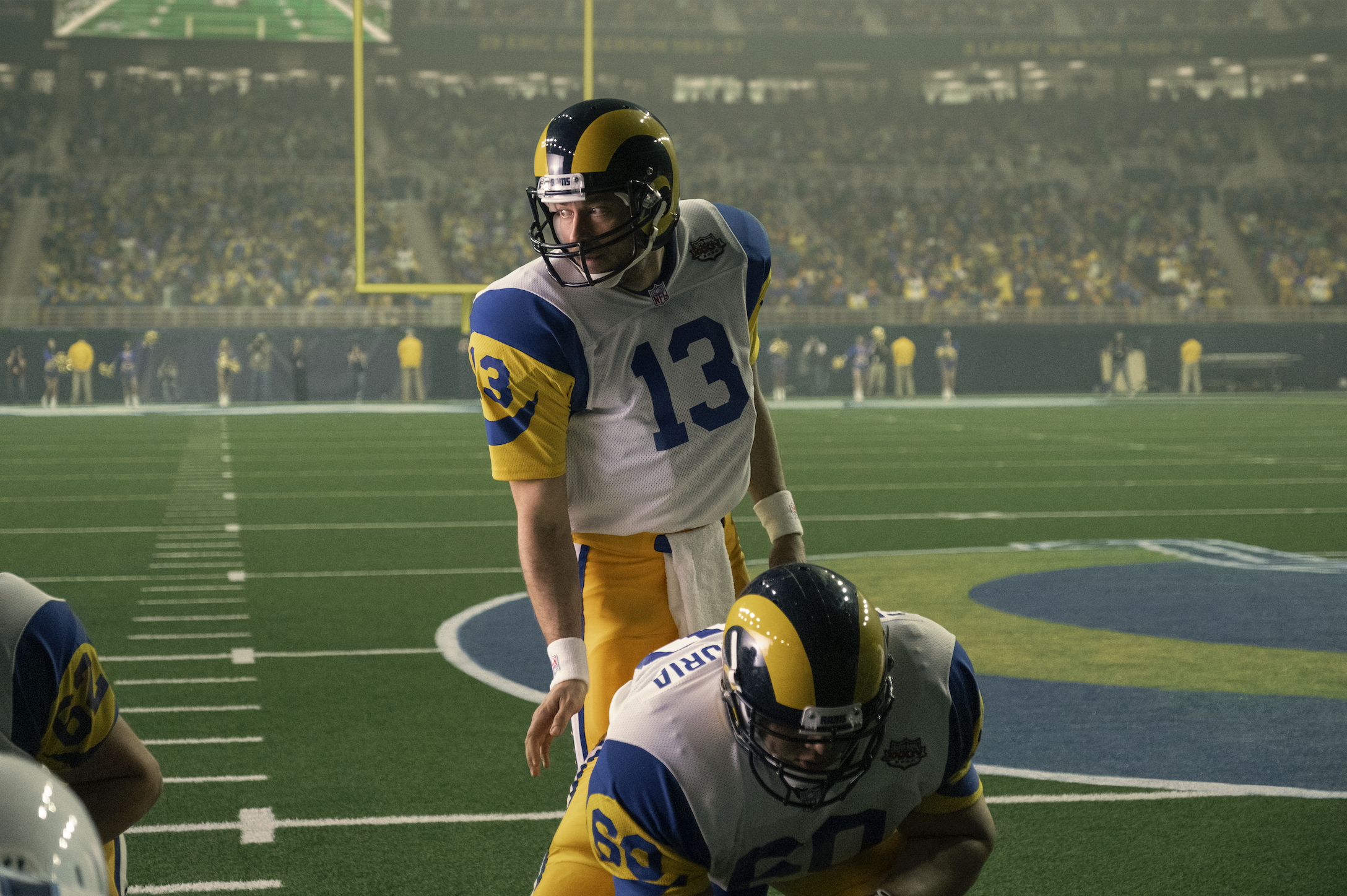
Zachary Levi (in the No. 13 jersey) plays quarterback Kurt Warner, in the biographical drama “American Underdog.” (Photo by Mike Kubeisy, courtesy of Lionsgate.)

Review: 'American Underdog' is a hokey, yet involving, biography of NFL star Kurt Warner, and the love story behind his improbably rise

December 23, 2021 by Sean P. Means

Like the NFL Hall of Famer whose unlikely career it chronicles, “American Underdog” on paper shouldn’t work — too hokey, too earnest, too corny, too old-school. Then it starts putting points on the board, and it’s hard to deny the overall effect.

The film introduces us to Kurt Warner as a headstrong college quarterback at the University of Northern Iowa. He’s got a cannon for an arm, but his coach (Adam Baldwin) has to drill him to be more patient and stay in the pocket.

One night at a country bar in Cedar Rapids, he meets Brenda (Anna Paquin), and works up the nerve to ask her out — even learning to like country music, her favorite, so he can line-dance with her. Brenda warns Kurt that she’s a divorced mother of two, whose older son, Zack (Hayden Zaller), is legally blind (the result of the boy’s father dropping him on his head when Zack was 4 months old). Kurt shows hesitation in the face of Brenda’s struggles, and isn’t sure how to pursue the relationship.

Hesitation becomes a pattern in Kurt’s early life. After going undrafted by the NFL, Kurt gets a tryout with the Packers, but a moment of indecision on the field dooms his chances. He returns to Iowa, continues to court Brenda, and tries to figure out a life without football. He even (and this has become part of Warner’s legend) stocks shelves at a supermarket.

Then Kurt gets a visit from Jim Foster (Bruce McGill), a showman and owner of the Iowa Barnstormers, an Arena Football League team. Foster wants Kurt to play for him — but first, Foster must drill Kurt to unlearn what he knows about football, and adopt the fast run-and-gun style of Arena ball. Foster also sweetens the deal, by handing Kurt a $100 bill on the sidelines every time he scores a touchdown. Soon, Kurt has amassed a nice pile of C-notes, which he saves as a nest egg for a home with Brenda and her kids.

An important part of Kurt’s story is that Brenda is a devout Christian and, through his love for her, Kurt becomes one as well. The movie’s directors, brothers Andrew and Jon Erwin (billed collectively as The Erwin Brothers), have made their reputation on Christian-centered dramas — like “I Can Only Imagine” and “I Still Believe” — so the most surprising thing about “American Underdog” is how the Erwins somewhat underplay the Christian message in Kurt and Brenda’s love story.

The last third of the movie retells the part of Kurt’s story that most people already know: His second chance with the NFL, when coach Dick Vermeil (played here by Dennis Quaid) signs him as a backup quarterback for the St. Louis Rams in 1999. When the Rams’ starting QB is injured in a preseason game, Warner takes over — and his impressive rookie season that culminates with a trip to Super Bowl XXXIV.

Levi (“Shazam!”) captures Warner’s on-the-field strengths and his old-fashioned charm, and he’s well-matched with Paquin’s Brenda, a single mom who has learned to guard her heart after having it broken before. Their charm nearly compensates for the narrative imbalance that shortchanges the human story for football action that anybody could look up on YouTube.  

——

‘American Underdog’

★★★

Opens Saturday, December 25, in theaters everywhere. Rated PG for some language and thematic elements. Running time: 112 minutes.

December 23, 2021 /Sean P. Means
Comment

Chanté Adams, left, and Michael B. Jordan play a newspaper reporter and a U.S. Army sergeant who fall in love, in the drama “A Journal for Jordan.” (Photo by David Lee, courtesy of Columbia Pictures.)

Review: In 'A Journal for Jordan,' an earnest look at a military family's sacrifice gets swallowed up by bland storytelling

December 23, 2021 by Sean P. Means

Bouncing from romance to parental drama, “A Journal for Jordan” is an earnestly told but sometimes wooden story about the sacrifices that come with a life in the military.

The movie is based on a memoir by former New York Times reporter Dana Canedy, played here by Chanté Adams. Canedy is trying to write down, for her son Jordan, her memories of his father, Army 1st Sgt. Charles Monroe King (Michael B. Jordan).

Thus starts the flashbacks through Dana and Charles’ romance in the 1990s into the 2000s, starting with her meeting him in the living room of her father (Robert Wisdom), an Army veteran who served in the same unit to which Charles is currently assigned. A romance ensues, hampered by distance — she’s in New York, he’s stationed in North Carolina — and by her memories of her father’s infidelity, which she blames in part on his Army influence. Charles assures Dana that he’s not like that, and will be true to her through everything.

Charles is too good to be true, and one of the weaknesses of Virgil Williams’ screenplay is that it depicts Charles as a plaster saint rather than a complex human being. Another weakness is letting Dana regularly whine about the demands of Charles’ military career, as if she didn’t remember that from her father’s Army experience.

When Dana becomes pregnant, and Charles is deployed in Iraq, Dana gives Charles a journal — so he can write to his unborn son, and start planning all the things he will say to the boy later.

Michael B. Jordan is as all-American as an actor can be, and he nearly manages to flesh out the saintly Charles into a fully realized human being. Jordan’s chemistry with Adams is palpable, and it’s too bad they don’t have more time together onscreen to let the sparks fly.

Not that sparks are abundant in director Denzel Washington’s handling of this story. Washington intercuts between different points on Dana and Charles’ timeline, usually to weak effect. It’s a bit of a shock, considering Washington’s track record of directing strong, dynamic stories (“Antwone Fisher,” “The Great Debaters” and, most importantly, “Fences”), that he would make a movie this bland and lifeless.

——

‘A Journal for Jordan’

★★

Opens Saturday, December 25, in theaters everywhere. Rated PG-13 for some sexual content, partial nudity, drug use and language. Running time: 131 minutes.

December 23, 2021 /Sean P. Means
Comment

Sophia Wu celebrates graduating with her class at San Francisco’sLowell High School, in director Debbie Lum’s documentary “Try Harder!” (Photo by Kathy Huang, courtesy of Greenwich Entertainment.)

Review: Documentary 'Try Harder!' takes viewers inside a high school for overachievers, and suggests that college admissions isn't the only thing in life

December 23, 2021 by Sean P. Means

Director Debbie Lum strikes a careful balance in her documentary “Try Harder!” — to celebrate the high-achieving students in one of America’s competitive high schools, while raising thorny questions about the competing that happens there.

Lowell High School in San Francisco is one of the most selective schools in the country, designed to teach STEM to the city’s best students and getting them into the best colleges. Importantly, the majority of students there are Asian Americans, often children of first-generation immigrants who, as the movie shows, fulfill the stereotype of the “tiger mom.”

Lum concentrates mostly on five teens, achieving a cross-section of the student body. Three of them are Asian American, one is white, and one is the daughter of a Black woman and a long-absent white father. Through them, the movie talks about the issues of race in the college-admission game — how some schools view Asian students as robotic test-taking machines, or how the biracial girl, Rachael, hears casually racist comments from her rival classmates.

Lum’s film also makes a strong argument that a school like Lowell, by being so laser-focused on college admissions, denies their kids the thing some colleges want most: A well-rounded life. There are a lot of extracurricular activities shown in the film — one boy, Alvan, discovers he enjoys dance class, while Rachael edits the school newspaper — but it’s forcefully implied that those are second-string behind the STEM work.

“Try Harder!” delves into these issues, but keeps the focus on the students, who are far more than the sum total of their application essays or the number of Ivy League schools that rejected them. Leaving the film, you can’t help but hope they learn more at college than the coursework.

——

‘Try Harder!’

★★★1/2

Opens Friday, December 24, at the Broadway Centre Cinemas (Salt Lake City). Not rated, but probably PG-13 for language. Running time: 85 minutes.

——

This review ran previously on this site on January 30, 2021, when the movie premiered at the 2021 Sundance Film Festival.

December 23, 2021 /Sean P. Means
Comment

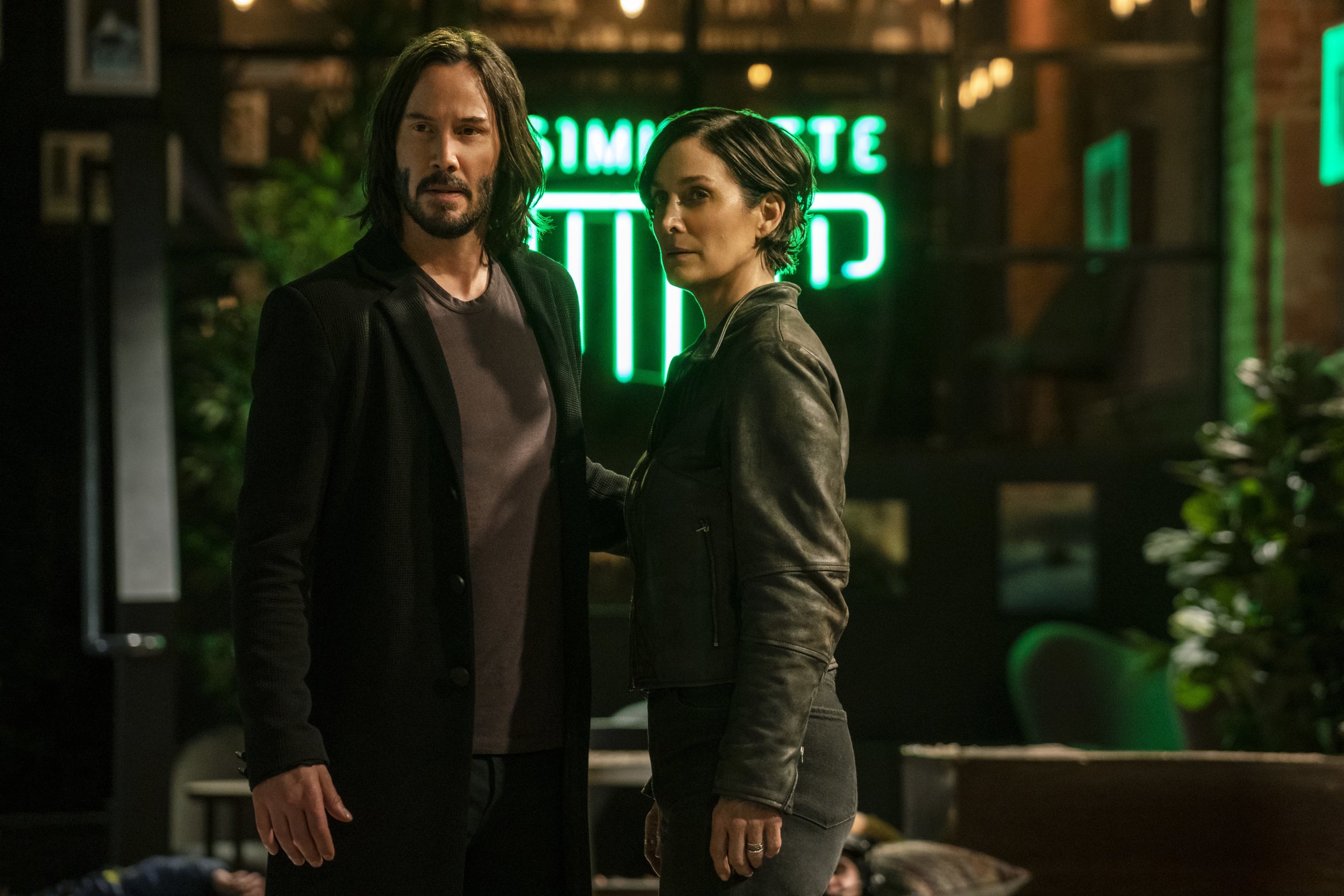
Keanu Reeves, left, and Carrie-Anne Moss return to The Matrix in director Lana Wachowski’s “The Matrix Resurrections.” (Photo by Murray Close, courtesy of Warner Bros. Pictures.)

Review: 'The Matrix Resurrections' proves that Lana Wachowski's ideas — like stars Keanu Reeves and Carrie-Anne Moss — haven't aged a day

December 21, 2021 by Sean P. Means

It’s been 22 years since the Wachowskis first took viewers through “The Matrix,” and 18 years since we went in last, with “The Matrix Reloaded” and “The Matrix Revolutions” — which turns out to be exactly enough time away to appreciate a return visit, in “The Matrix Resurrections,” which puts the “trip” in “nostalgia trip.”

The new film starts with what looks like a familiar situation: A fast-moving woman with short hair is evading mean-looking agents in matching suits, and when she can’t run she fights using gravity-defying moves. But it’s not the Trinity we remember from the first films. This woman, we’re told, is named Bugs, and played by Jessica Henwick (“Love & Monsters”) — but she’s a believer in Neo, “the one” who can free the humans enslaved by robot invaders to fill the computer-program world of The Matrix.

Where is Neo, the savior of the earlier trilogy? He’s living under his old name, Thomas Anderson, a video game designer in a prosperous San Francisco software firm — and, yes, still played by Keanu Reeves. His most popular game, called “Binary,” has elements from Anderson’s imagination, such as a leather-clad heroine named Trinity.

Anderson’s business partner (Jonathan Groff) informs him that the parent company — he actually refers to Warner Bros., the company that released all the “Matrix” films (and put the franchise in the new “Space Jam” movie) — wants a sequel. This prompts a brainstorming session with the younger game designers and marketers to rant about how game-changing the first game was, in a clever bit of meta-analysis that shows director Lana Wachowski has more of a sense of humor than we realized.

Anderson tells his analyst (Neil Patrick Harris) that he sometimes sees flashes that suggest his world isn’t real — to which the analyst prescribes more blue pills. But then, in the coffee shop, Anderson sees a woman who looks oddly familiar, who goes by the name Tiffany (played by Carrie-Anne Moss). 

That’s about as close to the land of spoilers as I’m willing to go, except for one thing: There’s a character with a familiar name — Morpheus — but with a different face (the one he shares with actor Yahya Abdul-Mateen II). This Morpheus, like the last one, has a mission to bring Anderson back out of The Matrix, though things outside aren’t exactly what we might remember.

Wachowski, working with co-writers David Mitchell and Aleksandar Hemon, clearly is enjoying playing in this particular sandbox again. She deploys all the iconography, and sometimes actual footage, from the previous films, usually with a fond wink — but also repurposing the familiar into fresh new storytelling.

Some things can’t be duplicated, though. The absence of Hugo Weaving, the originator of the ruthless Agent Smith, is keenly felt. But what this movie does for a new antagonist is fascinating.

While some things change, it’s uncanny how much Reeves and Moss — ages 57 and 54, respectively — have stayed the same. They still have the kick-ass charisma and unflappable allure that was as important to the cool factor of the original “Matrix” as the trench coats and bullet-time effects. They are also the embodiment of a new truth to this franchise: That it’s not about The One, but The Two.

——

‘The Matrix Resurrections’

★★★1/2

Opens Wednesday, December 22, in theaters everywhere, and streaming on HBO Max. Rated R for violence and some language. Running time: 148 minutes.

December 21, 2021 /Sean P. Means
Comment
  • Newer
  • Older

Powered by Squarespace