The Movie Cricket

Movie reviews by Sean P. Means.

  • The Movie Cricket
  • Sundance 2025
  • Reviews
  • Other writing
  • Review archive
  • About

Malik (Riz Ahmed, left), an ex-Marine who is convinced an alien invasion is happening, tries to persuade his sons, Jay (Lucian-River Chauhan, near right) and Bobby (Aditya Geddada), in the thriller “Encounter.” (Photo courtesy of Amazon Studios.)

Review: 'Encounter,' led by a ferocious Riz Ahmed, is a psychological thriller that leaves the audience off balance

December 01, 2021 by Sean P. Means

A wolf in an alien’s clothing, director Michael Pearce’s “Encounter” is a dark and intense psychological drama that follow the desperate actions of a tortured soul.

Pearce — who made the dark romance “Beast” with Jessie Buckley in 2017 — starts by showing us what appears to be an alien invasion at the microbial level. A meteor has somehow infected microscopic creatures with an alien parasite that is taking over human bodies.

The one person who seems to know this is happening is Malik Khan (played by Riz Ahmed), a former Marine who’s been off the grid for awhile. One night, Malik goes to the home of his ex-wife, Piya (Janina Gavankar), and her new husband, Dylan (Misha Collins), to pick up his sons, 10-year-old Jay (Lucian-River Chauhan) and 8-year-old Bobby (Aditya Geddada), for what he tells them will be a great camping adventure.

What soon becomes clear, to Jay and to us, is that there’s much doubt about whether this parasite invasion is real — or whether Malik is losing his mind. Certainly that’s the fear of Malik’s parole officer, Hattie (Octavia Spencer), and of the FBI agent (Rory Cochrane) who is investigating the boys’ departure as a kidnapping.

Part of the tension that Pearce and co-screenwriter Joe Barton build here is in leaving that central question — is Malik saving his kids or putting them in more danger? — up in the air for as long as possible. If Malik is going mad, the world seems to be going with him, particularly in a nasty encounter with some white-supremacist vigilantes.

Not all of the story works, and the inevitability of a “Thelma & Louise”-style ending grows with every minute. But Ahmed, coming off his Oscar-nominated turn in “Sound of Metal,” gives a ferocious performance here, burrowing deep into Malik’s troubled psyche as he wrestles with figuring out the best way to keep his sons safe. It’s a performance that makes “Encounter” irresistibly watchable, even as the plot churns toward the predictable.

——

‘Encounter’

★★★

Opens Friday, December 3, in select theaters. Rated R for lanaguage and some violence. Running time: 108 minutes.

December 01, 2021 /Sean P. Means
Comment

Sister Benedetta (Virginie Efira, foreground) prays, as other nuns, and the novice Bartolomea (Daphne Patakia, right), look on in a scene from Paul Verhoeven’s thriller “Benedetta.” (Photo courtesy of IFC Films.

Review: 'Benedetta' lets director Paul Verhoeven go medieval in the convent, with a story of carnality and Catholicism

December 01, 2021 by Sean P. Means

The Virgin Mary and some not-so-virginal nuns feature prominently in “Benedetta,” an erotically charged and sometimes unhinged thriller from Dutch director Paul Verhoeven.

It’s sometime in the 1600s, at a convent in a small Italian town. The Abbess (Charlotte Rampling) takes payment from a nobleman (David Clavel) to enroll his daughter — who as a little girl claimed to speak directly to the Virgin Mary — as a nun. As an adult, the girl, Benedetta (Virginie Efira), is the most devout sister in the order, so much so that she sometimes claims Jesus himself is speaking to her.

The Abbess, who’s cynical about the presence of miracles, indulges Benedetta’s flights of spiritual fancy. But the convent’s peaceful balance is upended when a wild young woman, Bartolomea (Daphne Patakia), runs in seeking sanctuary from her abusive father. Benedetta wants to take Bartolomea in, and Benedetta’s rich parents are willing to pay the Abbess off to let that happen.

Soon, Benedetta — who has never known carnal pleasure — finds herself drawn physically to Bartolomea, and vice versa. This being a Verhoeven movie, this attraction soon manifests itself in scenes of stark sexuality, including the use of a figurine of the Virgin Mary designed to offend any devout Catholics who mistakenly walked into the theater.

Oh, did I mention that Verhoeven and his co-screenwriter, David Birke, based their script off of real events — chronicled in historian Judith C. Brown’s book “Immodest Acts: The Life of a Lesbian Nun in Renaissance Italy”?

Of course, erotic thrillers are nothing new to Verhoeven, who gave the world “Basic Instinct” (1980) and “Showgirls” (1995) — along with action blockbusters like “RoboCop” (1987) and “Total Recall” (1990). Out of favor in Hollywood, Verhoeven went back to Europe, making the World War II spy thriller “Black Book” (2006) and the Isabelle Huppert rape drama “Elle” (2016).

Verhoeven is also an old hand at mixing sexuality and Catholicism — take his pre-Hollywood 1983 thriller “The 4th Man.” So medieval nuns getting it on shouldn’t be a shock, in context.

And, after a while, the novelty wears off, and the story concerns itself with the power dynamics between Benedetta and the Abbess — and with the Nuncio (Lambert Wilson), a papal representative determined to put an end to Benedetta’s claims of being a miracle worker.

Not everything in “Benedetta” tracks as a coherent narrative, and Verhoeven is more interested in throwing rocks in the pond than exploring the aftermath of the splash. But the sparks among the leads — particularly Efira’s electric scenes with Patakia and her cool head-to-head scenes with Rampling — make the movie intriguing even when it’s jumping off the rails.

——

‘Benedetta’

★★★

Opens Friday, December 3, in select theaters. Not rated, but probably R for sexual imagery and violence. Running time: 131 minutes; in French and Latin, with subtitles.

December 01, 2021 /Sean P. Means
Comment

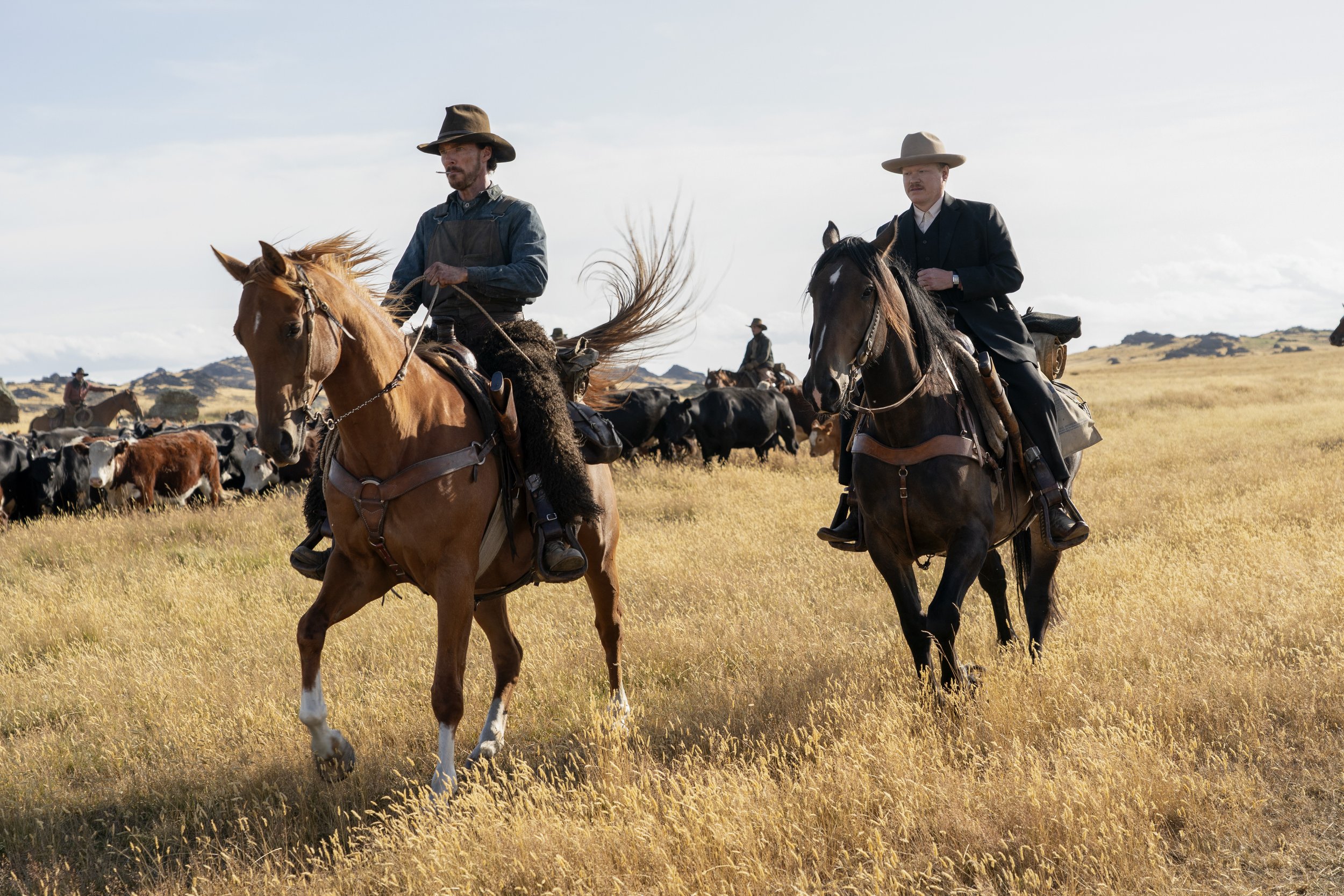
Phil Burbank (Benedict Cumberbatch, left) and his brother, George (Jesse Plemons), lead their ranch’s cattle drive in Montana, 1925, in a scene from writer-director Jane Campion’s “The Power of the Dog.” (Photo by Kristy Griffin, courtesy of Netflix.)

Review: Jane Campion returns with a bleak, gorgeous and emotionally riveting 'Power of the Dog'

November 22, 2021 by Sean P. Means

Director/screenwriter Jane Campion’s first feature film in more than a decade, “The Power of the Dog,” is a shatteringly beautiful return to form, a prickly tale of strained family bonds in the not-so-old West.

Campion’s adaptation of Thomas Savage’s acclaimed 1967 novel starts in Montana in 1925, just as the automobile and other refinements of “civilization” are starting to insert themselves in the rough-and-tumble frontier. The story centers on the Burbank brothers, who run the area’s most prosperous ranch. 

The brothers are a study in contrasts: Older brother Phil (Benedict Cumberbatch) is gruff and cruel, while George (Jesse Plemons) is quiet and kind, particularly to Rose (Kirsten Dunst), the woman who runs the restaurant in town where the Burbanks and their men have dinner after the cattle drive. And while Phil joins the men at the brothel next door, George stays behind and talks to Rose — a widow with an adult son, Peter (Kodi Smit-McPhee), who aims to study medicine like his father did.

George and Rose find their conversations are becoming a courtship, and it’s not long before they marry. This shifts the balance in the power dynamics at the Burbank ranch, particularly when Rose’s efforts to add some womanly touches to the house — and invite guests, like the governor (Keith Carradine), to dinner. 

When George is called away on business for a long stretch, Rose finds the ranch lonely — especially with only the gruff, unfeeling Phil for company — and she starts taking to the bottle. When Peter returns from medical school back east, Phil at first taunts him as a “nancy,” but soon starts taking the young man under his wing. There are hints about Phil, and a deceased cowboy he once revered, but those are thoughts Phil tries to brush aside.

Campion, as she did with her 1993 masterwork “The Piano,” uses the physical starkness of the landscape  to reflect the emotional desolation of the people who live in it. (She filmed in her native New Zealand.) Her dialogue is spare, with never a word wasted, the silences serving to convey the longing and regrets these characters are feeling. 

Campion also assembles a strong cast, all hitting at the peak of their powers. Cumberbatch quietly connects the dots between Phil’s outward cruelty and his self-loathing. Plemons and Dunst, a couple in real life, are nicely paired as the late-in-life lovers tenderly reaching for each other. The real breakthrough is Smit-McPhee, whose combination of outward fragility and smart scheming is reminiscent of a young Anthony Perkins. Together, they give “The Power of the Dog” the bite it needs to match Campion’s bleak but beautiful West.

——

‘The Power of the Dog’

★★★1/2

Opens Wednesday, November 24, in theaters; available for streaming December 1 on Netflix. Rated R for brief sexual content/full nudity. Running time: 126 minutes.

November 22, 2021 /Sean P. Means
Comment

Julia Child throws a wine and cheese party, in this image from the documentary “Julia.” (Photo by Paul Child, courtesy of Sony Pictures Classics. Copyright Schlesinger Library, Radcliffe Institute, Harvard University.)

Review: Julia Child's life was a four-course meal, but in the documentary 'Julia," the portions aren't big enough

November 22, 2021 by Sean P. Means

With a life as full and as rich as Julia Child’s, any documentary will feel like a trifle — but filmmakers Julie Cohen and Betsy West do an admirable job getting to the essence of the famed chef in “Julia.”

Cohen and West — who profiled Supreme Court Justice Ruth Bader Ginsburg (“RBG”) and legal pioneer Pauli Murray (“My Name Is Pauli Murray”) — have a lot to cover with Child’s life. Born in a wealthy California family, she sought adventure and found it during World War II, as a typist for the O.S.S. (the precursor to the modern CIA). She was stationed abroad, which is how she met Paul Child, a diplomat who introduced her to culture by way of food. They married, and he was posted to France, where she was introduced to French cooking.

Child wanted to learn how to cook such marvelous food, so she became one of the few women students at the famous cooking school, Le Cordon Bleu. She was imposing, at 6 feet, 3 inches, and soon proved herself an adept cook. Child teamed up with two French friends, Louisette Bertholle and Simone Beck (nicknamed “Simca”), to try to explain the techniques of French cuisine to an American audience. The result was “Mastering the Art of French Cooking.”

The book was a revelation, in an era of convenience foods and Campbell’s soup casseroles. It was so detailed that its initial publisher rejected it because the editors thought it was too much like an encyclopedia. The publisher Alfred A. Knopf, reportedly on the advice of his wife, picked up the book in 1961, and it became a gold mine for the publishing house.

The book also led Child to another kind of fame. Living in Boston at the time, Child was invited to appear on a talk show about books on the local educational TV station, WGBH. Child asked the station to provide a hot plate, so she could cook something while being interviewed. The segment showed Child’s comfort in front of the camera, and prompted WGBH to hire Child to present a weekly cooking show, “The French Chef.” It made her a star, America’s first celebrity chef.

Cohen and West tell much of Child’s story through her journals, and letters she wrote to friends and, most especially, with Paul. What those writings reveal is a passionate love affair — he wrote her a sonnet, guys — that spanned continents and decades. (The film employs Paul’s photographs, which demonstrate his love for her, including one tastefully composed nude.) 

One story sums up the romance perfectly. Julia developed breast cancer in 1968, and had a radical mastectomy. Julia cried when she lost her breast, and told Paul she worried he wouldn’t love her any more. Paul’s response was the last word on the subject: “I didn’t marry you for your breasts. I married you for your legs.”

The filmmakers don’t shy away from Child’s less-than-perfect qualities. For years, she was something of a homophobe. That changed when her attorney, who was gay, died from AIDS — and Child did an about-face and became a staunch advocate for the LGBTQ community, and a dedicated fund-raiser for AIDS charities.

The movie uses a wealth of archival footage of Child’s numerous TV appearances — including the time in 1978 when she cut her finger during a talk show, inspiring Dan Aykroyd’s bloody parody on “Saturday Night Live” a month later. The movie also includes interviews with current chefs, such as Marcus Samuelsson and Jose Andres, and other foodie celebrities talking about Child’s lasting impact on our TV screens and our taste buds.

There’s so much to be said about Child — and the footage shows how much joy she got in cooking and showing others how to do it — that “Julia” could have been longer than the fleet 95 minutes it takes to watch. That’s a good sign for any host: You never want your time with them to end.

——

‘Julia’

★★★1/2

Opens Wednesday, November 24, in theaters. Rated PG-13 for brief strong language/sexual reference, and some thematic elements. Running time: 95 minutes.

November 22, 2021 /Sean P. Means
Comment

In “Bruised,” Halle Berry, right, who directed, plays Jackie Justice, an MMA fighter seeking a comeback in a match with the champ, called “Lady Killer” (Valentina Schevchenko). (Photo by John Baer, courtesy of Netflix.)

Review: In 'Bruised,' Halle Berry's performance as a grizzled MMA fighter is the best thing in her uneven directing debut

November 22, 2021 by Sean P. Means

In “Bruised,” Halle Berry has finally found a director who can challenge her, to push her to a performance that rivals her Oscar-winning work in “Monster’s Ball” 20 years ago — and that director’s name is (checks notes) Halle Berry.

Berry plays Jackie Justice, an MMA fighter who once had a promising career, with 10 wins and no losses before a catastrophic fight where she climbed out of the ring. As the movie begins, Jackie is cleaning rich people’s houses, and living with her abusive boyfriend/manager, Desi (Adan Canto), hiding booze in a spray bottle under the sink. 

As her life is hitting rock bottom, two things re-enter her life. One is Manny (Danny Boyd Jr.), the child she gave up as a baby, who’s back because his daddy was killed. The other is a shot at returning to the UFC, the main league for MMA fighters, thanks to a charismatic promoter, Immaculate (Shamier Anderson), who wants to sign Jackie for a shot at the flyweight champ.

Jackie works to juggle caring for Manny while committing to sparring sessions with Immaculate’s top trainer, Buddhakan (Sheila Atim). Dealing with both forces Jackie to examine the worst parts of her life — namely, her arrangement with Desi and her relationship with her mother, Angel (Adriane Lenox). She quickly realizes that what’s most important is protecting Manny, who, like Jackie, has seen his share of trauma in his six years on this planet.

In her directing debut, Berry shows she can place a camera well and let scenes play out for maximum dramatic impact — particularly in the climactic fight scene, which is expertly staged. Berry also has an eye for casting, particularly in picking Atim, a Ugandan-born British actor whose striking beauty and dramatic intensity suggest big things in her future.

The weak link is the script, by rookie screenwriter Michelle Rosenfarb, which recycles every boxing and child cliche this side of Wallace Beery in “The Champ” (1931), as well as every poverty and addiction trope a semi-knowledgeable movie buff can recognize.

The best thing about “Bruised” is that Berry, deglamorizing herself to show the bumps and cuts of being an MMA fighter, delivers a performance that’s powerful both in its physicality and its emotional impact. It will be fascinating to see what Berry’s got up her sleeve for her follow-up.

——

‘Bruised’

★★1/2

Opened Wednesday, November 17, in theaters; available for streaming Wednesday, November 24, on Netflix. Rated R for pervasive language, some sexual content/nudity and violence. Running time: 129 minutes.

November 22, 2021 /Sean P. Means
Comment

Lady Gaga plays Patrizia Reggiani, who marries into wealth and power and wants more, in “House of Gucci.” (Photo courtesy of Metro Goldwyn Mayer.)

Review: 'House of Gucci' is trashy and campy, with a larger-than-life central performance by Lady Gaga

November 22, 2021 by Sean P. Means

Like the knockoff merchandise by which most people know the brand, director Ridley Scott’s “House of Gucci” is a gaudy, garish, tasteless exercise in excess — and, yet, I can’t say I wasn’t entertained.

There’s a lot to be said for camp value, and Lady Gaga’s central performance delivers that by the truckload. In this based-on-a-true-story crime drama, Lady G plays Patrizia Reggiani, who is introduced here in Milan, 1978, as an accountant for her father’s trucking firm. Patrizia aims for the good life, though, which is why she and a friend are at a ritzy party where she meets Maurizio Gucci (Adam Driver), a member of the family behind the Gucci fashion label.

Patrizia and Maurizio fall in love, but his father, Rodolfo (Jeremy Irons), is suspicious of anyone from the lower classes circling around the family fortune. But Patrizia charms the old man, while also consulting a TV psychic, Pina Auriemma (Salma Hayek), who provides pearls of encouragement about following her heart and making good things come to her.

Rodolfo runs Gucci with his brother, Aldo (Al Pacino), whose main contribution to the business is slapping the company’s double-G logo on coffee mugs and other cheap merchandise. When Rodolfo dies, Aldo encourages Maurizio to be his second-in-command — bypassing Aldo’s buffoon of a son, Paolo, played by Jared Leto under a ton of prosthetics. Paolo fancies himself a fashion designer, though his designs are so garish that Aldo fears they would ruin the Gucci reputation.

Maurizio isn’t a strong business leader, and Patrizia is quick to fill the managerial vacuum. Soon, Patrizia is appealing to Paolo’s vanity to trap him into selling his share of the family’s stock — a power play that puts her and Maurizio in firm control of the company. That’s the first of many twists of the tale, in a story that includes infidelity, divorce, bankruptcy, double-dealing and, eventually, a murder.

Scott, on the heels of his powerful medieval drama “The Last Duel,” goes over the top through much of “House of Gucci,” with every plot point and ‘80s needle drop coming together like an 18-car pile-up. The script — by Becky Johnston (“The Prince of Tides”) and Roberto Bentivegna (his first screenplay credit), adapting Sara Gay Forden’s book on the case — dances perilously close to comedy, a parody of “The Godfather” where every man in the Corleone family is a Fredo.

Driver gives a solid, understated performance, which means he’s completely lost amid this gaggle of scenery chewers. It says a lot when Pacino doesn’t give the biggest, hammiest performance in a movie, but he wasn’t conjuring with Leto pulling out the stops to play the balding, heavy-set Paolo with the aid of a talented make-up team and a series of ugly track suits.

Gaga, in her first leading role since her breakout turn in “A Star Is Born,” struggles with finding the humanity in the cartoonish depiction of Patrizia, as she cycles through several of the deadly sins — lust, avarice, envy, pride and wrath — largely unchecked. Clearly Scott has told Gaga to go big or go home, and she goes big in every scene, until the law of diminishing returns takes her and the movie down. But it’s a wild ride along the way.

——

‘House of Gucci’

★★1/2

Opens Wednesday, November 24, in theaters. Rated R for language, some sexual content, and brief nudity and violence. Running time: 157 minutes.

November 22, 2021 /Sean P. Means
Comment

Pre-teen Phoebe (McKenna Grace, right), aided by her friend Podcast (Logan Kim), tries out her late grandfather’s proton pack, in “Ghostbusters: Afterlife.” (Photo courtesy of Sony / Columbia Pictures.)

Review: 'Ghostbusters: Afterlife' is too haunted by its franchise's history, and its fans' limited imaginations, to deliver anything truly exciting

November 17, 2021 by Sean P. Means

I can pinpoint the exact moment when I gave up on “Ghostbusters: Afterlife,” when I knew that director Jason Reitman had no intention of creating something original within the universe begun with his dad Ivan’s 1984 action comedy.

I’d say “spoiler alert” here, but it’s hard to spoil a moment that’s the focus of the movie’s marketing campaign. It’s the moment where They show up — and you know exactly who They are, because everything that Jason Reitman and his co-screenwriter, Gil Kenan, have laid in place sets us up for when They enter the picture.

It’s too bad, because the idea that starts this film showed the promise of taking the familiar franchise in an interesting direction — just as intriguing as director Paul Feig’s unfairly maligned 2016 variation, and with as much potential for laughs and excitement.

Callie (Carrie Coon) is a single mom with two sharp kids — perpetually mortified 15-year-old Trevor (Finn Wolfhard), and 12-year-old science nerd Phoebe (McKenna Grace). The family is broke, and their last hope is an inheritance from Callie’s estranged and now deceased father: A dilapidated farm in the middle of nowhere in Oklahoma. We are not supposed to know who Callie’s father was, though it’s pretty obvious just looking at Phoebe’s curly black hair and oversized eyeglasses.

The clues pile up when Phoebe finds a still-functioning PKE meter, which guides her to her grandfather’s underground workshop, where a proton pack awaits repairs. Meanwhile, Trevor goes out to the barn and finds a rundown old car — a Cadillac hearse with a familiar red circular logo on the doors and the ECTO-1 license plate.

These Easter eggs and many others will make the diehard “Ghostbusters” fans feel right at home. So will Paul Rudd’s appearance as a summer school teacher who provides plot exposition to tell Phoebe about the Manhattan ghost appearances of the 1980s, thwarted by the OG Ghostbusters (Bill Murray, Dan Aykroyd, Ernie Hudson and the late Harold Ramis), whose videotaped exploits live forever on YouTube.

When Reitman focuses on the kids, the movie soars. There’s a great action set piece where Trevor is driving the Ecto-1, while Phoebe wields a proton pack from the vehicle’s gunner seat — a surprise to Phoebe’s ghost-obsessed new friend, Podcast (Logan Kim), as much as it is to us — as they chase a ghost through the streets of their new Oklahoma town. If the whole movie could be like that, this would be a fun and exciting thrill ride.

For a minute, even the grown-ups bring something to the table. Rudd does his patented funny Everyman thing, which still works like a charm. And Coon brings some real emotion to bear, dealing with her pent-up grief and anger at the father she never knew. But Coon and Rudd get sucked into the nostalgia machinery, starting when Rudd’s character is menaced by tiny marshmallow-based creatures in a WalMart.

The rabid fans of the original “Ghostbusters” won’t care — they get to see their beloved franchise just the way they like it, without trying to add anything fresh like the 2016 version where all the Ghostbusters were, gasp, women. That version, those fans declared, ruined their childhoods, but “Ghostbusters: Afterlife” does something worse: It traps those fans within their arrested childhoods, giving them everything they want and nothing they don’t expect.

——

‘Ghostbusters: Afterlife’

★★

Opening Friday, November 19, in theaters everywhere. Rated PG-13 for supernatural action and some suggestive references. Running time: 124 minutes.

November 17, 2021 /Sean P. Means
32 Comments

Tennis coach Rick Macci (Jon Bernthal, left) drills prodigies Serena and Venus Williams (Demi Singleton and Saniyya Sidney), while the girls’ dad and first coach, Richard Willliams (Will Smith), looks on, in a scene from “King Richard.” (Photo by Chiabella James, courtesy of Warner Bros. Pictures.)

Review: 'King Richard' highlights Will Smith and other strong performances, in a straight-ahead account of Venus and Serena Williams' early tennis days

November 17, 2021 by Sean P. Means

Even as it stays carefully within the lines of a standard sports biography, “King Richard” delivers its emotional punch in some unexpected ways — thanks largely to the performances by Will Smith, Aunjunue Ellis and two promising newcomers.

Smith plays Richard Williams, a former athlete living in Compton, Calif., in the early 1990s with his wife, Brandy (played by Ellis), and their large family. Williams, a tennis coach who obsessively studies every famous coach’s tapes, is pouring everything he knows into two of his daughters — Venus (Saniyya Sidney) and Serena (Demi Singleton). Knowing those names, you already know how this story ends, with the stellar careers of two of the greatest tennis players to ever pick up a racquet.

Director Reinaldo Marcus Green (“Joe Bell”) and first-time screenwriter Zach Baylin look at what happens before that. It shows Richard taking his family to the cracked concrete tennis courts in his neighborhood, drilling Venus and Serena while their siblings do their homework — then getting home so Venus and Serena can get their homework done, as well. 

The movie also shows the elder Williams trying to convince top-level coaches to take the girls in as prospects. First, he convinces coach Paul Cohen (Tony Goldwyn), who’s worked with the likes of John McEnroe and Pete Sampras, to teach Venus. 

It’s Cohen who convinces Richard to let Venus compete in some juniors tournaments, where she tears up southern California’s pre-teen tennis hierarchy. At one point, Serena sneaks behind Dad’s back and registers for a juniors tourney — and she shows herself to be as strong a competitor as Venus. “You got the next Michael Jordan,” someone tells Richard at one point, and he replies, “I got the next two.”

Later in the story, Richard gets a recruiting pitch from Rick Macci (Jon Bernthal), who’s developed a tennis academy in Florida, and wants the Williams family to relocate so Venus and Serena can train there. Macci lures the family to Florida, but he soon grows frustrated with Richard’s opinions, and his demand that Venus and Serena drop out of juniors tournaments, and focus on Venus turning pro at age 14.

Baylin’s script, a 2018 honoree of The Black List (a Hollywood industry compilation of the best unproduced screenplays), lays down some sharp commentary about the tennis world, from the self-loathing pre-teen players display when they lose a point to the high stakes gamesmanship of athletic shoe contracts. First and foremost, though, it’s a solid story about family, and the sacrifices Richard and Brandy make to ensure their children’s future is better than their present.

Smith gives a powerful performance, capturing the human dynamo that Richard Williams is (as evidenced by the unnecessary closing-credits video of the real Williams), a blend of paternal love and cagey calculation. He’s nicely matched by Ellis (so memorable in “Lovecraft Country”), who fights to protect her girls from anyone who might impede them — even if that might be Richard. And newcomers Sidney and Singleton balance the intensity of Venus and Serena with the joy of being kids who know that their parents love them, no matter how they fare on the court.

——

‘King Richard’

★★★1/2

Opening Friday, November 19, in theaters everywhere, and streaming on HBO Max. Rated PG-13 for some violence, strong language, a sexual reference and brief drug references. Running time: 137 minutes.

November 17, 2021 /Sean P. Means
Comment
  • Newer
  • Older

Powered by Squarespace