The Movie Cricket

Movie reviews by Sean P. Means.

  • The Movie Cricket
  • Sundance 2025
  • Reviews
  • Other writing
  • Review archive
  • About

The Eternals — from left: Kingo (Kumail Nanjiani), Makkari (Lauren Ridloff), Gilgamesh (Don Lee), Thena (Angelina Jolie), Ikaris (Richard Madden), Ajak (Salma Hayek), Sersi (Gemma Chan), Sprite (Lia McHugh), Phastos (Brian Tyree Henry) and Druig (Barry Keoghan) — arrive in prehistoric Earth, in a scene from Marvel Studios’ “Eternals.” (Photo courtesy of Marvel Studios.)

Review: 'Eternals' is an uneasy mix of Marvel's action dynamics and director Chloé Zhao's ethereal imagery

November 03, 2021 by Sean P. Means

What used to be a thrill of the Marvel Cinematic Universe was how individual directors could, within the confines of the superhero sandbox, play around with genre conventions — which is how we got Joe Johnston making a war movie (“Captain America: The First Avenger”), the Russo brothers making a political thriller (“Captain America: The Winter Soldier”) and Taika Waititi making a comedic fantasy flick (“Thor: Ragnarok”).

It’s not often, though, that a director’s vision is so at odds with the audience demands of a big-budget blockbuster as what happens with Chloé Zhao and Marvel’s “Eternals.”

Zhao is a wizard at mood, creating beauty out of the prosaic details of van life in her Oscar-winning “Nomadland” or the rodeo circuit in “The Rider.” Nobody this side of Terrence Malick can evoke such a sense of wonder out of something as simple as a sunrise.

Putting a passel of otherworldly super-beings in front of those sunrises — and staying true to both Zhao’s sensibilities and the requirements that those superheroes, you know, do something — is another matter altogether.

The Eternals, created in the comics by Jack Kirby in the 1970s, are 10 beings who arrived on Earth at the beginning of history, tasked by their godlike creator, a Celestial named Arishem, with two missions: To nudge humanity gently toward progress, and to defeat an evil monster species, the  Deviants, that appear bent on destroying all human life.

The Eternals do this with a variety of powers. Ikarus (Richard Madden) flies — and, more often, floats — and fires lasers from his eyes. Sersi (Gemma Chan) can alter inanimate matter, and has an empathic connection to humanity. Sprite (Lia McHugh) is a shape-shifter, but usually in the body of a teen girl. Kingo (Kumail Nanjiani) fires bolts of energy from his fingers. Druig (Barry Keoghan) can control humans’ minds. Phantos (Brian Tyree Henry) is an inventor, gradually introducing technological advances to the humans. Gilgamesh (Don Lee) is the strongest of the bunch, while Makkari (Lauren Ridloff) is the fastest (as well as being deaf). Thena (Angelina Jolie) is a fearsome warrior, while Ajak (Salma Hayek) is their leader, the link back to the Celestials.

With 10 heroes, “Eternals” has space for representation — Black, Latina, south Asian, east Asian, deaf and, as we learn later, LGBTQ — which can only be a good thing as Marvel’s universe tries to emulate our own.

The script (credited to Zhou, writing alone and with Patrick Burleigh, and Ryan and Kaz Firpo) sends these Eternals to various moments in Earth’s history, starting about 7,000 B.C., battling Deviants without changing human history too strongly. It’s later explained that they did not interfere in Thanos’ plan to eliminate half of all life in the universe because it wasn’t Deviant-related — but Ajak and others admired the humans’ resilience and ability to fight back.

In the 21st century, though, the Deviants are believed to be dead, and the Eternals have scattered to build their own lives. That’s how we find Sersi in London, working at a museum (oddly, the same job Diana Prince has in “Wonder Woman 1984,” just in a different city) and having a seemingly normal romance with a human coworker, Dane Whitman (Kit Harington). But when a Deviant attacks in London, and Ikarus and Sprite show up to fight it, Sersi must return to her old mission.

Cue the “getting the band back together” montage, which has its fun moments, like finding Kingo is now a Bollywood action star, and Phantos is happily married to a guy in Chicago and fixing their kid’s bike. Other revelations, like Druig’s fiefdom in the Amazon or Thena battling the superhero version of Alzheimer’s, are less cheery.

Along the way, the Eternals learn something unsettling about the Celestials — and each must decide how to respond.

Zhou and cinematographer Ben Davis (whose Marvel history includes “Guardians of the Galaxy,” “Doctor Strange” and “Captain Marvel”) create some beautiful images of superheroes posing superheroically on beaches and near erupting volcanoes. Zhou concentrates on character, particularly Chan’s Sersi finding her emotional voice through her compassion for humanity, in ways Marvel movies often don’t.

It’s the thing Marvel movies are supposed to have — action — where “Eternals” doesn’t quite keep up. The action set pieces have a robotic sameness to them, serviceable but not dynamic, like a director’s afterthought rather than an organic part of the whole. 

“Eternals” isn’t a terrible Marvel movie, just an average one. Considering the talent at work, and the potential of such a world-changing set of heroes, it could have been so much more.

——

‘Eternals’

★★★

Opens Friday, November 5, in theaters everywhere. Rated PG-13 for fantasy violence and action, some language and brief sexuality. Running time: 157 minutes.

November 03, 2021 /Sean P. Means
1 Comment

Claire (Ruth Negga, left) and Irene (Tessa Thompson) are old friends — one living as a white woman, the other living as a Black woman — in 1920s New York, in writer-director Rebecca Hall’s “Passing.” (Photo courtesy of Netflix.)

Review: 'Passing' finds shades of gray in its black-and-white telling of a classic story about race and prejudice

November 03, 2021 by Sean P. Means

Actor Rebecca Hall’s directing debut “Passing” is a delicate but powerful masterpiece of form and performance, telling a decades-old story of race and discrimination that’s as fresh as today’s news.

Based on Harlem Renaissance author Nella Larsen’s 1929 novel, which Hall’s screenplay adapts with painstaking care, the story begins when Irene Redfield (Tessa Thompson), a Harlem woman who can but seldom does pass for white, has a chance encounter with a former acquaintance, Claire Kendry (Ruth Negga). Claire is also light-skinned Black, but is living as a white woman, married to a prosperous businessman, John (Alexander Skarsgård), who is an unabashed bigot and doesn’t know that Claire is Black.

Claire becomes a regular visitor to Irene’s home in Harlem, which she shares with her doctor husband, Bryan (André Holland), and their two boys, who are all darker-skinned than Irene. Claire, her flask always filled (this is the age of Prohibition, after all), also insinuates herself into Irene’s social circle; Irene organizes fund-raising dances for the Negro Welfare League, and is good friends with a white author, Hugh Wentworth (Bill Camp), who is sympathetic to the cause of civil rights — though not above commenting on Claire’s free-wheeling behavior.

Claire’s presence, and absence, also stirs up disagreements in the Redfield marriage — particularly as Bryan presses Irene to leave America for some place with less overt discrimination.

Hall and cinematographer Edu Grau filmed “Passing” in black and white, in a strict 4-by-3 screen ratio, which matches the 1920s setting — the era of Al Jolson doing blackface, mind you — and concentrates the eye on the expressive, radiant faces of Thompson and Negga. The period look, realized by production designer Nora Mendis and costume designer Marci Rodgers and their teams, is exquisite.

Hall puts much care and detail into every shot, but her biggest coup is pairing Thompson and Negga, who embody the two sides of the racial divide and the psychological push-and-pull that both bonds and separates the characters. These talented women — the two in front of the camera, and the one  behind it — make “Passing” a sparkling gem with some surprisingly sharp edges. 

——

‘Passing’ 

★★★1/2

Opens Wednesday, November 3, at the Broadway Centre Cinemas (Salt Lake City); available for streaming on Netflix starting November 10. Rated PG-13 for thematic material, some racial slurs and smoking. Running time: 98 minutes.

——

This review originally appeared on this site on January 30, 2021, when the movie premiered at the 2021 Sundance Film Festival.

November 03, 2021 /Sean P. Means
Comment
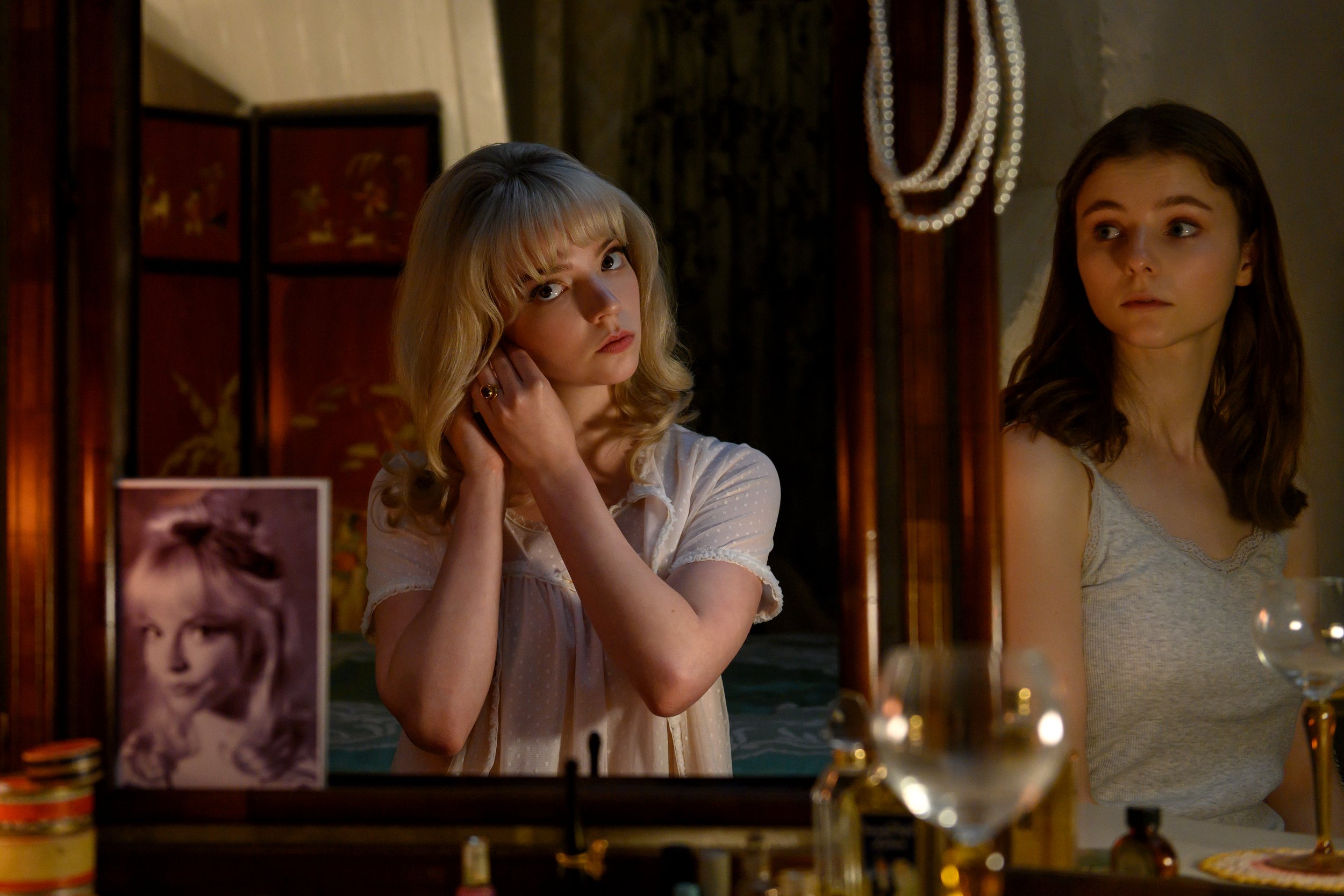
Eloise (Thomasin McKenzie, right) watches her possible alter ego, Sandie (Anya Taylor-Joy) — a girl who lived in Eloise’s London apartment more than six decades earlier — get ready for the night in Edgar Wright’s  “Last Night in Soho.” (Photo courtesy of Searchlight Pictures.)

Eloise (Thomasin McKenzie, right) watches her possible alter ego, Sandie (Anya Taylor-Joy) — a girl who lived in Eloise’s London apartment more than six decades earlier — get ready for the night in Edgar Wright’s “Last Night in Soho.” (Photo courtesy of Searchlight Pictures.)

Review: 'Last Night in Soho' is a hallucinatory time trip that goes from '60s swing to psychological terror

October 27, 2021 by Sean P. Means

With the deliciously surprising “Last Night in Soho,” director Edgar Wright delivers a movie that slips through genres — romantic fantasy, psychological thriller, murder mystery and revenge drama — with  subtle elegance and ferocious power.

Eloise (Thomasin McKenzie) is an aspiring fashion designer who’s leaving her life in rural England to study clothing design in London. It’s a culture shock for the shy Eloise, who makes regular phone calls to her grandma (played by ’60s screen icon Rita Tushingham) and tries not to notice her visions of her late mother (Aimee Cassettari) when she looks in the mirror.

After a disastrous night in student housing, Eloise decides to get a flat in Soho — a simple attic room in a house owned by the gruff Ms. Collins (Dame Diana Rigg, in her last role before her death in September 2020). The flat also seems to serve as a portal, transporting Eloise in her imagination to 1965.

It’s in this dreamy rendition of Carnaby Street, where the movie house is debuting “Thunderball,” where Eloise first spots Sandie (played by Anya Taylor-Joy), an aspiring singer who catches every man’s eye in the dance club. Soon, Eloise is getting an upclose look at Sandie, because she has turned into Sandie’s reflection in the mirrors of the swanky club — and, in one fantastic sequence, Sandie and Eloise pop in and out of the picture while dancing with Jack (Matt Smith), the man who’s going to make Sandie’s dreams of stardom come true.

At first, Eloise luxuriates in this ‘60s dream scene, and starts letting Sandie’s style influence her design-school work. Eloise even gets her hair bleached blonde to match Sandie’s, and gets a job as a Soho barmaid to get closer to the scene. But Eloise slowly sees that Sandie’s dreams turned sour, as Jack reveals his true, dark nature.

Wright (“Baby Driver,” “Scott Pilgrim vs. the World”) and screenwriter Krysty Wilson-Cairns (“1917”) masterfully shift tones, as Eloise’s fascination with Sandie’s glamorous life curdles into concern for her muse in her downward slide — and into fear that she’s losing her mind to a paranoia that makes her suspicious of everything, namely the smooth-talking old man (Terence Stamp) who hangs out at the bar where she works. Wright’s imagery grows more unsettling, his mood more Hitchcockian, with some spectacular twists before the end.

Wright’s pacing is dynamic, the camera work (by “Oldboy” cinematographer Chung-soon Chung) is hallucinogenic, and the period details are seductive. Populating this ‘60s-fueled story with icons of the era — Rigg, Stamp and Tushingham — is a calculated risk that pays off big. So does Wright’s knack for picking the perfect ‘60s radio hit for every moment, from Petula Clark’s “Downtown” (which Taylor-Joy re-creates into an eerie ballad) to James Ray’s “I Got My Mind Set on You.” (And all this time I thought George Harrison was the first to record that song. Live and learn.)

What makes it work are the twinned performances by Taylor-Joy and McKenzie. Taylor-Joy (“The Queen’s Gambit”) has the more showy role, the hyper-confident performer manipulated into sleazy doings. (Side note: A smart producer would be working on a movie where Taylor-Joy and Emma Stone play evil sisters.) Meanwhile, McKenzie (“Old,” “Jojo Rabbit”) burrows into the role of the mousy Eloise, and reveals an inner strength to confront the ghosts that her visions have stirred up six decades later.

“Last Night in Soho” is an intoxicating movie, a thrilling ride down a darkening road on the strength of dream logic and masterful storytelling and movie craft. It’s a time trip like no other, so hop on as soon as you can.

——

‘Last Night in Soho’

★★★1/2

Opens Friday, October 29, in theaters everywhere. Rated R for bloody violence, sexual content, language, brief drug material and brief graphic nudity. Running time: 116 minutes.

October 27, 2021 /Sean P. Means
Comment
Editor Arthur Howitzer Jr. (Bill Murray, left) consults with his writer, Roebuck Wright (Jeffrey Wright, right), about his latest article for his magazine, The French Dispatch, as another writer (Wally Wolodarsky) looks on, in Wes Anderson’s “The French Dispatch.” (Photo courtesy of Searchlight Pictures.)

Editor Arthur Howitzer Jr. (Bill Murray, left) consults with his writer, Roebuck Wright (Jeffrey Wright, right), about his latest article for his magazine, The French Dispatch, as another writer (Wally Wolodarsky) looks on, in Wes Anderson’s “The French Dispatch.” (Photo courtesy of Searchlight Pictures.)

Review: 'The French Dispatch' is an oddball collection of stories that show Wes Anderson at his most whimsical and detail-oriented

October 27, 2021 by Sean P. Means

One enters “The French Dispatch” hoping Wes Anderson has prepared a sumptuous five-course cinematic meal — and what we find is an hors d’oeuvres tray, each dish prepared beautifully but without a cohesive beginning, middle and end.

The movie — which Anderson directed and wrote with story credit shared with pals Roman Coppola, Hugh Guinness and Jason Schwartzman — is five short stories loosely tied to a central theme: They are all depictions of magazine articles from a publication called The French Dispatch. This magazine is the creation of an eccentric Kansas newspaperman, Arthur Howitzer Jr. (Bill Murray), and somewhat inspired by the literary-minded articles of The New Yorker back in the ‘50s and ‘60s. Really, that set-up is an excuse for Anderson to work at his most whimsical, and to mix black-and-white with color and play with aspect ratios for his different tales.

The five stories, mostly in order, are:

• Howitzer’s obituary, which serves as the framing device for the others.

• A travelogue of the fictional Ennui-Sur-Blasé, led by the bicycling correspondent Herbsaint Sazerac (Owen Wilson).

• An art critic J.K.L. Berensen (Tilda Swinton) describes an imprisoned artist (Benicio Del Toro), a guard (Léa Seydoux) who poses nude for him, and an art gallerist (Adrien Brody) doing time for tax fraud who discovers the painter’s greatness.

• An account by cynical war correspondent Lucinda Krementz (Frances McDormand), who encounters and inspires a headstrong student revolutionary (Timothée Chalamet).

• Another expatriate writer, Roebuck Wright (Jeffrey Wright), recalls his greatest story for the magazine: A profile of Nescaffier (Stephen Park), head chef to the city’s police commissioner (Mathieu Amalric), and how his cooking foiled a kidnapping plot.

The bicycle travelogue is fast and flighty, as Sazarec rattles off more observations about Ennui’s seedier side than one can keep track of. Krementz’ story is wistful in its appraisal of how young love and political idealism go hand in hand.

Both Berensen’s story and Wright’s are complex affairs, firstly because they are staged in a way where the storyteller is narrating — Berensen in a lecture hall, Wright on a TV talk show (with Liev Schreiber as the interviewer) — for a satisfactory story-within-a-story effect.

The artist’s story is a tricky dissection of the artist’s process and the art dealer’s ways of turning expression into cash. (The story also features Seydoux, last seen as James Bond’s lady love, fully unclothed and looking divine.) 

Wright’s tale, the best of the lot, is practically a full movie in its own, a police procedural complete with a shootout with a bunch of kidnappers (a crew that includes Edward Norton and Saoirse Ronan) and a car chase (shown in animation, but not as richly rendered as “The Fantastic Mr. Fox” or “Isle of Dogs”). Jeffrey Wright’s depiction of the writer, clearly modeled on the social commentator James Baldwin, adds a layer of soulfulness, an outsider digging into the life of another outcast, Nescaffier.

The weakest link in Anderson’s chain is the one that’s supposed to bind the others together: The framing device of the dearly departed editor, Howitzer. We get some flashes of the old newspaperman’s tenacity, and his deft handling of his writers, outwardly irascible but ultimately tender. But Anderson leans too heavily on Murray’s natural bearlike charm, as he dispenses such sage writing advice as “just try to make it sound like you wrote it that way on purpose.”

Anderson is definitely in his element, creating intricate set pieces that move like the most exquisitely engineered wind-up music boxes, as delicate and as light as a souffle. Anderson has become a magnet for actors wanting to get in on the act; besides those already mentioned, the cast includes Willem Dafoe, Henry Winkler, Bob Balaban, Lois Smith, Christoph Waltz, Tony Revolori, Lyna Khoudri, Elisabeth Moss, Jason Schwartzman, Fisher Stevens, Griffin Dunne and, as the narrator, Anjelica Huston.

No, it doesn’t actually build up to much, other than a showcase for Anderson’s fondness for old-school journalism, oddball outcasts, and perfectly pitched deadpan humor. There’s nothing wrong with the anthology approach — just don’t go into “The French Dispatch” expecting more than some small, well-polished gems.

——

‘The French Dispatch’

★★★1/2

Opens Friday, October 29, in theaters everywhere. Rated R for graphic nudity, some sexual references and language. Running time: 108 minutes.

October 27, 2021 /Sean P. Means
Comment
Teacher Julie Meadows (Keri Russell, right) sees something terrifying alongside her student, Lucas Weaver (Jeremy T. Thomas), in the horror drama “Antlers.” (Photo courtesy of Searchlight Pictures.)

Teacher Julie Meadows (Keri Russell, right) sees something terrifying alongside her student, Lucas Weaver (Jeremy T. Thomas), in the horror drama “Antlers.” (Photo courtesy of Searchlight Pictures.)

Review: Backwoods horror drama 'Antlers' is deeply unsettling, but too serious to be scary

October 27, 2021 by Sean P. Means

Oppressively atmospheric and more unsettling than scary, director Scott Cooper’s horror thriller “Antlers” made this viewer wince for all the wrong reasons.

In an Oregon town whose mine has gone bust, Julia Meadows (Keri Russell) is a middle-school teacher who notices one of her students, Lucas Weaver (Jeremy T. Thomas) is particularly troubled. He’s underfed, and skittish about talking about what’s going on at home. Julia suspects abuse, and talks about it to her brother, Paul (Jesse Plemons), who’s the sheriff. Paul has gone out to the Weaver place too many times, usually to revive Lucas’ dad, Frank (Scott Haze), from an opioid overdose.

What Cooper, working off a script he co-wrote with Henry Chaisson and Nick Antosca (based on Antosca’s short story), reveals to us is how bad things are at the Weaver house. Lucas is bringing food to his little brother, Aiden (Sawyer Jones), and trapped animals to his dad, who must be locked in a dark room and seems to be turning into some sort of beast. Eventually, we get an explanation from Paul’s predecessor, retired sheriff Warren Stokes — who’s played by Graham Greene, a reminder that all movies are improved with Graham Greene in them.

Julia is heavily laden with a tragic backstory — we get elbow-in-the-ribs hints of an alcohol problem, and arch dialogue and flashbacks of abuse dispensed on her and Paul by their father. Julia’s troubles are suggested as an impetus for her desire to help young Lucas, but Cooper’s execution is clunky and strained.

Julia’s sorrows also slow down the story just when Cooper needs to be building up tension. Eventually, the horror kicks in, though in such underlit settings — everything here is at night or in dimly lit rooms — that it’s difficult to make out who’s getting torn apart. In the end, “Antlers” is a grim drama whose serious themes get in the way of delivering an effective scare.

——

‘Antlers’

★★

Opens Friday, October 29, in theaters everywhere. Rated R for violence including gruesome images, and for language. Running time: 99 minutes.

October 27, 2021 /Sean P. Means
Comment
Julie (Amanda Seyfried, left) and Ethan (Finn Wittrock) hold their baby boy, Teddy, in a moment from the drama “A Mouthful of Air.” (Photo courtesy of Sony Pictures.)

Julie (Amanda Seyfried, left) and Ethan (Finn Wittrock) hold their baby boy, Teddy, in a moment from the drama “A Mouthful of Air.” (Photo courtesy of Sony Pictures.)

Review: 'A Mouthful of Air' is a well-intended but narratively muddled story of postpartum depression

October 27, 2021 by Sean P. Means

If good intentions were all it took to make a great movie, novelist-turned-filmmaker Amy Koppelman’s depression drama “A Mouthful of Air” would be a masterpiece, instead of the awkward, uneven film that it is.

Koppelman makes her directing debut and writes the adaptation of her own novel — as she did co-writing 2015’s “I Smile Back” (starring Sarah Silverman as a suburban drug addict) — that centers on Julie Davis, a young mom played by Amanda Seyfried. When we first see her, she’s struggling to keep her composure while caring for her baby boy in the New York City apartment she shares with her husband, Ethan (Finn Wittrock). At one point, while the baby watches “Sesame Street,” Julie takes an X-acto knife and slits her wrists. 

Koppelman doesn’t show the act, but keeps the camera trained on Julie’s face and the single tear that runs down her cheek as she does it. At first, the restraint is admirable, but soon it becomes something of an avoidance habit, keeping us from fully grasping the full measure of Julie’s postpartum depression.

Julie is a children’s book writer who draws and creates a character called Pinky Tinkerbink, who is able to unlock the fears that her creator, Julie, still struggles with, weeks after the attempt at suicide. Julie’s mother, Bobbi (Amy Irving), is a regular babysitter — of both the couple’s baby and of the fragile Julie. An attempt at a double date with Ethan’s sister, Lucy (Jennfer Carpenter), and her husband Kevin (Darren Goldstein) becomes an emotional struggle, because Lucy was the person who found Julie bleeding on the bathroom floor, and still can’t fathom why Julie would want to kill herself.

Lucy’s harsh tone feels off-the-charts nasty, until the movie eventually reveals that it’s set in 1995, a time when the medical knowledge of postpartum depression was thin. (One not-so-subtle hint of the timeframe is that in one of Julie’s Pinky Tinkerbink drawings — drawn by Koppelman — there’s an image of the twin towers of the World Trade Center.)

Julie is lucky to have a psychiatrist, Dr. Sylvester (Paul Giamatti), who seems sensitive to Julie’s postpartum issues — he even reads Sylvia Plath to her — and puts her on anti-depression meds. The complication of the film comes when Julie is pregnant again, and she wants to discontinue the meds, against Dr. Sylvester’s advice.

For a movie about a mental-health ordeal, as this one is, two elements have to be in sync: The main actor’s performance, and the emotional beats in the script. Seyfried, whose big eyes express a wealth of emotions, fulfills her end of the bargain, showing Julie as both broken and resilient, seeming to bounce back from her suicide attempt.

Koppelman’s script doesn’t give Seyfried enough of a foundation. It strings together too many “close call” vignettes, while laying in some screamingly obvious plot points about Julie’s long-absent and abusive father (Michael Gaston). Then comes a third-act plot complication that gives an overly simplified explanation for Julie’s mental state that feels forced and inadequate to the important issues about postpartum life that Koppelman wants to impart. By the time the ending finally hits, the viewer isn’t sad so much as worn out. 

——

‘A Mouthful of Air’

★★1/2

Opens Friday, October 29, in theaters everywhere. Rated R for some language. Running time: 105 minutes.

October 27, 2021 /Sean P. Means
1 Comment
Paul Atreides (Timothee Chalamet) runs to stay out of the maw of a sandworm, in Denis Villeneuve’s adaptation of Frank Herbert’s science-fiction epic “Dune.” (Photo courtesy of Warner Bros. Pictures and Legendary Pictures.)

Paul Atreides (Timothee Chalamet) runs to stay out of the maw of a sandworm, in Denis Villeneuve’s adaptation of Frank Herbert’s science-fiction epic “Dune.” (Photo courtesy of Warner Bros. Pictures and Legendary Pictures.)

Review: 'Dune' is big, bold and beautiful — and it's only the first half of a sprawling space epic

October 21, 2021 by Sean P. Means

The first sign that Denis Villeneuve’s “Dune” might have a shot at getting it right — at succeeding where avant-garde directors like David Lynch and Alejandro Jodorowsky failed — comes at the very beginning, when two words appear under the title: “Part One.”

This is an instant signal that Villeneuve (“Arrival,” “Blade Runner 2049”) is going to take the time necessary to tell Frank Herbert’s sprawling science-fiction epic properly. No need to cram everything into one movie, as Lynch did in 1984. 

And, even though the plot revolves around a mind-altering spice, Villeneuve soon shows he’s taking a down-to-earth approach to the visuals. Gone are the hallucinatory wonders of Lynch’s pre-“”Blue Velvet” imagination, or the fevered phantasmagoria of Jodorowsky’s doomed ‘70s project (as described in the documentary “Jodorowsky’s Dune”). 

Villeneuve, who shares screenplay credit with Jon Spaihts and Eric Roth, starts with the basics: It’s the year 10,191, and two mighty clans are in conflict. On the bad guys’ side is House Harkonnen, led by the pustulant and corpulent Baron Harkonnen (Stellen Skarsgard), which has operated the spice harvesting on the desert planet Arrakis — collecting the drug that navigators need to “fold space.” The good guys are House Atreides, with Duke Leto Atreides (Oscar Isaac) grooming his son, Paul (Timothee Chalamet), to one day succeed him, helped by the Duke’s loyal aides: Gurney Halleck (Josh Brolin), Duncan Idaho (Jason Momoa) and Thufir Hawat (Stephen McKinley Harrison).

Someone else has been training Paul: His mother, Lady Jessica (Rebecca Ferguson). Jessica is a member of the Bene Gesserit, the holy order that’s officially acting as peacemakers as House Atreides takes over Arrakis’ operations from House Harkonnen, under order of the emperor.

Then the Mother Superior (Charlotte Rampling) comes to test Paul’s abilities and his bravery. These skills will become important, when Duke Leto is betrayed, having walked into the trap set by the nasty Baron. Paul and Jessica must travel the deserts, careful not to attract the skyscraper-sized worms that roam the dunes outside the castle walls. so they can meet the Fremen, the desert-equipped natives. Paul has seen one Fremen, Chani (Zendaya), in his dreams. 

Being the first of a planned two-part adaptation, those dreams are about all you see of Zendaya, and Javier Bardem’s appearance as the Fremen leader, Stilgar, is scant in this chapter. On the other hand, there are characters in this first installment who won’t be around for Part Two. (Not saying who.)

The script includes some of the palace intrigue, without letting the narrative get sucked into it, as happened with Lynch (and, for that matter, Herbert). One clever touch is how Villeneuve tacitly compares Arrakis to Afghanistan, where desert dwellers watch as foreign superpowers, some with better intentions than others, come looking to impose order on a secretive native population. 

The look of Villeneuve’s Arrakis is breathtaking, combining the best of modern CGI images with the sweep of an epic like “Lawrence of Arabia.” Every detail, from the giant sandworms that explode from the sands to the desert “stillsuits” the Fremen wear to collect their sweat, is executed to movie perfection.

First and foremost, “Dune” is a coming-of-age story, with the young Paul growing into the role destiny has assigned — to lead his world into a giant cosmic battle to come. In that context, Chalamet is inspired casting. Chalamet’s Paul can be impetuous at times, like when he begs his pal Duncan to take him along on a reconnaissance flight. But this Paul also can be thoughtful, observant, and heroic. Some heroism won’t come until the second chapter, but there’s enough potential, in Paul and in this franchise, to suggest this “Dune” can go the distance.

——

‘Dune’

★★★1/2

Opens Friday, October 22, in theaters everywhere and streaming on HBO Max. Rated PG-13 for sequences of strong violence, some disturbing images and suggestive material.

October 21, 2021 /Sean P. Means
1 Comment
Nat Love (Jonathan Majors, right) shares a tender moment with his ex, Stagecoach Mary (Zazie Beetz), in the Western drama “The Harder They Fall.” (Photo courtesy of Netflix.)

Nat Love (Jonathan Majors, right) shares a tender moment with his ex, Stagecoach Mary (Zazie Beetz), in the Western drama “The Harder They Fall.” (Photo courtesy of Netflix.)

Review: 'The Harder They Fall' is a slick, stylish Western that changes the genre's hero myths to reflect Black lives back then

October 21, 2021 by Sean P. Means

One might suspect musician-turned-filmmakaer Jeymes Samuel of cribbing from the Quentin Tarantino playbook in “The Harder They Fall,” and certainly this slick Western ticks many of the same boxes.

Dynamic camerawork? Check. Florid mile-a-minute dialogue? Check. Action set pieces as creative as they are violent? Check. Music drops that seem out of place, but end up fitting in perfectly? Check. Deploying historical figures in ways history never did? Check.

The first recognizable difference between Samuel’s approach and Tarantino’s turns out to be a critical one: With Samuels, when someone starts using the “N-word,” Regina King’s character shoots them dead before they finish the first syllable.

This turns out to be a crucial difference, though. Where Tarantino plays with ideas of racism to stir up trouble, Samuel is trying to create a new Western mythology — with Black heroes and villains, based on real figures of the Old West, leading the way.

First we meet the villain, Rufus Buck (Idris Elba), a cold-blooded killer who opens the movie by killing a preacher and his wife, and putting a cross-shaped scar on their son’s forehead.

That boy comes back in view as a grown man, Nat Love (Jonathan Majors), an outlaw who doesn’t rob banks, but instead robs the gangs that rob the banks. Love also has hunted down the men who assisted Buck when he killed Love’s parents — until Buck’s the only one left.

Getting to Buck will be difficult, though. He runs his own town, and has a gang of nasty killers on his side, including King’s character, saloon operator Trudy Smith, and the quick-shooting Cherokee Bill (LaKeith Stanfield). 

But Love has his own ride-or-die gang, including the fast-draw champ Jim Beckwourth (RJ Cyler), rifle-toting Bill Pickett (Edi Gathegi), the androgynous but hard-fighting Cuffee (Danielle Deadwyler), and the toughest one of all — saloon magnate Stagecoach Mary (Zazie Beetz), who’s also Love’s ex. And there’s someone else, the cagey marshal Bass Reeves (Delroy Lindo), who has designs on ending Buck’s reign.

Samuel — who, under the name The Bullitts, is a respected music producer who worked with Jay-Z as a music consultant on Baz Luhrmann’s “The Great Gatsby” — stages action scenes with the fast cadence and insistent beats of a good rap song. There’s never nothing happening in the movie, which can be exciting to watch, but also a little exhausting sometimes. Even at over two hours, there’s almost no room here to breathe.

Samuel and co-screenwriter Boaz Yakin (“Now You See Me”) also give the cast pages and pages of smart, sharp dialogue to chew up and spit out. My favorite line comes early, in the scene where King’s Trudy is leading a train heist and shoots the engineer who starts to call her the “N-word.” Cherokee Bill wryly suggests that Trudy was hasty. “He might have been calling you a nincompoop,” Bill says.

The cast is powerful, individually and as a group. Let’s single out just the ringleaders: Elba cements his badass image as the ruthless Buck, and Majors shows, as he did in HBO’s “Lovecraft Country,” that he has the heart and charisma to be a leading man.

There is symbolism, sometimes none too subtle. At one point, someone has to rob a bank in a nearby all-white town. When Samuel’s camera arrives, it certainly is white — every building is whitewashed as if Tom Sawyer tricked an entire town into painting it. It’s an in-your-face metaphor for the racism our heroes and anti-heroes face in the Old West, and Samuel proves in “The Harder They Fall” that being in one’s face is a faster way to get the message across than the Pony Express.

——

‘The Harder They Fall’

★★★1/2

Opens Friday, October 22, in theaters everywhere; available for streaming starting November 3 on Netflix. Rated R for strong violence and language. Running time: 130 minutes.

October 21, 2021 /Sean P. Means
Comment
  • Newer
  • Older

Powered by Squarespace