The Movie Cricket

Movie reviews by Sean P. Means.

  • The Movie Cricket
  • Sundance 2025
  • Reviews
  • Other writing
  • Review archive
  • About
Anthony Ramos plays Usnavi, a bodega operator who’s torn between his love of New York and his dreams of returning to the Dominican Republic, in the musical film “In the Heights.” (Photo courtesy of Warner Bros. Pictures.)

Anthony Ramos plays Usnavi, a bodega operator who’s torn between his love of New York and his dreams of returning to the Dominican Republic, in the musical film “In the Heights.” (Photo courtesy of Warner Bros. Pictures.)

Review: 'In the Heights' brings Broadway to the streets, with a joyful look at a vibrant New York neighborhood

June 09, 2021 by Sean P. Means

Just when we needed it most, as the country starts to emerge from virus-inflicted isolation and wanting to have fun, playwright Lin-Manuel Miranda and director Jon M. Chu bring the party with the long-awaited movie version of “In the Heights.”

Miranda’s debut musical, first staged off-Broadway in 2007 and debuting on Broadway in 2008, is a rhythm-driven, joy-filled celebration of Washington Heights. For those who don’t know — and Miranda & Co. are eager to tell you — that’s the neighborhood in far northern Manhattan where first- and second-generation immigrants toil and strive to make better lives for themselves.

The narrator is Usnavi de la Vega, played by Anthony Ramos, who’s best known for playing two doomed characters — John Laurens and Philip Hamilton — in Miranda’s “Hamilton.” Usnavi’s parents brought him to “Nueva York” from the Dominican Republic. It’s Usnavi’s dream to leave behind his dad’s run-down bodega, where he sells coffee and lottery tickets to the neighborhood, and reopen the bar his dad used to run in Santo Domingo.

But there’s more than money woes keeping Usnavi from going back to the Dominican Republic. There’s his young cousin Sonny (Gregory Diaz IV), a DACA kid who runs the store with him. And there’s Claudia (Olga Merediz), who raised Usnavi after his parents died — and serves as “abuela,” or grandmother, to the neighborhood. But, mostly, Usnavi is tied by his unrequited crush on Vanessa (Melissa Barrera), a fashion designer who also dreams of leaving Washington Heights — in her case, for an apartment downtown.

The story’s other romantic coupling is between Nina Rosario (Leslie Grace), who’s back from her first year at Stanford, and Benny (Corey Hawkins), the dispatcher at the taxi company owned by Nina’s dad, Kevin Rosario (Jimmy Smits). Nina is dealing with the pressure of being Kevin’s perfect daughter, and being the one person everyone knows who escaped the Heights — which is why she’s having trouble telling everyone that she wants to drop out of Stanford, where she feels alienated and alone.

Miranda and Quiara Alegria Hudes, who wrote the musical’s book and the film’s screenplay, mostly make space for the characters to sing about their hardships and dreams. What little plot there is involves a blackout, the miscommunication between Usnavi and Vanessa (easily the musical’s weakest link), and the word spreading around the neighborhood that Usnavi’s bodega sold somebody a winning lottery ticket worth $96,000.

Fans of the play will notice some changes. The film removes the subplot where Kevin disapproves of Benny dating his daughter; in fact, the movie also takes away Kevin’s big solo number and makes him a widower. Merediz’ show-stopper “Paciencia y Fe,” in which Abuela Claudia sings of her passage from Cuba and her family’s hard work in New York, is moved into the second act.

Merediz, who received a Tony nomination for the role, is the only Broadway cast member who reprises her role for the movie. Miranda played Usnavi back in 2008, but has aged out. Now he plays the Piragueno, the shaved-ice man, selling his sweet treats around the block — and serving as the symbol of the Heights’ resistance to gentrification, personified by the corporate-backed Mister Softee truck. (The Mister Softee driver is played by Christopher Jackson, who was the original Benny and later played George Washington in “Hamilton.”)

“In the Heights” is part of a long Broadway tradition: Enticing rich theatergoers to plunk down hundreds of dollars for tickets to watch poor people persevere. It’s a tradition that stretches from “Oliver!” to “Fiddler on the Roof,” from “Les Miserables” to “Miss Saigon,” and from “Rent” to “Urinetown.”

Miranda’s debut musical doesn’t wallow too much in the historic nostalgia of “Fiddler,” or the operatic self-importance of “Les Miz,” or the smug sanctimony of “Rent.” No, “In the Heights” is a big-hearted work — weaving together stories of hope holding firm in the face of disappointment, love winning out over adversity — that also tackles issues of poverty, immigration and the preservation of Latino culture.

And in the hands of Chu, who directed “Crazy Rich Asians” and a couple of the “Step Up” movies, it’s the sort of musical spectacle — fast-moving, dance-focused, candy-colored — that Miranda’s music deserves. The fact that much of it is filmed on location gives the movie magic an underpinning of street-smart authenticity.

Chu sets the ensemble piece “96,000,” when everyone considers what they would do with a lottery windfall, at the public pool in a throwback to Busby Berkeley’s watery extravaganzas with Esther Williams. He smartly casts Daphne Rubin-Vega (the original Mimi from “Rent”) in the key role of Daniela, the exuberant owner of the local hair salon. And in Benny and Nina’s duet “When the Sun Goes Down,” he stages the dance on the side of their building, reminiscent of Fred Astaire in “Royal Wedding.”

Ramos gives a star turn as Usnavi, caught between his New York life and his Dominican dreams. Barrera is a charming discovery as the ambitious Vanessa, and Hawkins and Grace bring soul to Benny and Nina’s love story. Smits and especially Merediz shine as they show that pursuing one’s dreams is a multi-generational occupation.

Throughout “In the Heights,” one hears Miranda’s way of melding traditional musical theater and the rhythms of hip-hop, the Caribbean and the New York street. As he did in “Hamilton,” Miranda here is  bending the musical to fit the moment, creating something both timely and timeless.

——

‘In the Heights’

★★★1/2

Opens Friday, June 11, in theaters and streaming on HBO Max. Rated PG-13 for some language and suggestive references. Running time: 143 minutes.
June 09, 2021 /Sean P. Means
Comment
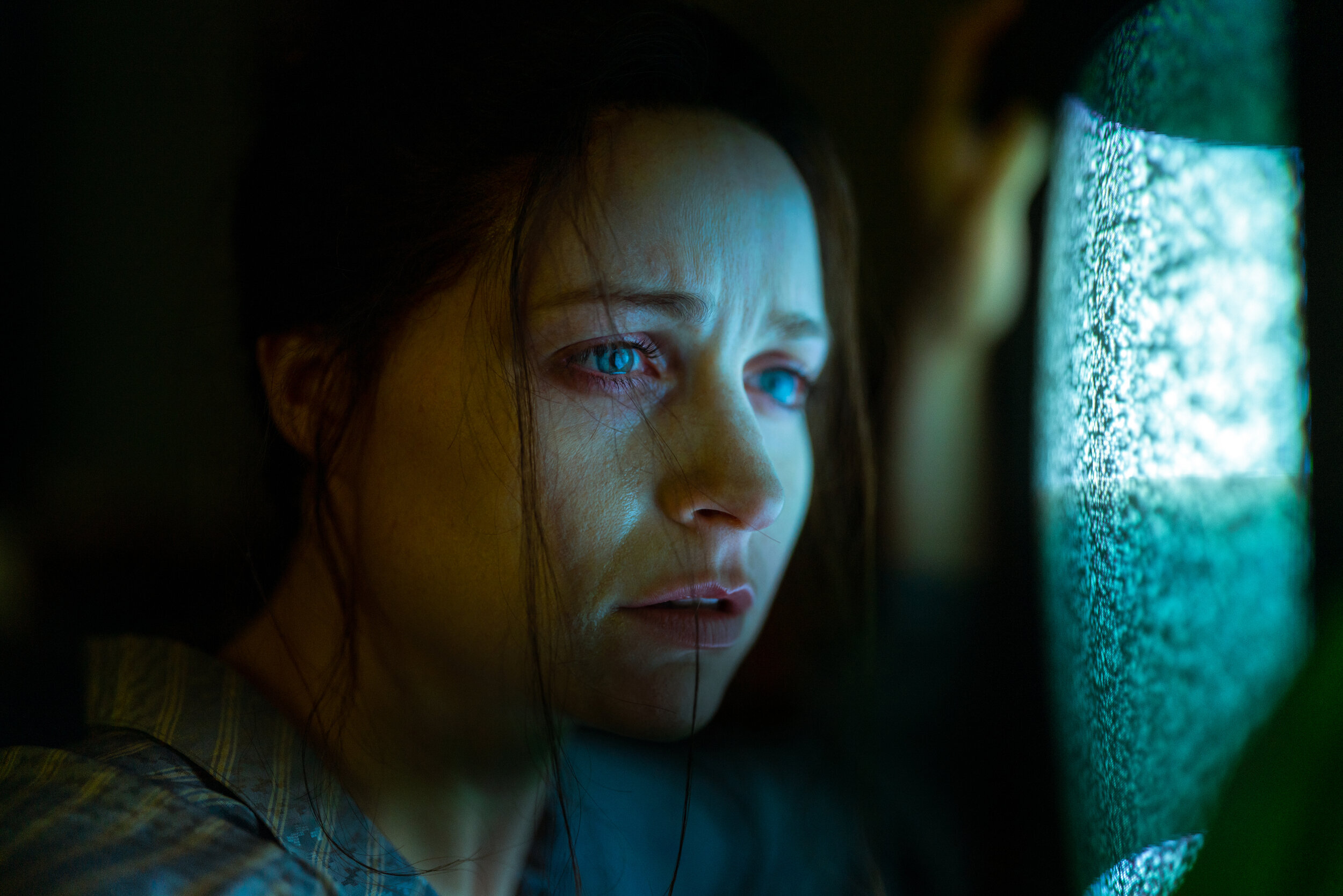
Enid (Niamh Algar) is a film censor who becomes obsessed with one of the horror films she is assigned to watch, in the horror thriller “Censor.” (Photo by Maria Lax, courtesy of Magnolia Pictures.)

Enid (Niamh Algar) is a film censor who becomes obsessed with one of the horror films she is assigned to watch, in the horror thriller “Censor.” (Photo by Maria Lax, courtesy of Magnolia Pictures.)

Review: 'Censor' is a smart and scary horror tale that also comments on the 'video nasties' panic of the '80s.

June 09, 2021 by Sean P. Means

The smartly spooky Welsh-made shocker “Censor” shows that it’s possible to comment on the horror genre while still making a movie that will scare the crap out of you.

It’s the early ‘80s in Great Britain, in the era of Margaret Thatcher, and Enid Baines (played by Irish actress Niamh Algar) works for the government agency that censors and rates movies. It’s the age of “video nasties,” cheaply made horror whose gore is so abundant that it’s set off a moral panic in the tabloid press — and when an accused killer is linked to a movie Enid and her colleagues approved, the press hordes start hounding her.

Then a new horror movie comes in for screening, and it’s disturbing to Enid in ways beyond the usual guts and gore. Enid becomes convinced that the lead actress (Sophia La Porta) is the adult version of Enid’s sister, Nina, who disappeared when she was 7 years old — when a 10-year-old Enid was with her. When Enid can’t convince her parents, who have taken steps to have Nina declared legally dead, Enid decides she has to find the film’s enigmatic director (Adrian Schiller), who is now filming another movie that eerily parallels Nina’s disappearance.

In her feature debut, director/co-writer Prano Bailey-Bond (who wrote the script with Anthony Fletcher) finds delicious tension in following the straitlaced Enid descend into madness and mayhem. It helps that Algar, last seen by American audiences in Guy Ritchie’s recent heist thriller “Wrath of Man,” is so compelling to watch as Enid slowly unravels.

Interestingly, for a movie that delves into “video nasties,” the gore is judiciously applied — except for an early montage of ‘80s-style splatter films and a fairly gruesome finale. Bailey-Bond proves that what we think is happening on the screen is infinitely more terrifying than onscreen bloodshed, and allows the scariest parts of the movie to play out within the viewer’s head. 

——

‘Censor’

★★★1/2

Opens Friday, June 11, in select theaters; on demand June 18. Not rated, but probably R for violence, gore, sexual situations and language. Running time: 84 minutes.

June 09, 2021 /Sean P. Means
Comment
Paula Beer plays Undine, a woman whose romantic troubles take a surprising turn in Christian Petzold’s “Undine.” (Photo courtesy of IFC Films.)

Paula Beer plays Undine, a woman whose romantic troubles take a surprising turn in Christian Petzold’s “Undine.” (Photo courtesy of IFC Films.)

Review: 'Undine' is surprising and moving, a sneakily sharp melding of realism and fantasy

June 02, 2021 by Sean P. Means

The German romantic drama “Undine” is a fantasy steeped in realism — or is it the other way around? — and another example of how writer-director Christian Petzold can knock an audience off balance in the most interesting ways.

When Petzold introduces the title character, Undine Wibeau (played by Paula Beer), she’s sitting at a table in an outdoor cafe, and she’s crying. Her boyfriend, Johannes (Jacob Matschenz), has just told her they’re through, and that he has had an affair with another woman. Undine tells Johannes that he has two choices: Dump the new woman and return with her, or risk Undine killing him.

That sounds like either a psychotic threat or, more likely, a desperate last-gasp effort to rescue the relationship. But there’s also a hint of the mythological — since the name Undine also refers to a figure of European legend, a water nymph who becomes human when she falls in love with a man, but is doomed to die when he betrays her. (The myth is one of the roots for Hans Christian Andersen’s “The Little Mermaid,” among other interpretations.)

Undine returns to her job, as tour guide for an exhibit of models of Berlin’s changing cityscape, but can’t put Johannes out of her head. That is, until she meets Christoph (Franz Rogowski), a diver who performs underwater welding for a local utility. When this new romance blooms, Christoph thinks it’s fate — because before they met, he found Undine’s name carved on a stone under the water near an aqueduct. But when Christoph suspects Undine is holding something back, the relationship becomes in danger of going under.

Petzold played with genre perceptions expertly in his last movie, “Transit,” a World War II refugee drama filmed in modern settings. Here, Petzold keeps everything as real as can be, which gives the question of whether Undine is mad or magical an unexpected weight.

And, as he did in “Transit,” Petzold capitalizes on the beautiful pairing of Beer and Rogowski, whose onscreen chemistry is by turns tender and explosive. The performances, and Petzold’s sly handling of the story’s fantasy undercurrents, combine to produce a surprisingly moving tale of love, infidelity and revenge.

——

‘Undine’

★★★1/2

Available starting Friday, June 4, for digital rental on demand. Not rated, but probably PG-13 for sexual content and language. Running time: 89 minutes; in German, with subtitles.

June 02, 2021 /Sean P. Means
Comment
Lucky Prescott, center (voiced by Isabela Merced), rides Spirit, accompanied by friends Abigail, left (voiced by Mckenna Grace), and Pru (voiced by Marsai Martin), in the animated tale “Spirit Untamed.” (Image courtesy of DreamWorks / Universal.)

Lucky Prescott, center (voiced by Isabela Merced), rides Spirit, accompanied by friends Abigail, left (voiced by Mckenna Grace), and Pru (voiced by Marsai Martin), in the animated tale “Spirit Untamed.” (Image courtesy of DreamWorks / Universal.)

Review: 'Spirit Untamed' is a lackluster animated tale, a recycling of ideas from older and better movies

June 02, 2021 by Sean P. Means

The only mystery presented by “Spirit Untamed,” a by-the-numbers computer-animated tale of wild horses and adventurous pre-teen girls, is why Universal Pictures wanted to release it in theaters — because even before the pandemic, this one had “direct to video” written all over it.

“Spirit Untamed” is a spiritual sequel, of sorts, to the 2002 DreamWorks animated tale “Spirit: Stallion of the Cimarron” — except where that line-drawn film gave the horses voices (the title horse was voiced by Matt Damon), here the horses make only horse noise. (Credit voice actor and foley artist Gary A. Hacker for the whinnies and other horse noises heard here.)

Instead, “Spirit Untamed” focuses on a 12-year-old girl, Lucky Prescott (voiced by Isabela Merced, star of the live-action “Dora the Explorer”). Lucky was called “Fortuna” by her mom, Milagro (voiced by Eiza Gonzalez), a stunt rider who died in a horse accident when Lucky was just a baby. Her grieving father, Jim (voiced by Jake Gyllenhaal), sent Lucky to grow up in the city, cared for by Jim’s sister, Cora (voiced by Julianne Moore).

One summer, though, when Jim’s father is running for governor of the territory (which territory is never mentioned), Cora escorts Lucky out west to spend the summer with her dad. On the train over, Lucky encounters a herd of wild horses — whose alpha closely resembles the Spirit of the first movie. Lucky also meets Hendricks (voiced by Walton Goggins), an unscrupulous cowboy who’s determined to catch those wild horses and make a tidy profit.

Upon arriving in town, Lucky makes fast friends with Pru Granger (voice by “blackish” actress Marsai Martin), who rides in her dad’s rodeo show, and the guitar-strumming Abigail Stone (voiced by Mckenna Grace, who has had recurring roles on “The Haunting of Hill House” and “Young Sheldon”). Making friends with Spirit, who’s temporarily tied up in the corral, takes longer.

Besides its origin in the 2002 movie, “Spirit Untamed” also recycles characters from “Spirit Riding Free,” an animated series that ran on Netflix from 2017 to 2020. And that’s what “Spirit Untamed” feels like: Something recycled. 

Director Elaine Bogan — making her directing debut after toiling away at DreamWorks’ TV products —works to put some spark in the chase sequences and humor, humor in the scenes between Lucky and Spirit, and girl-power enthusiasm when Lucky, Pru and Abigail are on the trail. 

Unfortunately, Bogan is boxed in by lackluster animation and a script (by Kristin Hahn and Katherine Nolfi) stretched too thin to cover the running time. “Spirit Untamed” isn’t really a bad movie, just a mediocre one — and, what’s sadder, an unnecessary one.

——

‘Spirit: Untamed’

★★

Opens Friday, June 4, in theaters nationwide. Rated PG for some adventure action. Running time: 87 minutes.

June 02, 2021 /Sean P. Means
Comment
Joseph Smith (Paul Wuthrich, second from left) prays with the three men — from left, Martin Harris (Lincoln Hoppe), David Whitmer (Michael Zuccola) and Oliver Cowdrey (Caleb J. Spivak) — who helped scribe Smith’s translation of The Book of Mormon, in a scene from the movie “Witnesses.” (Photo courtesy of Purdie Distribution.)

Joseph Smith (Paul Wuthrich, second from left) prays with the three men — from left, Martin Harris (Lincoln Hoppe), David Whitmer (Michael Zuccola) and Oliver Cowdrey (Caleb J. Spivak) — who helped scribe Smith’s translation of The Book of Mormon, in a scene from the movie “Witnesses.” (Photo courtesy of Purdie Distribution.)

Review: 'Witnesses' is more compelling when it covers the after-effects of religious faith, rather than the small details.

June 02, 2021 by Sean P. Means

As is customary with movies that cover the history and doctrine of The Church of Jesus Christ of Latter-day Saints, the drama “Witnesses” will have different meaning and impact depending on whether the viewer is a believer in the faith.

For members, there’s nothing new in the movie’s overview of the church’s early history. They will nod with recognition at the steps of Joseph Smith’s journey — receiving the golden plates on which were written The Book of Mormon, working to translate the ancient language on those plates, and how he and his flock were persecuted across New York and the Midwest.

Non-members will likely get stuck on how director Mark Goodman shows details of that history that, from an outside perspective, seem a little ludicrous. One example: The part where Smith (played by Paul Wuthrich) is looking at a “seer stone” in his hat as he translates the golden plates.

This is not meant to belittle my Latter-day Saint neighbors or their faith. Consider for a moment “The Book of Mormon,” Trey Parker and Matt Stone’s irreverent musical about Latter-day Saint missionaries trying to explain their faith to incredulous Africans. The story of The Book of Mormon (the actual book, not the play) may sound strange to those unfamiliar with it, Parker and Stone say — because, at heart, the origin stories of every religion sound weird when you say them out loud. The play’s message is that a faith’s value is not in the arcana, but in how it inspires its people to be better and kinder.

Smith is the focus of the first half of “Witnesses,” written by veteran Latter-day Saint filmmaker Mitch Davis (who directed one of the first “Mormon Cinema” movies, 2001’s “The Other Side of Heaven”). Smith is such a charismatic figure, able to persuade crowds and sway grown men toward his fledgling religion, that he’s sure to overwhelm any movie about the church’s early days.

When Goodman and Davis first show us Smith, he’s seen as a man of action — running through a forest, trying to protect the plates from the men hunting him down. He’s larger than life, and such figures are more appropriate for statues, not flesh-and-blood movie characters.

Eventually, as the title promises, the view turns to the three men who scribed for Smith, who saw firsthand the translation work and vouched for the miracle they believed Smith was performing. The three were Martin Harris (Lincoln Hoppe), a neighbor of Smith’s and an early convert, and two more converts who joined Smith in upstate New York: Oliver Cowdery (Caleb J. Spivak) and David Whitmer (Michael Zuccola).

It’s in the stories of these men where “Witnesses” gets interesting, as Goodman and Davis (who had collaborated previously on a 2017 docudrama, “Joseph Smith: American Prophet”) depict the struggles and sacrifices the men made because they stuck to their accounts. They faced ridicule, angry mobs, death threats and — when they openly disagreed with Smith during the church’s early days — excommunication. The fact that they continued to trust in their faith, and their founder, is both spiritually inspirational and dramatically compelling.

One might wish that Goodman and Davis had kept Smith an enigmatic side character, and focused more on how these three followers persevered in his wake. Smith makes for a good sermon, but the human story produces drama worth watching on a movie screen.

——

‘Witnesses’

★★1/2

Opens Friday, June 4, in theaters across Utah. Rated PG for violence and thematic elements. Running time: 110 minutes.

June 02, 2021 /Sean P. Means
2 Comments
Regan (Millicent Simmonds) helps the Abbott family find a new hiding place from murderous aliens in “A Quiet Place Part II.” (Photo by Jonny Cournoyer, courtesy of Paramount Pictures.)

Regan (Millicent Simmonds) helps the Abbott family find a new hiding place from murderous aliens in “A Quiet Place Part II.” (Photo by Jonny Cournoyer, courtesy of Paramount Pictures.)

Review: 'A Quiet Place Part II' delivers chilling moments, and strong performances by Emily Blunt and Millicent Simmonds

May 27, 2021 by Sean P. Means

If you accept the premise that “A Quiet Place” was a near-perfect horror thriller, and so perfectly self-contained that a sequel was unnecessary, then you can also accept that “A Quiet Place Part II” is the dessert that’s nearly as good as the meal that preceded it.

Director John Krasinski, who this time also wrote the screenplay solo (he co-wrote the first one with Bryan Woods and Scott Beck), appears in the new film’s prologue. It’s the day that the sound-sensitive space critters invaded, turning the Abbott family’s outing — watching teen son Marcus (Noah June) playing Little League — into an unceasing terror. 

The prologue also allows us to see Krasinski as the patriarch, Lee Abbott, trying to protect his wife, Evelyn (Emily Blunt), and their children: Marcus; Regan (Millicent Simmonds), who’s deaf; and Beau (Dean Woodward), who didn’t make it past the first 10 minutes of the first movie.

The rest of this sequel happens some 16 months later, immediately after the end of the first movie. Evelyn, carrying her new baby in a sling, travels with Marcus and Regan across the countryside, seeking a new place to hide from the horrific aliens — and, possibly, use the shrill noise from Regan’s hearing aid to immobilize the beasts long enough to kill them. At one stop, they encounter Emmett (Cillian Murphy), a family friend — his son was one of Marcus’ Little League teammates — who has become a hermit living underground in an abandoned factory.

Krasinski doesn’t mess too much with the formula that made the first “A Quiet Place” so chillingly effective. He shows the aliens more here than in the first film, but hides them enough to make their menace more palpable and frightening. And the sound design burrows into the subconscious, picking away at our nerves, to heighten the suspense.

What makes “A Quiet Place Part II” work is also what made the first one work: The strong performances by its female leads. Blunt (a k a Mrs. Krasinski) gives Evelyn a sharp intelligence and a keen sense of family protectiveness. Most fascinating is Simmonds, a Utah native, who shows how resourceful, brave and determined Regan can be — and does it without saying much at all.

—————

‘A Quiet Place Part II’

★★★1/2

Opens Friday, May 28, in theaters everywhere. Rated PG-13 for terror, violence and bloody/disgusting images. Running time: 98 minutes.

May 27, 2021 /Sean P. Means
Comment
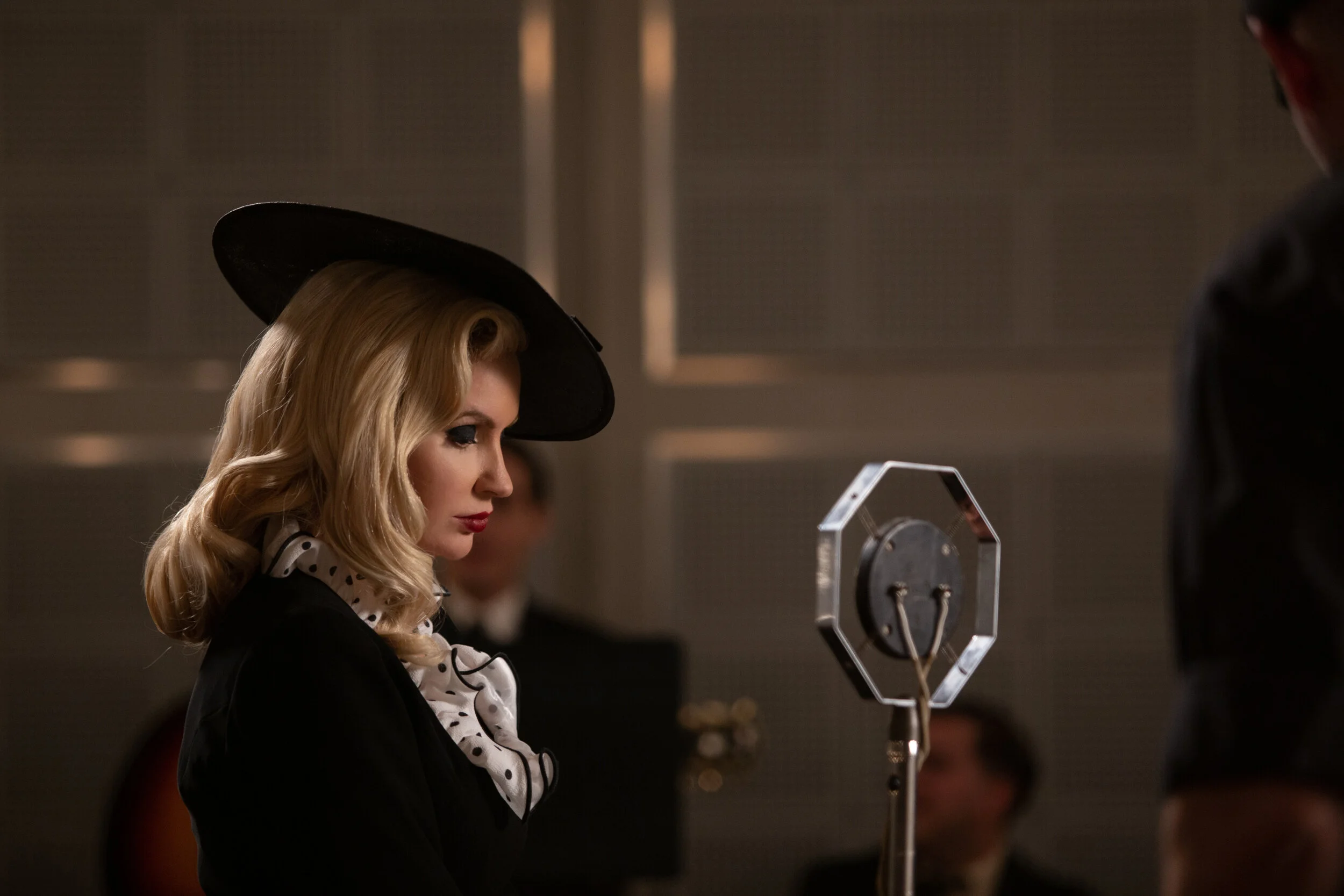
Meadow Williams plays Mildred Gillars, the American who read Nazi propaganda to GI’s listening in, in the drama “American Traitor: The Trial of Axis Sally.” (Photo courtesy of Vertical Entertainment.)

Meadow Williams plays Mildred Gillars, the American who read Nazi propaganda to GI’s listening in, in the drama “American Traitor: The Trial of Axis Sally.” (Photo courtesy of Vertical Entertainment.)

Review: 'American Traitor' is a misguided bore, a sad mingling of courtroom drama and melodramatic weepie

May 27, 2021 by Sean P. Means

I’m not sure what happened to Michael Polish — but whatever led him from making offbeat and daring films like “Twin Falls Idaho” and “The Astronaut Farmer” to helming schlocky nonsense like “American Traitor: The Trial of Axis Sally” is a tragedy worthy of its own movie.

The title character in this “based on a true story” courtroom drama is Mildred Gillars (played by Meadow Williams), an American living in Germany in the 1930s, working as a lounge singer and sometime radio host. Her lover, radio producer Max Otto Koischwitz (Carsten Norgaard) is close to Joseph Goebbels (Thomas Kretschmann), Hitler’s propaganda chief — and Goebbels thinks Mildred has what it takes to be the Third Reich’s secret weapon.

Soon, Mildred is reading scripts, in English, extolling the might of the German army, and suggesting to American GI’s that Franklin Roosevelt and Winston Churchill are putting troops in harm’s way for their own greed purposes. As Mildred tells it, Goebbels forced her to say those lines — holding Mildred’s passport, forcing her to sign a loyalty oath, and raping her and threatening to kill her.

The script — by Wayne Owen (based on a book he co-wrote and Darryl Hicks, with a rewrite by Polish — jumps from these scenes to an American courtroom in 1948, where Mildred is on trial for treason. Her only hope is a gruff and sometimes theatrical lawyer, James Laughlin, played by Al Pacino, who apparently jumped at the chance to ham it up in a courtroom drama.

Where to begin on where “American Traitor” fails? Maybe with the idea of trying to wring tears out of Gillars’ claims of being a cog in someone else’s propaganda machine — or painting herself as a subversive satirist, pitching Goebbels’ propaganda message in a way no one could take seriously.

It might be possible to buy either of Gillars’ lines if a decent actor was performing the role. Instead, we get Williams, a B-movie queen who apparently watched too many ‘40s noir thrillers and couldn’t decide between playing the damsel in distress or the femme fatale.

Pacino manages to tone down his usual scenery chewing, but he doesn’t give much to replace the histrionics. It says something about a movie when Lala Kent, the Utah native and one-time “Vanderpump Rules” reality star, gives a mediocre performance as assistant to the prosecutor (Mitch Pileggi) and isn’t the worst thing in the movie.

Polish seems torn between making a courtroom procedural and a ridiculously melodramatic biopic. He ends up shortchanging both ends of the narrative spectrum, and completing the circle of incompetence that hangs on “American Traitor” like a noose.

——

‘American Traitor: The Trial of Axis Sally’

★

Opens Friday, May 28, in select theaters and streaming on demand. Rated R for sexual assault. Running time: 109 minutes; in English and in German with subtitles.

May 27, 2021 /Sean P. Means
1 Comment
Emma Stone plays the title role in “Cruella,” a reimagined origin story for Disney’s fashion-forward villainess. (Photo courtesy of Disney.)

Emma Stone plays the title role in “Cruella,” a reimagined origin story for Disney’s fashion-forward villainess. (Photo courtesy of Disney.)

Review: 'Cruella' gives sympathy for DeVil, with a wickedly witty origin story for Disney's puppy-snatching villainess

May 26, 2021 by Sean P. Means

Turning one of Disney’s meanest villains — a would-be puppy killer, no less — into a sympathetic character is a tall order, but director Craig Gillespie is up to the task in the spirited and wickedly fun “Cruella.”

Gillespie has a track record of finding the tender side of unpleasant people. Early in his career, in “Lars and the Real Girl,” he gave us Ryan Gosling as a lonely nerd in love with a realistic sex doll. In “I, Tonya,” he and Margot Robbie conspired to make us take pity on Olympic skater and tabloid sensation Tonya Harding. And he’s signed up next to tell the twisted love story of Pamela Anderson and Tommy Lee for Netflix. So humanizing a maniacal fashion designer should be a snap.

“Cruella” is an origin story that begins with a little girl named Estella (played at age 12 by Tipper Seifert-Cleveland), a girl bullied at her boarding school because her hair is half black and half white. She retaliates by letting her proto-punk nasty side out — an alter ego her mother (Emily Beecham) dubs “Cruella.”

When Estella’s mum suddenly uproots her daughter, and they are set to move to London, they make a fateful stop at Hellman Hall, home of the famous fashion designer known as The Baroness (Emma Thompson). Estella is traumatized when she sees The Baroness’s attack dogs — dalmatians, of course — push her mum off a cliff.

The now-orphaned Estella lands in London and is befriended by two young thieves, Jasper and Horace. The three become fast friends, and partners in crime. A decade later, in the late ’70s, Estella — now played by Emma Stone — wants to fulfill her dreams of being a designer. Horace (Paul Walter Hauser) thinks it’s an angle for a new crime spree, but Jasper (Joel Fry) believes in Estella, and finagles a job interview for her at a posh department store.

The department store gig leads Estella to a bigger job, as an assistant and junior designer to The Baroness. Estella, her two-tone hair covered by a dye job, labors intensely to satisfy her imperious boss. At the same time, she wants to take revenge on The Baroness. So she enlists a secondhand-store operator, Artie (played by John McCrea, soon to be world-famous as the star of “Everybody’s Talking About Jamie”), to create an alternate fashion persona — named Cruella.

One of the joys of “Cruella” is how the screenplay — credited to Dana Fox (“How to Be Single”) and Tony McNamara (who co-wrote “The Favourite”), with three other writers getting story credit — escalates the public fashion battle between the established Baroness and the punk-minded Cruella. The frock fight is made more entertaining by the outlandishly stylish work of costume designer Jenny Beavan (an Oscar winner for “A Room With a View” and “Mad Max: Fury Road”). 

Gillespie guides us through Estella’s transformation from punk pre-teen to fashionista to scourge of London with devilishly fun set pieces and a rollicking pace. He also is smart to deploy the movie’s best weapons, the two Emmas, for maximum cattiness. Both Stone and Thompson are clearly having the time of their lives chewing the scenery and taking swipes at each other — with Stone’s snide derision matching Thompson’s haughty high maintenance at every turn.

Disney purists may be put off by the rewriting of canon — what comic-book fans call “retcon,” short for “retroactive continuity,” the act of reverse-engineering the past to sync up to the present — that makes Cruella more sympathetic than her character was in the original “101 Dalmatians.” If viewers can get past that, as Disney asked them to do with “Maleficent,” this “Cruella” is a DeVil of a good time.

——

‘Cruella’

★★★1/2

Opens Friday, May 28, in theaters everywhere, and available on Disney+ Premier. Rated PG-13 for some violence and thematic elements. Running time: 134 minutes.

May 26, 2021 /Sean P. Means
Comment
  • Newer
  • Older

Powered by Squarespace