The Movie Cricket

Movie reviews by Sean P. Means.

  • The Movie Cricket
  • Sundance 2025
  • Reviews
  • Other writing
  • Review archive
  • About
Katherine Waterston, left, and Vanessa Kirby play 19th-century farm wives who develop an intense friendship in director Mona Fastvold’s drama “The World To Come.” (Photo by Vlad Cioplea, courtesy of Bleecker Street Films.)

Katherine Waterston, left, and Vanessa Kirby play 19th-century farm wives who develop an intense friendship in director Mona Fastvold’s drama “The World To Come.” (Photo by Vlad Cioplea, courtesy of Bleecker Street Films.)

Review: Farm life turns passionate in 'The World to Come,' an austere drama whose magic is in its details

February 10, 2021 by Sean P. Means

Passion runs hot in the cold of 19th century New York state in “The World to Come,” a slow-burn romantic drama where the details are everything.

It’s 1856, and a couple, Abigail (Katherine Waterston) and Dyer (Casey Affleck) are scratching out an existence on their small farm. Abigail writes in her journal about her loneliness, and her concerns for Dyer’s mental state: “He told me contentment was a friend that he never gets to see.” Abigail is also mourning the death of her daughter, from whooping cough, and worried that she will never have another child.

Abigail’s spirit is lightened when a new couple arrives nearby, Finney (Christopher Abbott) and Tallie (Vanessa Kirby). Tallie becomes a fast friend, who invites herself over to see Abigail when Finney is doing the disgusting business of slaughtering a pig. Soon Tallie is a regular visitor, and Abigail is beside herself in those spaces when Tallie is not there.

Director Mona Fastvold (“The Sleepwalker,” SFF ’14) builds unbearable tension in the unspoken thoughts Abigail directs toward Tallie and the slight glances Tallie returns in Abigail’s direction. Eventually that tension must break, with life-shattering consequences for all concerned.

Fastvold, working off a script by Ron Hansen and Jim Shepard, steeps this story in the authentic details of the two couples’ farm lives, until one can almost smell the pigpen and feel the pressing of pen to paper in Abigail’s fervent writing.

Affleck’s quiet menace isn’t as flashy as Abbott’s pious browbeating of Tallie, but both men embody the unspoken oppression their wives endure. Kirby, so powerful in “Pieces of a Woman,” matches that performance with a strong turn as a woman willing to unleash the passion she’s feeling. Waterston carries the movie’s weight, as narrator and the vulnerable, yet forceful, woman who imagines a better world than the one in which she must survive. This quartet comes together to make “The World to Come” a quietly heartbreaking drama.

——

‘The World to Come’

★★★1/2

Opens Friday, February 12, in theaters where open. Rated R for some sexuality/nudity. Running time: 98 minutes.

——

This review originally ran on this site on February 2, 2021, when the movie screened at the 2021 Sundance Film Festival.

February 10, 2021 /Sean P. Means
Comment
Morfydd Clark stars as Maud, a nurse who experiences religious delusions, in the horror drama “Saint Maud.” (Photo courtesy of A24.)

Morfydd Clark stars as Maud, a nurse who experiences religious delusions, in the horror drama “Saint Maud.” (Photo courtesy of A24.)

Review: 'Saint Maud' is a lurid, atmospheric horror film that showcases actress Morfydd Clark and director Rose Glass

January 27, 2021 by Sean P. Means

A nurse with a messiah complex is at the bloody heart of “Saint Maud,” an atmospheric horror drama that spotlights two intriguing young talents: Actress Morfydd Clark and director Rose Glass.

Clark is somewhat familiar, or should be, having given solid performances in two Charles Dickens-adjacent period films: “The Man Who Invented Christmas,” in which he played Dickens’ young wife, and “The Personal History of David Copperfield,” where she stole the show as the title character’s ditzy fiancee.

Here, Clark plays Maud — or, at least, that’s the name she’s using now — who takes a job as a home nurse to Amanda (Jennifer Ehle), a famous dancer and choreographer who’s now using a wheelchair because of a cancer on her spinal column. We come to learn that Maud had an incident at the hospital where she previously worked, but her nursing skills and bedside manner seem to be OK for Amanda.

Glass, in her feature debut as director and screenwriter, shows us that Maud is a recent convert to Jesus — and is concerned, almost to the point of obsession, with Amanda’s imminent death and her destination in the afterlife. Amanda jokingly calls Maud her savior, but Maud seems to be seriously auditioning for the role.

Glass puts an intriguing spin on the straight-forward narrative, by showing us this relationship through two prisms: Reality, and the hyper-real fantasy land that Maud sees as she carries out her plan to “save” Amanda’s soul. The view isn’t always pretty, but it’s often fascinating.

Glass’ pace is brisk, but leaving enough time for Clark to put her stamp on this tricky role. Clark plays Maud as a madwoman, certainly, but with an earnestness that makes her delusions almost defensible. Together, Glass and Clark create an intense portrait of madness, of fanatical belief taken to bloody extremes.

——

‘Saint Maud’

★★★

Opens Friday, January 29, in theaters where open; debuts February 12 on Epix. Rated R for disturbing and violent content, sexual content and language. Running time: 84 minutes.

January 27, 2021 /Sean P. Means
Comment
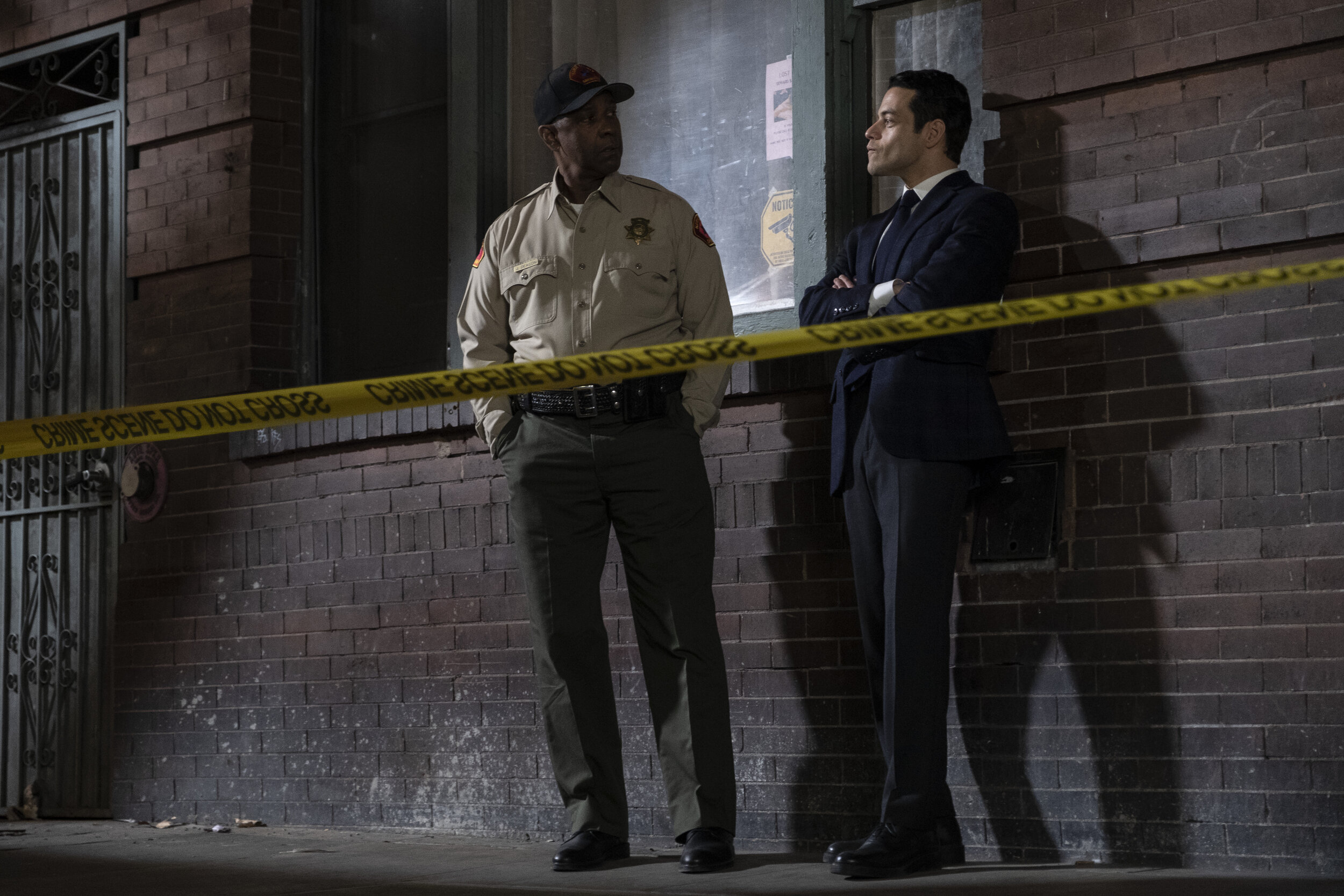
Joe “Deke” Deacon (Denzel Washington), a rural sheriff’s deputy, assists Jim Baxter (Rami Malek), an L.A. Sheriff’s Department detective, on a difficult murder investigation, in the crime thriller “The Little Things.” (Photo by Nicola Goode, courtes…

Joe “Deke” Deacon (Denzel Washington), a rural sheriff’s deputy, assists Jim Baxter (Rami Malek), an L.A. Sheriff’s Department detective, on a difficult murder investigation, in the crime thriller “The Little Things.” (Photo by Nicola Goode, courtesy of Warner Bros. Pictures.)

Review: 'The Little Things' is one big mess, in spite of three Oscar winners filling out this sleazy serial-killer movie

January 27, 2021 by Sean P. Means

On a scale of one to “Se7en,” “The Little Things” barely rates a three.

Writer-director John Lee Hancock peddles many of the tropes of David Fincher’s famous serial-killer police procedural — with an old cop working with a young cop, trying to outwit a seemingly implacable madman. But in trying to duplicate that movie’s moral ambiguity, Hancock just produces a muddled mess.

Set in Los Angeles in 1990, the story follows Joe Deacon (Denzel Washington), known as “Deke” to his friends — of which he doesn’t have too many these days. Deke’s a deputy in a rural California jurisdiction, sent by his boss to collect some evidence being held by the Los Angeles Sheriff’s Department, a couple hours’ drive away.

Deke still has some friends in the L.A. Sheriff’s Department, where he worked as a detective a few years earlier — that is, until a case that, according to his old boss, Capt. Carl Farris (Terry Kinney), led to his suspension, a divorce and a triple bypass. Deke looks up some old acquaintances, but he also listens in as a young detective, Jim Baxter (Rami Malek), tries to reassure the press that the serial-killer case that’s terrorizing the L.A. area will be solved.

Despite warnings from Farris, Baxter seeks advice on the case from Deke — who sees parallels between this killer and the case that abruptly ended his LASD career. Soon, Deke is riding shotgun with Baxter, helping the ambitious young detective track down leads and try to make a case against a creepy guy named Albert Sparma (Jared Leto), who seems to be having too much fun toying with Baxter and Deke.

With three Oscar-winning actors and some luridly sensuous images of Los Angeles captured by cinematographer John Schwartzman (“Seabiscuit”), Hancock — who directed “Saving Mr. Banks” and “The Blind Side,” among others — should be able to knock this one out with little effort. Alas, his script is riddled with ham-fisted plot mechanics, a flashback structure that telegraphs the movie’s punches, and (no spoilers here) an ending in which the filmmaker thumbs his nose at every police-reform argument we have heard in the last few years.

Washington and Malek have some nice moments together in “The Little Things,” two generations of actors trying to bring some gravitas to a sleazy police drama. But they’re thwarted by that stink-bomb ending, which demonstrated that sometimes it’s not the little things but one big thing that destroys a movie.

——

‘The Little Things’

★1/2

Opens Friday, January 29, in theaters where open, and streams on HBO Max. Rated R for violent/disturbing images, language and full nudity. Running time: 127 minutes.

January 27, 2021 /Sean P. Means
Comment
Jackson Greer (played by Jake Allyn) rides on his family’s ranch, in a scene from the drama “No Man’s Land.” (Photo courtesy of IFC Films.)

Jackson Greer (played by Jake Allyn) rides on his family’s ranch, in a scene from the drama “No Man’s Land.” (Photo courtesy of IFC Films.)

Review: 'No Man's Land' is a border thriller that takes an intriguing turn into a redemption drama

January 21, 2021 by Sean P. Means

Like the Rio Grande that’s a central feature of the story, director Conor Allyn’s “No Man’s Land” has some twists and turns in it, delivering more emotional weight than first impressions would suggest.

The title refers to a stretch of real estate along the Rio Grande, between the river and the U.S. border fence. It’s an area where migrants cross over into the States from Mexico. It’s also where the Greer family runs a small cattle ranch, and deals with migrants walking through their land and disturbing the cattle.

Bill Greer (Frank Grillo) and his wife, Monica (Andie MacDowell), try to keep the ranch financially afloat, aided by their sons, Lucas (Alex MacNicoll) and Jackson (Jake Allyn, who co-wrote the script with David Barraza). Jackson has a way out of ranch life: A 92 mph fastball and a chance to join the Yankees’ AA farm team.

On the other side of the river, Gustavo (Jorge A. Jimenez), who has the nickname “Shepherd” because of his faith, is trying to get his 11-year-old son, Fernando (Alessio Valentini), over the border.

One night, the two families have an encounter, as Bill and Lucas try to retrieve some wayward cattle, and find Gustavo’s group trying to traverse the desert. One kid with Gustavo’s group pulls a knife, there’s a struggle for Bill’s rifle — and Jackson unexpectedly ends up in the middle of it. When the dust has settled, Lucas has been shot in the gut, and Jake has killed little Fernando.

One might think this is the jumping-off point for a revenge thriller, a kill-or-be-killed struggle between Jake and Gustavo. Instead, something more interesting happens: Jake rides off into Mexico, toward the city of Guanajuato, in an effort to find Gustavo and atone for what he’s done.

Jake’s journey is a rough one, across the Mexican desert. He finds help along the way, working as a laborer for a prosperous rancher (Juan Carlos Remolina). And he experiences Mexico, learning that the bigoted information he inherited from Bill is not accurate. Jake also has a violent thug, Luis (Andrés Delgado), and a Texas Ranger, Ramirez (George Lopez), on his trail.

Some of the characterizations, particularly of Jake and the family who takes him in, are well-drawn and compelling — people with whom you’d like to sit around a big dinner table and just talk all night. Alas, other characters, like the nasty Luis, are cardboard cutouts of humanity, repositories for every screenwriting cliche that comes to mind.

The Allyn’s have a lot working for them: A strong cast, a good sense of storytelling, and an eye for rugged landscapes. “No Man’s Land” doesn’t pretend it’s solving the problems along the U.S./Mexico border, but it gives all sides a chance to be heard, which is enough.

——

‘No Man’s Land’

★★★

Opens Friday, January 22, in theaters where open. Rated PG-13 for some strong violence and language. Running time: 115 minutes.

January 21, 2021 /Sean P. Means
Comment
Liam Neeson plays Jim Hansen, an Arizona rancher who comes across a young Mexican man being chased by drug lords, in the crime drama “The Marksman.” (Photo courtesy of Open Road Films.)

Liam Neeson plays Jim Hansen, an Arizona rancher who comes across a young Mexican man being chased by drug lords, in the crime drama “The Marksman.” (Photo courtesy of Open Road Films.)

Review: 'The Marksman' is a straight-forward thriller, with Liam Neeson getting progressively craggier

January 13, 2021 by Sean P. Means

Despite its head-fake toward current-events relevance, “The Marksman” is a serviceable road thriller that demonstrates that Liam Neeson is slowly, inexorably, morphing into Clint Eastwood.

Neeson plays Jim Hansen, an Arizona rancher whose property abuts the U.S./Mexican border fence. In quick strokes, we learn that Jim is: a) in arrears on his ranch, due to the medical bills of his late wife; b) a retired Marine who’s quite handy with his sharpshooter’s rifle; c) equipped with a walkie-talkie with a direct signal to the U.S. Border Patrol; d) an alcoholic; and e) the stepfather of a Border Patrol detective, Sarah (Katheryn Winnick).

One day, a Mexican woman, Rosa (Teresa Ruiz), and her 11-year-old son, Miguel (Jacob Perez), come through the border fence, right in front of Jim’s pick-up truck. Jim gets on his walkie and calls the Border Patrol. Before they arrive, a Mexican drug cartel boss, Mauricio (Juan Pablo Raba), drives up to the fence, ordering Jim to give Rosa and Miguel back across. Jim refuses, and guns start going off — and soon Rosa is dead, and Jim is tasked with getting a reluctant Miguel to family in Chicago.

Of course, Mauricio and his goons aren’t going to make Jim and Miguel’s drive up Route 66 an easy one. The reason may have to do with the big bag of money Rosa was carrying before she died. With high-tech tools and an army of thugs, Mauricio traces Jim’s path through his credit card — and leaves a bloody trail as he pursues Jim and Miguel.

Director Robert Lorenz (who directed Eastwood in the baseball drama “Trouble With the Curve”), who co-wrote the script with Chris Charles and Danny Kravitz, creates scenes that are functional without being flashy. They’re not great cinema, but they move the story along to its expected destination.

There are attempts to make Miguel a stand-in for several hot-button issues — namely, the Mexicans who seek asylum to escape the violence of the drug cartels — but never with enough conviction to be anything more than an interesting plot point.

Neeson carries the bulk of “The Marksman” with gravel-voiced sincerity and an Old West “a man’s gotta do what a man’s gotta do” demeanor. It’s the sort of role Clint Eastwood used to do in his sleep, and Neeson is quickly proving to be Eastwood’s heir apparent for gruff, aging tough guys. 

——

‘The Marksman’

★★1/2

Opens Friday, January 15, in theaters where open. Rated PG-13 for violence, some bloody images and brief strong language. Running time: 104 minutes.

January 13, 2021 /Sean P. Means
Comment
Capt. Leo (Anthony Mackie, left) and Lt. Thomas Harp (Damson Idris) encounter enemy fire, in the futuristic war drama “Outside the Wire.” (Photo courtesy of Netflix.)

Capt. Leo (Anthony Mackie, left) and Lt. Thomas Harp (Damson Idris) encounter enemy fire, in the futuristic war drama “Outside the Wire.” (Photo courtesy of Netflix.)

Review: In 'Outside the Wire," a military officer meets an android warrior, but the sparks never fly.

January 13, 2021 by Sean P. Means

One thing a viewer never need worry about during the future-set war thriller “Outside the Wire” is not knowing what’s happening in the plot — because someone, usually star Anthony Mackie, will stop in his tracks to explain it, over and over again, stopping the action dead.

Convoluted only in the sense that no one will care to follow it, “Outside the Wire” begins in the year 2036 with Lt. Thomas Harp (Damson Idris), a self-assured drone pilot who fires missiles into combat situations with calm assurance, from the relative comfort of a military base in Nevada. On one such drone strike, he fires into a shooting situation and kills two Marines — though Harp defends his actions, under the cold calculation that he saved the other 38 Marines on that mission.

Instead of a court-martial, Harp is sent to the war zone where his drone was flying, deep in Ukraine. In the combat area, oversized battle robots, called Gumps, accompany human troops on missions, mostly to maintain an uneasy truce between a rebel group and a shadowy warlord, Viktor Koval (Pilou Asbaek, from “Game of Thrones”). Harp is assigned to work with Capt. Leo (Anthony Mackie), who is running a stealth mission to deliver vaccines to a field hospital outside the American military perimeter.

Harp quickly learns two things about Leo. One is that the vaccine mission is a cover for his true purpose, which is to hunt down Koval. The second, which actually comes first, is that Leo is an android, a next-generation robot soldier who can think independently of military constraints. Leo can also smile, laugh, hurl insults and swear like Samuel L. Jackson on a snake-filled plane.

Director Michael Håfström (“Escape Plan,” “The Rite”), working off a hash of a script by Rowan Athale and Rob Yescombe, ploddingly alternates between talky exposition scenes and hamfisted action sequences that are bloody enough to make one realize Leo never read Asimov’s First Law of Robotics — “A robot may not injure a human being or, through inaction, allow a human being to come to harm” — and certainly never read my First Law of Action Movies: Don’t be boring.

The most interesting aspect of “Outside the Wire” is a late-innings plot twist that would only be shocking if the movie ever encouraged the audience to connect in any way with Leo or Harp. As much as Mackie aims to bring some authenticity to his android character, this movie is as lifeless as a switched-off robot.

——

‘Outside the Wire’

★★

Available for streaming Friday, January 15, on Netflix. Rated R for strong violence and language throughout. Running time: 115 minutes.

January 13, 2021 /Sean P. Means
Comment
Malcolm X (Kingsley Ben-Adir, left) snaps a photo of his famous friends — football star Jim Brown (Aldis Hodge), boxer Cassius Clay (Eli Goree) and singer Sam Cooke (Leslie Odom Jr.) — in 1964, in the drama “One Night in Miami.” (Photo courtesy of N…

Malcolm X (Kingsley Ben-Adir, left) snaps a photo of his famous friends — football star Jim Brown (Aldis Hodge), boxer Cassius Clay (Eli Goree) and singer Sam Cooke (Leslie Odom Jr.) — in 1964, in the drama “One Night in Miami.” (Photo courtesy of Netflix.)

Review: In thought-provoking 'One Night in Miami,' Regina King shows she's right at home in the director's chair

January 07, 2021 by Sean P. Means

After watching her in her Emmy-winning role in “Watchmen” and her Oscar-winning performance in “If Beale Street Could Talk” — and now, with her feature directing debut, “One Night in Miami” — I am convinced that Regina King can do anything.

Appoint her Attorney General. Let her quarterback the Jets. Put her on “The Masked Singer.” Whatever it is, she can do it, and brilliantly.

Here, King and screenwriter Kemp Powers (“Soul”), adapting his own stage play, imagine the conversation that occurred before one of the most famous photos of 1964. The photo was taken in a Miami diner, after Muhammad Ali — when he was still using the name Cassius Clay — celebrated taking the heavyweight title in a match against Sonny Liston. Attending this impromptu party were the football icon Jim Brown, the singer Sam Cooke, and the activist Malcolm X.

Before this photo was taken, we find Malcolm (played by Kingsley Ben-Adir) preparing his hotel room to meet the other three men. They think they’re going to a party, but Malcolm has something else in mind: A conversation about how these icons can use their status to further the cause of Black liberation.

Most of Malcolm’s attention is focused on Cooke (played by Leslie Odom Jr.), a popular singer who should, in Malcolm’s view, be using his music to further the cause — not singing sappy love songs like “You Send Me.” Cooke argues back that, as a Black entrepreneur, he’s doing his part for his people, like making sure the Black artists he manages get proper royalties when The Rolling Stones covers one of their songs.

While Brown (Aldis Hodge) looks on with amusement, and talks about his side career of getting into the movies, Malcolm also wants a word with Clay (Eli Goree). Malcolm has been guiding Clay on his path to converting to Islam, but hasn’t told the future Ali that he’s had a falling-out with the leader of the Nation of Islam, Elijah Muhammad.

King maintains the contours of the stage origins of Powers’ story — most of the “action” is confined to Malcolm’s small hotel room, and consists of heartfelt, sometimes contentious, dialogue among the quartet. That’s not a handicap here, and King as a director isn’t afraid to let ideas and words propel the drama. King also expands outside that hotel room, with some visually striking moments, in the boxing ring with Clay or on “The Tonight Show” with Cooke, among others.

King also trusts her actors, and they repay that trust tenfold. Ben-Adir bottles the intellectual intensity of Malcolm X, both as an agitator trying to provoke Cooke and a counselor to Clay in his spiritual journey. Odom (“Hamilton”) gets the showiest role, singing in Cooke’s style but also embodying the showman’s smoothness. Goree captures Clay’s ebullient confidence, and the anger bubbling underneath it. Hodge makes Brown a cool observer, more thoughtful than one expects from a football player.

Together, the four actors bring Powers’ dialogue to full life, guided by King’s light but sure hand, posing big questions about Black identity and reactions to systemic racism. They make “One Night in Miami” an exhilarating, thought-provoking experience that’s as vital now as it was would have been in 1964

——

‘One Night in Miami’

★★★1/2

Opens Friday, January 8, in select theaters, including Megaplex Valley Fair (West Valley City), Megaplex Jordan Commons (Sandy), Megaplex at The District (South Jordan) and Megaplex Thanksgiving Point (Lehi); available for streaming starting Friday, January 15, on Netflix. Rated R for language throughout. Running time: 114 minutes.

January 07, 2021 /Sean P. Means
Comment
Sandra (Clare Dunne, foreground) leads her daughters and friends at the site where she’s building a house for her family, in the drama “Herself.” (Photo courtesy of Amazon Studios.)

Sandra (Clare Dunne, foreground) leads her daughters and friends at the site where she’s building a house for her family, in the drama “Herself.” (Photo courtesy of Amazon Studios.)

Review: 'Herself' is a warm, winning Irish drama, and a star-making turn for actor/writer Clare Dunne

January 07, 2021 by Sean P. Means

The Irish domestic drama “Herself” is a big-hearted and inspirational story of resilience and motherly love — and a grand global introduction of actor/writer Clare Dunne.

Dunne — who has story credit and co-wrote the screenplay with Malcolm Campbell — plays Sandra White, a Dublin mother who we first see playing with her young daughters, Emma (Ruby Rose O’Hara) and Molly (Molly McCann). That brief happiness is shattered when Sandra’s husband, Gary (Ian Lloyd Anderson) comes home, sends the children away, and then savagely beats Sandra. This isn’t the first time, we know, because Sandra and Emma have a secret code to call the police.

The story cuts to some time later, with Sandra and the girls living in a hotel near the Dublin airport, subsidized by welfare — and even then, Sandra is working in a bar and cleaning a woman’s house to make ends meet. Finding a new apartment is impossible, even with rent vouchers, but she’s determined that she’s not going to return to Gary.

While juggling jobs, and a custody schedule with Gary, Sandra comes across a potential solution to her housing problem: A self-built mini-house. She can’t get the city welfare office to help, but gets an unexpected offer from Peggy (Harriet Walter), the doctor whose house Sandra cleans: Free land in Peggy’s backyard, and a loan to pay for the house materials. Sandra even finds a retired contractor, Aido (Conleth Hill, from “Game of Thrones”), to oversee construction.

Director Phyllida Lloyd (“Mamma Mia!,” “The Iron Lady”) doesn’t shy away from Sandra’s pain as an abused spouse or a poverty-stricken mom. But Lloyd doesn’t let Sandra or the movie wallow in the misery, either. This is a story about Sandra’s resolve and survival skills, as she battles bureaucracy and her own self-doubt to make a better life for herself and her daughters — and, almost by accident, discovering a community of friends who support her dream.

Dunne gives a tender, yet intense, portrayal of Sandra, a woman finally driven to leave her abusive husband and strong enough to handle the consequences of that decision. Dunne, in writing herself a plum role, gives “Herself” a warm glow generated from an emotional melodrama that’s never pandering and always true to its heart.

——

‘Herself’

★★★1/2

Available for streaming starting Friday, January 8, on Prime video; now playing at Megaplex Valley Fair (West Valley City). Rated R for language and some domestic violence. Running time: 97 minutes.

January 07, 2021 /Sean P. Means
Comment
  • Newer
  • Older

Powered by Squarespace