The Movie Cricket

Movie reviews by Sean P. Means.

  • The Movie Cricket
  • Sundance 2025
  • Reviews
  • Other writing
  • Review archive
  • About
Author Shirley Jackson (Elisabeth Moss, left) takes an interest in Rose (Odessa Young, right), a young newlywed, in director Josephine Decker’s drama “Shirley.” (Photo courtesy of Neon.)

Author Shirley Jackson (Elisabeth Moss, left) takes an interest in Rose (Odessa Young, right), a young newlywed, in director Josephine Decker’s drama “Shirley.” (Photo courtesy of Neon.)

Review: Elisabeth Moss is remarkable in 'Shirley,' capturing a manipulative, vulnerable author

June 04, 2020 by Sean P. Means

Director Josephine Decker’s drama “Shirley” is part biographical drama, part murder mystery, part sexually fueled fantasy, and part chronicle of madness — and all of it held together by powerhouse acting, particularly by Elisabeth Moss.

Moss plays Shirley Jackson, the famed author of such macabre stories as “The Lottery” and “The Haunting of Hill House.” In the movie’s telling, it’s the late 1940s in Vermont, and Jackson lives with her husband, the literary critic and scholar Stanley Hyman (Michael Stuhlbarg), who teaches at that hotbed of passion, Bennington College.

In this story, adapted from Susan Scarf Merrell’s 2014 novel, Hyman has just taken on a new assistant, Fred Nemser (Logan Lerman), who is recently married to Rose (Odessa Young). Rose is fascinated with Shirley, though the author’s brusque manner on their first meeting unsettles her — but not as much as Shirley intuiting that Rose is pregnant.

Stanley asks the Nemsers to live with them for awhile, and asks Rose to help out with housekeeping — but, more importantly, to keep an eye on Shirley, who hasn’t left the house in weeks and sometimes never gets out of bed. Rose’s interest in Shirley grows deeper, particularly when Shirley starts researching the case of a missing college student and contemplates writing a novel based on the case, even though Stanley thinks the subject matter beneath her talents. 

Decker and screenwriter Sarah Gubbins — who explored infatuation with artists by creating the series “I Love Dick” — blur the lines between fact and fantasy, suggesting Shirley as fragile flower and master manipulator, sometimes in the same sentence. Several flashbacks (or are they dream sequences?) take us inside the mind of the missing student, suggesting her desires are the same as Rose’s. The audience is left to question how much of Shirley’s quirks are the product of an unstable mind and how much are calculated to produce good material for her book.

“Shirley” eventually becomes a meeting of the minds between the jaded Shirley and the wide-eyed Rose, and both Moss and Young bring ferocity and vulnerability to the pairing. The result is an intriguing “what if” scenario of American literature. 

——

‘Shirley’’

★★★1/2

Available beginning Friday, June 5, as a video-on-demand rental through virtual cinemas (including SLFS@Home). Rated R for sexual content, nudity, language and brief disturbing images. Running time: 107 minutes.

——

This review ran previously on this website on Feb. 1, 2020, when the movie premiered at the 2020 Sundance Film Festival.

June 04, 2020 /Sean P. Means
Comment
Tommaso (Willem Dafoe, at right) shares a happy moment with his wife, Nikki (Cristina Chiriac) and their daughter, Deedee (Anna Ferrara), in writer-director Abel Ferrara’s character study, “Tommasso.” (Photo courtesy of Kino Lorber.

Tommaso (Willem Dafoe, at right) shares a happy moment with his wife, Nikki (Cristina Chiriac) and their daughter, Deedee (Anna Ferrara), in writer-director Abel Ferrara’s character study, “Tommasso.” (Photo courtesy of Kino Lorber.

Review: Willem Dafoe's performance as a tortured soul nearly lifts 'Tommaso' from its director's self-indulgence

June 04, 2020 by Sean P. Means

Veering between brutal self-examination and head-scratching inscrutability, writer-director Abel Ferrara reveals and conceals equally in “Tommaso,” a movie that keeps audiences hooked despite its deep-seated flaws because of its always-fascinating star, Willem Dafoe.

Dafoe plays the title character, an American filmmaker living in Italy who, we have to assume, is a stand-in for Ferrara himself. Tommaso lives what on the surface looks like a perfect life for a middle-aged artist: Married to the beautiful, and much younger, Nikki (Cristina Chiriac), and their 3-year-old daughter, Deedee (played by Ferrara’s own child, Anna). He spends his days learning Italian, teaching young actors, and developing the script for an existential science-fiction movie.

Not everything is perfect, though. Tommaso — who is six years’ sober, and uses his regular AA meetings as talk therapy — is frustrated is frustrated because Nikki is so invested in Deedee’s care that she never gives him time for romance.

For a creature of passions like Tommaso, enforced celibacy takes its toll — though in Ferrara’s telling, it’s sometimes up to the viewer to decide what’s really happening and what’s in his character’s head. He think he sees Nikki in the park, flirting with a younger man. And when Tommaso goes into a cafe, or his acting class, he’s presented with beautiful young women who are completely naked.

There’s more to Ferrara’s narrative than Tommaso going crazy because he can’t get laid — but what that extra something is open to the viewer’s interpretation. To get to that interpretation, the viewer must have the patience to stick with Tommaso’s mood swings and Ferrara’s oblique storytelling cues. Fans of Ferrara’s past work — most notably his controversial 1992 thriller “Bad Lieutenant” — will know what they’re getting into here, but newcomers may have trepidations about following him diwb his character’s dark path.

Dafoe, as he so often does, makes the trip interesting. As he did as Van Gogh in “At Eternity’s Gate,” Dafoe climes into the skin of the tortured artist and helps us understand — to some degree, at least — how the mental anguish fuels the creative fire. If Ferrara had given Dafoe a complete arc rather than an incomplete series of dead ends, “Tommaso” could have been their shared masterpiece, rather than an uneven portrait of artistic madness.

——

‘Tommaso’

★★1/2

Available beginning Friday, June 5, as a video-on-demand rental through virtual cinemas (including SLFS@Home). Not rated, but probably R for graphic nudity, sexuality, violence and language. Running time: 118 minutes; mostly in English, but some in Italian with subtitles.

June 04, 2020 /Sean P. Means
Comment
Filmmaker Damon Gameau (right) plants a tree with his wife, Zoe, and their 4-year-old daughter, Velvet, in a scene from his documentary, “2040.” (Photo courtesy of Good Pitch Productions.)

Filmmaker Damon Gameau (right) plants a tree with his wife, Zoe, and their 4-year-old daughter, Velvet, in a scene from his documentary, “2040.” (Photo courtesy of Good Pitch Productions.)

Review: Documentary '2040' gives a hopeful look at climate change, and the solutions that could be available to us now

June 04, 2020 by Sean P. Means

Australian filmmaker Damon Gameau manages something quite remarkable with his documentary “2040”: He makes a documentary about climate change that isn’t doom-laden and pessimistic, but hopeful and, believe it or not, joyous.

It all starts with the premise. Gameau first shows us his happy home life, with his wife Zoe and their 4-year-old daughter, Velvet. Then he asks, as any father would, what kind of future Velvet will have — and what technologies exist right now that, if fully implemented, could give her a decent future when she’s 25 years old, in the year 2040.

So Gameau travels around the world (all carbon emissions used on his travels are offset by carbon credits, the opening title card tells us) to see what’s being developed. He shows us solar panels on homes in Bangladesh, networked through “microgrid” systems that pay back homeowners for unused electricity. He talks about driverless cars that people will use on an as-needed basis, reducing the need to buy and park their own autos. He shows us regenerative agriculture in Australia and seaweed cultivation in the ocean — both of which can both reduce carbon but also produce healthier food.

In Gameau’s show-and-tell of these forward-thinking technologies, he makes brief mention of the forces arrayed against them — namely, entrenched industries like agribusiness and Big Oil that won’t want to give up their hold on the status quo. But Gameau prefers not to be a downer, instead showing us a lighthearted look at an adult Velvet (Eva Lazzaro) living her best life in a utopian future of self-driving cars, urban farms, coffee cups that can be planted for crops after use, and empowered girls getting their educations.

A little too pie in the sky? Perhaps. But after years of environmental documentaries that are aimed at scaring us into composting and putting coastal cities on stilts, Gameau’s view of “2040” is a welcome approach that shows what positive steps Velvet’s generation can do to make up for what her predecessors have done wrong.

——

‘2040’

★★★

Available beginning Friday, June 5, as a video-on-demand rental through virtual cinemas (including SLFS@Home). Not rated, but probably PG for mature themes.  Running time: 92 minutes.

June 04, 2020 /Sean P. Means
Comment
Singing star Grace Davis (Tracee Ellis Ross, center) waves to her fans, walking ahead of her assistant, Maggie Sherwoode (Dakota Johnson, left), and manager, Jack Robertson (Ice Cube, behind Ross), in “The High Note.” (Photo by Glen Wilson, courtesy…

Singing star Grace Davis (Tracee Ellis Ross, center) waves to her fans, walking ahead of her assistant, Maggie Sherwoode (Dakota Johnson, left), and manager, Jack Robertson (Ice Cube, behind Ross), in “The High Note.” (Photo by Glen Wilson, courtesy of Focus Features.)

Review: Music fuels 'The High Note,' but Tracee Ellis Ross' comic turn as a diva makes it sing

May 25, 2020 by Sean P. Means

Taking an unfamiliar route to a well-traveled destination, the music-fueled comedy-drama “The High Note” is a witty, warm-hearted story about the recording industry seen from the top and the bottom.

On top is Grace Davis (played by “Black-ish” star Tracee Ellis Ross), a superstar singer whose career has spanned more than 30 years, and is facing the prospect of becoming a “legacy” act. Her longtime manager, Jack Robertson (played by Ice Cube), is nudging her toward signing a contract with Caesars Palace for a Las Vegas residency — a sure sign that her hit-making days are over.

Read the full review at sltrib.com.

May 25, 2020 /Sean P. Means
Comment
Steve Coogan, left, and Rob Brydon are on the road again, this time following the route of Homer’s “The Odyssey,” in “The Trip to Greece.” (Photo courtesy of IFC Films.)

Steve Coogan, left, and Rob Brydon are on the road again, this time following the route of Homer’s “The Odyssey,” in “The Trip to Greece.” (Photo courtesy of IFC Films.)

Review: 'The Trip to Greece' rounds up Steve Coogan and Rob Brydon for a melancholy final journey

May 21, 2020 by Sean P. Means

If there was ever a time to live vicariously through the gourmet travelogues Steve Coogan and Rob Brydon present in director Michael Winterbottom’s “The Trip” series, it’s now — when we’ve all been stuck at home, unable to travel to fancy hotels or dine at expensive restaurants.

And it’s doubly fitting that the fourth — and, according to the marketing, final — in the series, “The Trip to Greece,” conveys a melancholy air, as the sadness of the outside world starts to infringe on the fun times of extravagant dining and boisterous repartee.

Generally, the formula holds from the three previous installments: Coogan and Brydon tour some region — the north of England in “The Trip” (2010), followed by sequels to Italy (2014) and Spain (2017) — so Steve can write a piece for The Observer. The writing is a cover for the story’s true purpose, which is to get Coogan and Brydon (as fictionalized versions of themselves) on the road, exchanging banter and dead-on impersonations.

This time, the premise is that the lads are following the route of Homer in “The Odyssey,” which causes Coogan to reflect on their own 10-year odyssey of this series. (In the UK, it is a TV series, each trip a six-episode comedy that’s been edited to movie length for the Yanks.)

The two friends do a bit of sight-seeing, which prompts wry or sometimes just silly observations. When they visit ruins where a great army once camped for 10 years, Brydon notes, “I can do a week, tops. With a pillow. I won’t camp without a pillow.”

Soon they run into Kareem (Kareem Alkabbani), who worked with Coogan on another movie filmed in Greece not long before (the satirical comedy “Greed,” which Winterbottom also directed). Kareem played a Syrian refugee in that movie, and in this one he asks for a lift to where he works: A refugee camp. The glimpse of the camp turns the movie serious for a moment, though the conversation quickly moves to Brydon needling Coogan for not being able to remember Kareem’s name.

Coogan’s self-centeredness is, as always, a recurring theme. Somehow, the conversation always turns to subject of the seven BAFTAs Coogan has won, or the rave reviews he got for “Stan & Ollie” — even the review that compliments Coogan’s performance while insulting him as a human being.

The pair regularly try to one-up each other with jokes and, especially, impressions. That’s when “The Trip to Greece” is the most fun, as they pull out their Marlon Brando or James Bond impersonations. For the record, Coogan’s Mick Jagger is amazing, while Brydon delivers a great Dustin Hoffman from “Marathon Man.” (The series’ signature move, when the two deliver contrasting Michael Caines, is skipped over this go-round.)

But there are deeper, darker strains underlying on this “Trip,” as Brydon considers his happy marriage and Coogan faces an impending death in the family. The way Coogan and Brydon try to laugh past the graveyards of antiquity and in their own lives is what makes “The Trip to Greece” such a moving experience.  

——

‘The Trip to Greece’

★★★1/2

Debuts Friday, May 22, as a digital rental on various streaming platforms. Not rated, but probably R for language and mild sexual content. Running time: 103 minutes.

May 21, 2020 /Sean P. Means
1 Comment
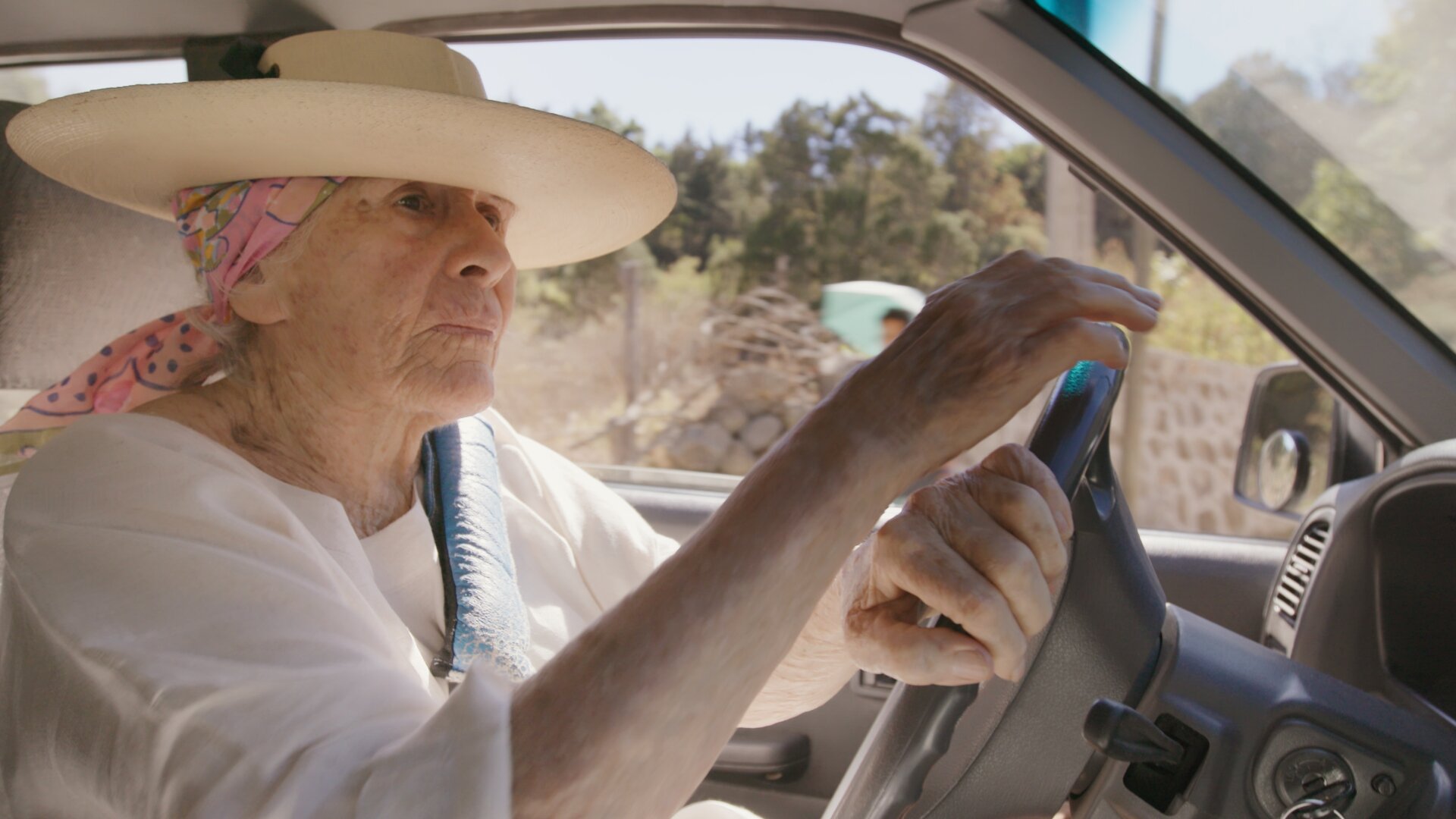
Cookbook author and sustainability activist Diana Kennedy drives her Nissan pick-up truck through the streets of her Mexican town, in a moment from the documentary “Diana Kennedy: Nothing Fancy.” (Photo courtesy of Greenwich Entertainment.)

Cookbook author and sustainability activist Diana Kennedy drives her Nissan pick-up truck through the streets of her Mexican town, in a moment from the documentary “Diana Kennedy: Nothing Fancy.” (Photo courtesy of Greenwich Entertainment.)

Review: 'Diana Kennedy: Nothing Fancy' celebrates the irascible British legend of Mexican cooking

May 21, 2020 by Sean P. Means

The fascinating question that first-time director Elizabeth Carroll asks in this fond documentary “Diana Kennedy: Nothing Fancy” is: How did an irascible Englishwoman become the world’s leading expert on Mexican cuisine, so revered by foodies that even the Mexican government has honored her?

The short answer is that she worked, and at 97 continues to work, very hard to learn the details of Mexican cooking from the ground up — and did so with respect for Mexico, the land and the people.

Carroll’s camera follows Kennedy around her house in Michoacán, so eco-friendly that the architect built around a VW-sized boulder that was on the property. Carroll then rides shotgun as Kennedy drives her Nissan pick-up — without power steering — into town, and watches her shop in the market to pick up the authentic ingredients to make proper tamales or guacamole. (Her main rule for guacamole: Don’t overmix the avocado, and leave the lumps in.)

Kennedy tells the story of how she came to live in Michoacán. She grew up in Essex, and during World War II was in the Timber Corps; she didn’t have the heart to cut the trees, so she was in charge of measuring the logs — and, to this days, she plants trees where she can. She emigrated to Canada after the war, and on a whim took a trip to Haiti in 1957

It was in Haiti that she met Paul Kennedy, a New York Times correspondent based in Mexico and covering Central America and the Caribbean. They fell in love, got married, and Diana moved to Mexico City to be with him. When he was working, or off on assignment, Diana would roam around Mexican villages and towns, learning from the local women the best recipes and how to find the proper ingredients. She also studied the cookbooks written in Mexico, notably the work of Josefina Velázquez de León.

The Kennedys also entertained diplomats and visiting New York Times colleagues. Once, she tried to get the Times’ famed food editor, Craig Claiborne, to take a Mexican cookbook. Claiborne declined, saying, “I’ll only read a Mexican cookbook once you have written one.” In 1965, the Kennedys moved briefly to New York — where Diana felt lost and alone, except for teaching cooking in her apartment. Paul was diagnosed with prostate cancer, and died in 1966. She returned to Mexico, and researched regional Mexican food for her first cookbook, “The Cuisines of Mexico,” published in 1972.

Carroll clearly admires Diana Kennedy a great deal — and part of that admiration is to capture Kennedy as she is, sometimes surly and often passionate, curious and respectful of her adopted home. This caring documentary shows us all sides of Kennedy’s life and work, and helps us understand what has driven her to make the rest of the world appreciate the many facets of Mexican food.

——

‘Diana Kennedy: Nothing Fancy’

★★★1/2

Debuts Friday, May 22, as a digital rental on various streaming platforms, including SLFS@Home. Not rated, but probably PG-13 for some language. Running time: 71 minutes.

May 21, 2020 /Sean P. Means
Comment
Artist Barbora Kysilkova, right, sketches Karl-Bertil Nordlund, who once stole two of Kysilkova’s paintngs, in a moment from "The Painter and the Thief," directed by Benjamin Ree. (Photo by Benjamin Ree, courtesy of Neon.)

Artist Barbora Kysilkova, right, sketches Karl-Bertil Nordlund, who once stole two of Kysilkova’s paintngs, in a moment from "The Painter and the Thief," directed by Benjamin Ree. (Photo by Benjamin Ree, courtesy of Neon.)

Review: An artist finds a muse, and a junkie finds a friend, in fascinating documentary 'The Painter and the Thief'

May 21, 2020 by Sean P. Means

An artist never knows the form a muse will take or where that muse will take the artist — as the documentary “The Painter and the Thief” demonstrates through its fascinating twists and turns.

The story begins with Barbora Kysilkova, a Czech-born painter living in Oslo, Norway. Known for her large naturalist paintings, she had a major exhibition at an Oslo gallery in 2015, when two men broke into the gallery and stole two large canvases off their wooden supporting frames.

One thief, Karl-Bertil Nordlund, was caught quickly, but he couldn’t remember — because of the haze of his heroin addiction — where the paintings wound up. In court, Kysilkova approached Nordlund with an odd request: She wanted him to model for her. Nordlund agreed, and the rest of director Benjamin Ree’s film follows the progression of that artist/model relationship.

Through this story, which has plot twists too outlandish for a fictional film, Ree explores the give and take between artist and subject, and the weight of responsibility for a remorseful criminal and a forgiving victim. Rees presents both sides of the story fairly equally, with Kysilkova’s story and Nordlund’s dovetailing in unexpected ways all the way to a surprising final shot.

——

‘The Painter and the Thief’

★★★1/2

Debuts Friday, May 22, as a digital rental on various streaming platforms. Not rated, but probably R for images of nudity, and for language. Running time: 102 minutes; in Norwegian, with subtitles.

——

This review appeared previously on this website, on January 23, 2020, when the movie premiered at the 2020 Sundance Film Festival.

May 21, 2020 /Sean P. Means
Comment
Kristin Scott Thomas, left, and Sharon Horgan play spouses of British servicemen who start a choir in the comedy-drama “Military Wives.” (Photo courtesy of Bleecker Street Films.)

Kristin Scott Thomas, left, and Sharon Horgan play spouses of British servicemen who start a choir in the comedy-drama “Military Wives.” (Photo courtesy of Bleecker Street Films.)

Review: British dramedy 'Military Wives' is predictably heartwarming, but the cast makes it worthwhile

May 21, 2020 by Sean P. Means

If you’ve seen “The Full Monty” or “Calendar Girls,” you know the kind of movie you’re getting with “Military Wives”: A warm-hearted story of stiff-upper-lipped Brits united by a common purpose, in a narrative that delivers exactly the emotional ride you expect, but with a cast charming enough to make you not mind the manipulation.

At the Flitcroft Garrison, the soldiers prepare for a deployment to Afghanistan, and their wives prepare to carry on while they’re gone. It falls to Lisa (Sharon Horgan), because she’s married to Red (Robbie Gee), the sergeant-major (the ranking enlisted man), to lead the organization of social events for the wives. Usually, this involves morning coffee meetings and the occasional movie night — which is usually a pretense for having a few drinks.

Kate (Kristin Scott Thomas), the wife of the garrison’s commander, Richard (Greg Wise), decides she wants to help Lisa along. Kate’s agenda is more structured, toward book clubs and knitting circles — and her pert efficiency rubs Lisa the wrong way early on.

For their differences, Kate and Lisa have something in common: Worry about their children. With Lisa, it’s her rebellious teen daughter, Frankie (India Amarteifio). With Kate, it’s the void left by her son, Jamie, a soldier killed in Afghanistan.

Kate and Lisa finally agree on one activity for the soldier’s wives: A singing club. But where Kate wants to teach vocal exercises, Lisa would rather have the women sing pop songs that they enjoy. Despite the battle of wills up front, the ladies’ choir actually starts to sound good — enough so that the visiting brigadier (Colin Mace) pulls some strings and gets the ladies a gig: A performance at the Festival of Remembrance, a Memorial Day-like concert at the Royal Albert Hall, and televised across Britain.

Director Peter Cattaneo directed “The Full Monty” many years ago, so he knows the contours of this story — inspired by the creation of real military-wives’ choirs, and whipped into a screenplay by Rosanne Flynn and Rachel Tunnard. There will be laughs, of course, as the mismatched women battle for the choir’s leadership and respect. There will be moments of tragedy and camaraderie. And there will be a rousing finish.

Yes, “Military Wives” is as formulaic as a movie can get. But the ingredients come together nicely, and Horgan (best known for playing opposite Rob Delaney on the sitcom “Catastrophe”) especially shines as the no-nonsense sergeant’s wife with a hidden rock-band streak. Nobody reinvents the wheel with “Military Wives,” but they spin it well enough to get it where it needs to go.

——

‘Military Wives’

★★★

Debuts Friday, May 22, as a digital rental on various streaming platforms. Rated PG-13 for some strong language and sexual references. Running time: 113 minutes.

May 21, 2020 /Sean P. Means
Comment
  • Newer
  • Older

Powered by Squarespace