The Movie Cricket

Movie reviews by Sean P. Means.

  • The Movie Cricket
  • Sundance 2025
  • Reviews
  • Other writing
  • Review archive
  • About
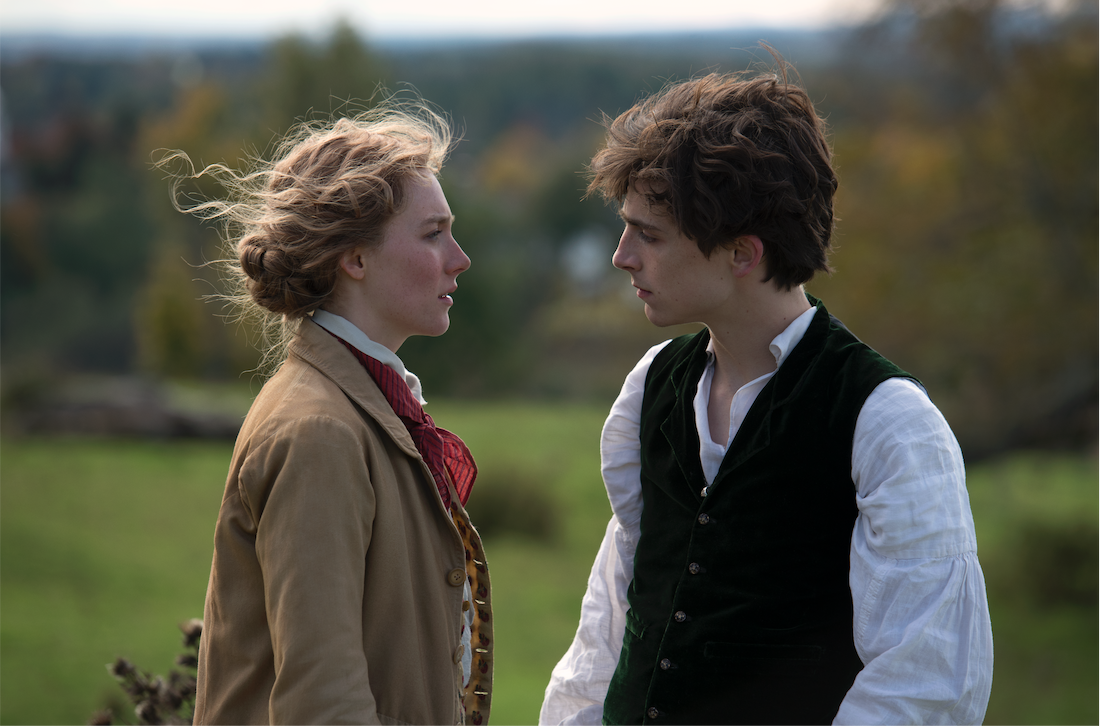
Jo (Saoirse Ronan, left) and Laurie (Timothée Chalamet) express their feelings for each other, in a scene from writer-director Greta Gerwig’s adaptation of “Little Women.” (Photo by Wilson Webb, courtesy of Columbia Pictures / Sony.)

Jo (Saoirse Ronan, left) and Laurie (Timothée Chalamet) express their feelings for each other, in a scene from writer-director Greta Gerwig’s adaptation of “Little Women.” (Photo by Wilson Webb, courtesy of Columbia Pictures / Sony.)

'Little Women'

December 19, 2019 by Sean P. Means

It’s almost always a delight when the March sisters pay a visit, and this time they have a new friend, Greta Gerwig, who seems to understand the dreams and desires of Jo, Meg, Beth and Amy better than nearly anyone.

Yes, there have been many movie adaptations of Louisa May Alcott’s classic novel “Little Women” — 1933 with Katharine Hepburn, 1949 with June Allyson and Elizabeth Taylor, the rightly acclaimed 1998 version with Winona Ryder, even a modern-day adaptation filmed in Utah and released last year. All those speak to the durability of Alcott’s story, and the enduring love for these luminous characters. 

Gerwig, as writer and director, pulls off the difficult trick of showing these characters in their time but also informing our era — both in female empowerment and the changes in storytelling conventions.

While most adaptations follow Alcott’s largely linear narrative, Gerwig jumps first into the book’s later passages, when Jo March (Saoirse Ronan) is living in New York, writing short stories for the newspaper, for a publisher (Tracy Letts) who will pay more if the stories are particularly gruesome. Jo shows her writing to Prof. Bhaer (Louis Garrel), an academic who lives in the same boarding house — but he’s unimpressed with these stories, because he doesn’t see Jo’s personality in them.

What drives Jo? That we see in flashbacks, to seven years before, and the traditional start of the story. Jo lives with her sisters — Meg (Emma Watson), the oldest; Beth (Eliza Scanlan), the kindly middle child; and bratty Amy (Florence Pugh) — and their mother, Marmee (Laura Dern), in a snowy Massachusetts town. The family is scraping by with less, with Mr. March off working as a medic with the Union troops in the Civil War.

Poverty means small sacrifices, like not having a new dress for the holiday party thrown by their well-to-do neighbors. It’s at this dance where Jo first meets Theodore Laurence (Timothée Chalemet), aka Laurie, the grandson of the rich Mr. Laurence (Chris Cooper) who lives next door. Laurie becomes fast friends with the March girls, helping Meg through her first debutante ball, flirting with the too-young-to-get-it Amy, and connecting shy Beth with his grandfather, who is cheered when Beth comes over to play on his long-dormant piano.

Gerwig slides effortlessly between the two timelines — the winter in Massachusetts, and Jo’s life in New York — with one informing the other, the memories of the distant past feeding Jo’s writing of the less-distant past. What was a bold move, altering the narrative line of a classic, becomes a natural and obvious choice, because the approach breathes new life into Alcott’s familiar high spots.

For example, Beth’s bout of scarlet fever is telegraphed a bit more, but the impact is no less devastating to the sisters and Marmee. And the resolution of Jo and Laurie’s story becomes a cliffhanger that leaves us breathless to the end.

Gerwig and her team — full marks to cinematographer Yorick Le Saux, film editor Nick Houy, production designer Jess Gonchor and composer Alexandre Desplat — soak the movie in a million little details of 19th century life, that feel both authentic and lively.

And Gerwig is blessed with a dream cast, with co-conspirator Ronan (who starred in Gerwig’s “Lady Bird”) bringing out all of Jo’s drive and coltish exuberance. Watson and Scanlan fill out their comparatively thankless roles beautifully, as does Chalamet as the lovestruck Laurie. Dern and Cooper add adult gravitas, and Meryl Streep scores some laughs as the imperious matriarch, Aunt March. But the scene-stealer is Pugh, who plays Amy at two different ages — the impulsive pre-teen and the burgeoning woman — and aces them both. (Really, after this, the wrestling comedy “Fighting With My Family” and her horror turn in “Midsommar,” just this year, is there anything Pugh can’t do?)

It’s always been assumed that Alcott was writing about her own childhood, so Gerwig nudges that idea just a bit further, incorporating some of Alcott’s story into Jo’s — while also delivering a meta-critique of storytelling expectations, then and now. Here, Gerwig pulls off her finest trick, by delivering exactly what “Little Women” needs to be in a way that’s as fresh and alive as a spring meadow.

——

‘Little Women’

★★★1/2

Opens Wednesday, December 25, in theaters everywhere. Rated PG for thematic elements and brief smoking. Running time: 134 minutes.

December 19, 2019 /Sean P. Means
Comment
Jeweler Howard Ratner (Adam Sandler, right) and his associate Demary (Lakeith Stanfield, center) try to make a deal with NBA star Kevin Garnett (playing himself), in a scene from the drama “Uncut Gems.” (Photo courtesy of A24 Films.)

Jeweler Howard Ratner (Adam Sandler, right) and his associate Demary (Lakeith Stanfield, center) try to make a deal with NBA star Kevin Garnett (playing himself), in a scene from the drama “Uncut Gems.” (Photo courtesy of A24 Films.)

'Uncut Gems'

December 19, 2019 by Sean P. Means

There’s broad agreement among critics that Adam Sandler gives the performance of his career in “Uncut Gems,” another breakneck run through the halls of New York greed by the directing-writing team of Benny and Josh Safdie.

It’s true that the Safdies channel Sandler’s rapid-fire delivery and manic desperation into the strongest character he’s ever played, and that Sandler gives back a passionate performance. That doesn’t make Sandler’s character any more likable, or his actions less repellent, or the movie any less uncomfortable to sit through.

It’s May 2012 in New York’s diamond district, and Sandler’s character, Howard Ratner, thinks he’s mere days away from the biggest score of his life. He’s procured a rare mineral, a stone embedded with uncut opals, smuggled out of an Ethiopian mine. His plan is to auction off the opal stone, make a ton of money and repay the Russian thugs and their boss, Arno (Eric Bogosian), before anybody’s thumbs get broken.

Howard’s weakness is gambling, particularly on the NBA playoffs that are underway. So things get really complicated when a business associate, Demany (Lakeith Stanfield), brings in a high-level client: Celtics center Kevin Garnett (playing himself), whose team is locked in a conference battle with the 76ers. When Garnett sees the opal stone, he thinks it’s the good-luck charm he needs, so Howard reluctantly loans it to him for a night. But the stone’s absence causes an unraveling in Howard’s plans, with bloody consequences.

Further complicating Howard’s life is that his wife, Dinah (Idina Menzel), wants a divorce — and when we see Howard maintains a downtown apartment for his mistress, Julia (Julia Fox), who works in Howard’s jewelry store, we start thinking Dinah’s got the right idea.

The Safdies excel in creating a grimy New York world and creating the characters who inhabit it. In this case, it’s the tiny super-expensive jewelry stores where the doors are double secure, like an airlock in a spaceship, and the riches are both luxurious and ridiculous (like the diamond-encrusted Furby medallions Howard tries to sell). Demany’s connections also take Howard, and us, backstage at the playoffs and into exclusive nightclubs, like the one where an up-and-coming singer called The Weeknd (playing himself) performs.

Sandler is so good as Howard, this perpetual schemer and hustler, that it’s unsettling. As the Safdies follow Howard down that rabbit hole of his lies, a viewer may squirm from the tension that’s built, even as the storyline devolves into some “Ocean’s 11” plotting that feels artificial next to the gritty world the Safdies have created through most of this dynamic, frenzied movie. 

——

‘Uncut Gems’

★★★

Opened December 13 in select cities; opening Wednesday, December 25, at the Broadway Centre Cinemas (Salt Lake City). Rated R for pervasive strong language, violence, some sexual content and brief drug use.

December 19, 2019 /Sean P. Means
Comment
Superspy Lance Sterling (left, voiced by Will Smith) adjusts to life as a pigeon, a condition caused by tech genius Walter Beckett (Tom Holland), in the animated adventure “Spies in Disguise.” (Image courtesy of 20th Century Fox.)

Superspy Lance Sterling (left, voiced by Will Smith) adjusts to life as a pigeon, a condition caused by tech genius Walter Beckett (Tom Holland), in the animated adventure “Spies in Disguise.” (Image courtesy of 20th Century Fox.)

'Spies in Disguise'

December 19, 2019 by Sean P. Means

The animated “Spies in Disguise” has one cute idea — what if an international super-spy could become a pigeon — and can’t quite find enough to do with that idea to fill a feature-length movie.

Meet Lance Sterling, a spy so cool he brings his own entrance music when he infiltrates a nest of criminals. So cool he gets an ovation when he returns to his agency’s secret headquarters under the reflecting pool by the Lincoln Memorial. So cool that he’s voiced by Will Smith.

Meet Walter Beckett. Walter is not cool. He’s an inventor working in the bowels of that same spy agency, working on non-lethal alternatives to the spies’ usual array of deadly gadgets. When he surprises Lance by putting a kitty glitter bomb in his arsenal — glitter releases endorphins that temporarily neutralize an opponent with cuteness — Walter (voiced by Tom Holland) gets fired.

When it turns out Lance’s latest mission went awry, and an Internal Affairs agent, Marcy Kappel (voiced by Rashida Jones), suspects Lance is a double agent who stole the murderous drone he was supposed to bring back to HQ. Lance needs to escape his own agency and disappear, so he suddenly needs Walter’s help. Walter’s solution is a serum that alters Lance’s DNA and turns him into a pigeon. 

Lance wants none of this, even though Walter tells him that pigeons are the perfect disguise, because they reside in every major city and no one pays attention to them. Certainly it comes in handy when Lance and Walter take Lance’s super-fancy yacht to Venice, to track down the mysterious villain (voiced by Ben Mendelsohn) who apparently has a device that project Lance’s face onto the villain’s head.

There are some good gags here, mostly from the banter between the irate Lance and the eager-to-please Walter. Directors Tony Quane and Nick Bruno, both veterans of Blue Sky Animation (working on “The Peanuts Movie” and the “Ice Age” franchise), know how to pace a movie and ramp up the animation pyrotechnics. But, ultimately, the pigeon jokes and the juxtaposition of feathers and espionage run their course, and “Spies in Disguise” becomes another unremarkable animated gag reel.

——

‘Spies in Disguise’

★★1/2

Opens Wednesday, December 25, at theaters everywhere. Rated PG for action, violence and rude humor. Running time: 101 minutes.

December 19, 2019 /Sean P. Means
Comment
Fox News Channel anchor Megyn Kelly (Charlize Theron, left) works with her assistant, Lily Balin (Liv Hewson), in a scene from the comedy-drama “Bombshell.” (Photo by Hilary Bronwyn Gayle, courtesy of Lionsgate.)

Fox News Channel anchor Megyn Kelly (Charlize Theron, left) works with her assistant, Lily Balin (Liv Hewson), in a scene from the comedy-drama “Bombshell.” (Photo by Hilary Bronwyn Gayle, courtesy of Lionsgate.)

'Bombshell'

December 19, 2019 by Sean P. Means

Director Jay Roach wants “Bombshell” to be just another workplace empowerment story, a “9 to 5” for the modern media age, where working women wrestle with the challenge of bringing down a powerful boss who’s sexually abusive.

And if this story were set in most workplaces, that would be that. But the based-on-a-true-story “Bombshell” is set in a specific workplace: The offices of the Fox News Channel. And the boss in question is Roger Ailes, the man who weaponized right-wing propaganda and injected the poison into the body politic. And the women who ended his career, anchors Gretchen Carlson and Megyn Kelly among them, were willing purveyors of that fear-mongering garbage.

“Anything that would scare your grandmother or piss off your grandfather — that’s a Fox story,” a fast-talking Fox producer, Jess Carr (Kate McKinnon) tells a newbie colleague, Kayla Pospisil (Margot Robbie). For Kayla, a conservative Christian, Fox News is her dream job, and she’s got the blonde hair and good looks to go far there. But to do so, she must please one man: Ailes, played by John Lithgow with a lot of prosthetics and padding.

Kayla is a composite character, in a movie overloaded with name actors playing equally as famous people all over Fox News. That means Kayla is our conduit to see the foul behavior Ailes, who died in 2017 and can’t sue for slander, was accused of doing to many young, ambitious newswomen over the years.

Kayla is one of three legs of the narrative stool Roach, who pulled comedy out of recent history with the political tale “Game Change,” and screenwriter Charles Randolph (“The Big Short”) build. Another is Carlson (Nicole Kidman), depicted as not being willing to put up with the sexism of her “Fox & Friends” colleagues, and fuming when Ailes demotes her to hosting a show in the mid-afternoon dead zone. And the third is Kelly (Charlize Theron), facing a torrent of hostility after challenging then-candidate Donald Trump in a Republican debate — and learning how Ailes’ loyalty has its limits.

When Ailes fires Carlson, and Carlson then sues Ailes — not the company — for sexual harassment, Ailes becomes even more paranoid and dictatorial than usual. That leaves Kayla wondering if her career will be over before it begins, and it leaves Kelly to contemplate whether to support Carlson or stick with Ales.

The crux of the drama focuses on Kelly pondering, like Hamlet, this momentous decision. Theron is a great actor, and her impersonation of Kelly’s clipped cadences is spot on, but no performer alive could make an audience belief that the woman who declared on air that Santa Claus is a white man could be troubled by her conscience.

Roach’s yuk-it-up view of history, though, is less concerned with those kind of nuances. No, broad strokes are the requirement for the actors playing familiar faces. Alanna Ubach’s take on Jeanine Pirro is brutal, as is Allison Janney’s depiction of Ailes lawyer Susan Estrich — but Richard Kind’s portrayal of Rudy Giuliani is a comedy gold mine, whether he intended it to be or not.

Some moments work, like the montage where female Fox stars frantically slip into Spanx and short skirts while telling outside reporters that Ailes doesn’t tell them what to wear on the air. But painting the women of Fox News as the vanguard of the #MeToo movement is a tough sell, one that “Bombshell’s” uneven rhythms ultimately can’t make stick.

——

‘Bombshell’

★★

Opened December 13 in select cities; opens Friday, December 20, in theaters everywhere. Rated R for sexual material and language throughout. Running time: 108 minutes.

December 19, 2019 /Sean P. Means
Comment
August Diehl, left, and Valerie Pachner play Franz and Fani, a farming couple in Austria whose lives are disrupted by war, in the drama “A Hidden Life.” (Photo courtesy of Fox Searchlight Pictures.)

August Diehl, left, and Valerie Pachner play Franz and Fani, a farming couple in Austria whose lives are disrupted by war, in the drama “A Hidden Life.” (Photo courtesy of Fox Searchlight Pictures.)

'A Hidden Life'

December 19, 2019 by Sean P. Means

In the last couple of decades, the films of director Terrence Malick have become a known quantity: An immersive, meditative experience, with the camera either capturing vast landscapes in long view or darting among people who may not acknowledge the camera or speak mostly in voice-overs.

Such experiences can be transporting, in the father-and-son tension of “The Tree of Life,” or pretentious navel-gazing, as in “Knight of Cups” and “Song to Song.” In his latest, “A Hidden Life,” a tale of a prisoner of conscience under Hitler’s rule, the slow, thoughtful tone brings out the suffering of both the main character and his devoted wife.

Based on true events, Malick’s story focuses on Franz Jägerstatter (August Diehl), a farmer in a remote, mountainous part of Austria. Franz is a man who wants nothing more than to till his fields, raise his livestock, tend to his family, and make love to his wife, Fani (Valerie Pachner). But the war comes calling, and after one stint in training, Franz awaits the day when his draft number is called up again.

When he gets the order, he reports for duty, but at the base he refused to follow one specific order: He won’t, as all Austrian soldiers are required to do, swear an oath supporting Adolf Hitler. For that, he is put in prison, where he is treated brutally by guards, and faces a trial where the punishment is likely to be his execution.

While Franz sits in prison, Fani struggles to keep the farm going, and to raise the couple’s children. Fani gets some help from her sister, Resie (Maria Simon), but she is shunned by the women of the nearby farms and village — because they think Franz a traitor.

Taking nearly three hours to tell this story, Malick and cinematographer Jörg Widmer luxuriously train our view on the rugged Austrian countryside, where it always seems ready to storm, a metaphor for the terrors of war waiting over the mountains. Malick also takes time to let us experience the Jägerstatters’ bucolic life, giving us a richer appreciation of what Franz stands to lose.

Franz’ journey brings him in contact with various officials, bewildered by his principled stand. These include his local Catholic bishop (played by the Swedish actor Michael Nyqvist, who died in 2017), a prison captain (the Belgian star Matthias Schoenaerts) and a sympathetic judge (the German actor Bruno Ganz, who died in February).

The bright line that connects everything in “A Hidden Life” is the connection between Franz and Fani, how their love and their shared belief in the righteousness of his stand support them in the worst of times. In his sometimes dreamlike technique, Malick makes that love as real as any you’ll see on screen, and gives the movie a power few can attain.

——

‘A Hidden Life’

★★★1/2

Opened December 13 in select cities; opens Friday, December 20, at the Broadway Centre Cinemas (Salt Lake City). Rated PG-13 for thematic material including violent images. Running time: 174 minutes; in English and unsubtitled German.

December 19, 2019 /Sean P. Means
Comment
Jennifer Hudson plays Grizabella, “the glamour cat,” in the movie version of “Cats.” (Photo courtesy of Universal Pictures.)

Jennifer Hudson plays Grizabella, “the glamour cat,” in the movie version of “Cats.” (Photo courtesy of Universal Pictures.)

'Cats'

December 18, 2019 by Sean P. Means

Watching the movie version of the Broadway musical “Cats,” I’m sure I had the same look on my face that I get when I watch my own two cats, Angel and Gracie, prowling around my house: A bemused bewilderment as my brain forms the question, “What the hell are they doing?”

I know Andrew Lloyd Webber’s stage musical, adapting a book of whimsical poems by T.S. Eliot, has been wildly popular ever since it debuted in London in 1981, and had a 21-year run on Broadway — a record at the time, now held by Lloyd Webber’s “The Phantom of the Opera.” What I didn’t know is what a formless blob it is, a jumble of musical numbers devoid of plot and pacing, and director Tom Hooper, who last corralled “Les Miserables” to the screen, can do nothing to change that.

Read the full review at sltrib.com.

December 18, 2019 /Sean P. Means
Comment
General Leia Organa (Carrie Fisher, right) hugs Rey (Daisy Ridley) in a scene from “Star Wars, Episode IX: The Rise of Skywalker.” (Photo courtesy of Lucasfilm Ltd. / Disney.)

General Leia Organa (Carrie Fisher, right) hugs Rey (Daisy Ridley) in a scene from “Star Wars, Episode IX: The Rise of Skywalker.” (Photo courtesy of Lucasfilm Ltd. / Disney.)

'Star Wars, Episode IX: The Rise of Skywalker'

December 18, 2019 by Sean P. Means

Where a “Star Wars” fan lands regarding “The Rise of Skywalker” — the ninth and (supposedly) final chapter of the story that began back in 1977 — will depend largely on where the fan started the journey.

Younger viewers, the ones whose memories of young Luke Skywalker battling Darth Vader and destroying the Death Star played out on the small screen, likely will be satisfied with where director J.J. Abrams brings back the narrative that he started with “The Force Awakens” in 2015. The old guard like me, who thrilled to Luke and Leia and Han decades ago in the movie theaters, may be struck with a sense of “been there, blasted that.”

Read the full review on sltrib.com.

December 18, 2019 /Sean P. Means
Comment
Pope Benedict XVI (Anthony Hopkins, left) talks with Cardinal Jorge Bergoglio (Jonathan Pryce) — the man who would become Pope Francis I — in a scene from “The Two Popes.” (Photo by Peter Mountain, courtesy of Netflix.)

Pope Benedict XVI (Anthony Hopkins, left) talks with Cardinal Jorge Bergoglio (Jonathan Pryce) — the man who would become Pope Francis I — in a scene from “The Two Popes.” (Photo by Peter Mountain, courtesy of Netflix.)

'The Two Popes'

December 11, 2019 by Sean P. Means

Director Fernando Meirelles’ “The Two Popes” is a fascinating study in contrasts — of two clerics’ theologies, of two men’s personalities, and of two actors’ approaches to their roles.

Meirelles and screenwriter Anthony McCarten — who has invented conversations for famous figures in “The Theory of Everything,” “Darkest Hour” and “Bohemian Rhapsody” — begin the story in 2005, with the conclave in the Vatican to elect a new pope after the death of John Paul II. The cardinals select Joseph Ratzinger (played by Anthony Hopkins), a stern German who was expected to maintain the Roman Catholic Church’s strict doctrines. Among those receiving votes was Jorge Bergoglio (Jonathan Pryce), the kindly and populist cardinal of Buenos Aires, Argentina.

Cut to 2012, and Bergoglio has written to Ratzinger, now Pope Benedict XVI, to ask permission to retire. Benedict summons Bergoglio to the Vatican to talk, and the conversations — fictionalized, of course — make up the bulk of McCarten’s script.

The talks are tense from the outset. Benedict accuses Bergoglio of being soft on church doctrine by, for example, ministering to LGBTQ Catholics in Argentina. Bergoglio, though he’s diplomat enough not to say it too forcefully, worries Benedict’s rigidity — and his foot-dragging on disciplining pedophile priests — is driving away the younger generations of Catholics.

The two men talk about lighter subjects, and develop a rapport. Benedict is a fan of a cheesy Italian police procedural show and likes to play piano, while Bergoglio is an avid soccer fan and knows where there’s good pizza in Rome.

As the conversations continue, Benedict drops a bombshell on Bergoglio: It’s not the Argentine who’s going to retire, but the German — the first time in centuries a pope didn’t leave the job in a casket.

Meirelles (“City of God,” “The Constant Gardener”) keeps the talking in McCarten’s script lively. Meirelles relies both on the actors’ abundant talent and some well-placed flashbacks — particularly of Bergoglio’s not-so-noble record during the Argentine military juntas.

It seems Meirelles and McCarten side more with Bergoglio — the man who would become Pope Francis I — than with Benedict. That could be chalked up to doctrinal bias, supporting the more liberal Francis over the conservative Benedict. But I also think back to an interview I heard once with Lawrence O’Donnell, the MSNBC commentator, about his days writing for “The West Wing,” and how they had to make Josiah Bartlett a Democrat because a government saying “yes” to new initiatives made better drama than a government that said “no” to everything.

What’s most compelling about “The Two Popes” is how Hopkins and Pryce approach their roles. Pryce aims to subsume himself into Bergoglio, mimicking the Argentine’s voice and mannerisms, and even speaking Spanish as much as English. Hopkins, the old theater dog, always sounds like Hopkins, with no attempt at a German accent. 

Even taking different paths, both actors eventually arrive where they and the story need to be — a meeting of minds between two smart, headstrong men with different views on where their church needs to go. Those parallel roads make “The Two Popes” a worthwhile pilgrimage for the viewer.

———

‘The Two Popes’

★★★1/2

Opened November 27 in select cities; opens Friday, December 13, at the Tower Theatre (Salt Lake City); begins streaming on Netflix on December 20. Rated PG-13 for thematic content and some disturbing violent images. Running time: 125 minutes; in English, and in Spanish and Latin and other languages with subtitles.

December 11, 2019 /Sean P. Means
Comment
  • Newer
  • Older

Powered by Squarespace