The Movie Cricket

Movie reviews by Sean P. Means.

  • The Movie Cricket
  • Sundance 2026
  • Reviews
  • Other writing
  • Review archive
  • About
August Diehl, left, and Valerie Pachner play Franz and Fani, a farming couple in Austria whose lives are disrupted by war, in the drama “A Hidden Life.” (Photo courtesy of Fox Searchlight Pictures.)

August Diehl, left, and Valerie Pachner play Franz and Fani, a farming couple in Austria whose lives are disrupted by war, in the drama “A Hidden Life.” (Photo courtesy of Fox Searchlight Pictures.)

'A Hidden Life'

December 19, 2019 by Sean P. Means

In the last couple of decades, the films of director Terrence Malick have become a known quantity: An immersive, meditative experience, with the camera either capturing vast landscapes in long view or darting among people who may not acknowledge the camera or speak mostly in voice-overs.

Such experiences can be transporting, in the father-and-son tension of “The Tree of Life,” or pretentious navel-gazing, as in “Knight of Cups” and “Song to Song.” In his latest, “A Hidden Life,” a tale of a prisoner of conscience under Hitler’s rule, the slow, thoughtful tone brings out the suffering of both the main character and his devoted wife.

Based on true events, Malick’s story focuses on Franz Jägerstatter (August Diehl), a farmer in a remote, mountainous part of Austria. Franz is a man who wants nothing more than to till his fields, raise his livestock, tend to his family, and make love to his wife, Fani (Valerie Pachner). But the war comes calling, and after one stint in training, Franz awaits the day when his draft number is called up again.

When he gets the order, he reports for duty, but at the base he refused to follow one specific order: He won’t, as all Austrian soldiers are required to do, swear an oath supporting Adolf Hitler. For that, he is put in prison, where he is treated brutally by guards, and faces a trial where the punishment is likely to be his execution.

While Franz sits in prison, Fani struggles to keep the farm going, and to raise the couple’s children. Fani gets some help from her sister, Resie (Maria Simon), but she is shunned by the women of the nearby farms and village — because they think Franz a traitor.

Taking nearly three hours to tell this story, Malick and cinematographer Jörg Widmer luxuriously train our view on the rugged Austrian countryside, where it always seems ready to storm, a metaphor for the terrors of war waiting over the mountains. Malick also takes time to let us experience the Jägerstatters’ bucolic life, giving us a richer appreciation of what Franz stands to lose.

Franz’ journey brings him in contact with various officials, bewildered by his principled stand. These include his local Catholic bishop (played by the Swedish actor Michael Nyqvist, who died in 2017), a prison captain (the Belgian star Matthias Schoenaerts) and a sympathetic judge (the German actor Bruno Ganz, who died in February).

The bright line that connects everything in “A Hidden Life” is the connection between Franz and Fani, how their love and their shared belief in the righteousness of his stand support them in the worst of times. In his sometimes dreamlike technique, Malick makes that love as real as any you’ll see on screen, and gives the movie a power few can attain.

——

‘A Hidden Life’

★★★1/2

Opened December 13 in select cities; opens Friday, December 20, at the Broadway Centre Cinemas (Salt Lake City). Rated PG-13 for thematic material including violent images. Running time: 174 minutes; in English and unsubtitled German.

December 19, 2019 /Sean P. Means
Comment
Jennifer Hudson plays Grizabella, “the glamour cat,” in the movie version of “Cats.” (Photo courtesy of Universal Pictures.)

Jennifer Hudson plays Grizabella, “the glamour cat,” in the movie version of “Cats.” (Photo courtesy of Universal Pictures.)

'Cats'

December 18, 2019 by Sean P. Means

Watching the movie version of the Broadway musical “Cats,” I’m sure I had the same look on my face that I get when I watch my own two cats, Angel and Gracie, prowling around my house: A bemused bewilderment as my brain forms the question, “What the hell are they doing?”

I know Andrew Lloyd Webber’s stage musical, adapting a book of whimsical poems by T.S. Eliot, has been wildly popular ever since it debuted in London in 1981, and had a 21-year run on Broadway — a record at the time, now held by Lloyd Webber’s “The Phantom of the Opera.” What I didn’t know is what a formless blob it is, a jumble of musical numbers devoid of plot and pacing, and director Tom Hooper, who last corralled “Les Miserables” to the screen, can do nothing to change that.

Read the full review at sltrib.com.

December 18, 2019 /Sean P. Means
Comment
General Leia Organa (Carrie Fisher, right) hugs Rey (Daisy Ridley) in a scene from “Star Wars, Episode IX: The Rise of Skywalker.” (Photo courtesy of Lucasfilm Ltd. / Disney.)

General Leia Organa (Carrie Fisher, right) hugs Rey (Daisy Ridley) in a scene from “Star Wars, Episode IX: The Rise of Skywalker.” (Photo courtesy of Lucasfilm Ltd. / Disney.)

'Star Wars, Episode IX: The Rise of Skywalker'

December 18, 2019 by Sean P. Means

Where a “Star Wars” fan lands regarding “The Rise of Skywalker” — the ninth and (supposedly) final chapter of the story that began back in 1977 — will depend largely on where the fan started the journey.

Younger viewers, the ones whose memories of young Luke Skywalker battling Darth Vader and destroying the Death Star played out on the small screen, likely will be satisfied with where director J.J. Abrams brings back the narrative that he started with “The Force Awakens” in 2015. The old guard like me, who thrilled to Luke and Leia and Han decades ago in the movie theaters, may be struck with a sense of “been there, blasted that.”

Read the full review on sltrib.com.

December 18, 2019 /Sean P. Means
Comment
Pope Benedict XVI (Anthony Hopkins, left) talks with Cardinal Jorge Bergoglio (Jonathan Pryce) — the man who would become Pope Francis I — in a scene from “The Two Popes.” (Photo by Peter Mountain, courtesy of Netflix.)

Pope Benedict XVI (Anthony Hopkins, left) talks with Cardinal Jorge Bergoglio (Jonathan Pryce) — the man who would become Pope Francis I — in a scene from “The Two Popes.” (Photo by Peter Mountain, courtesy of Netflix.)

'The Two Popes'

December 11, 2019 by Sean P. Means

Director Fernando Meirelles’ “The Two Popes” is a fascinating study in contrasts — of two clerics’ theologies, of two men’s personalities, and of two actors’ approaches to their roles.

Meirelles and screenwriter Anthony McCarten — who has invented conversations for famous figures in “The Theory of Everything,” “Darkest Hour” and “Bohemian Rhapsody” — begin the story in 2005, with the conclave in the Vatican to elect a new pope after the death of John Paul II. The cardinals select Joseph Ratzinger (played by Anthony Hopkins), a stern German who was expected to maintain the Roman Catholic Church’s strict doctrines. Among those receiving votes was Jorge Bergoglio (Jonathan Pryce), the kindly and populist cardinal of Buenos Aires, Argentina.

Cut to 2012, and Bergoglio has written to Ratzinger, now Pope Benedict XVI, to ask permission to retire. Benedict summons Bergoglio to the Vatican to talk, and the conversations — fictionalized, of course — make up the bulk of McCarten’s script.

The talks are tense from the outset. Benedict accuses Bergoglio of being soft on church doctrine by, for example, ministering to LGBTQ Catholics in Argentina. Bergoglio, though he’s diplomat enough not to say it too forcefully, worries Benedict’s rigidity — and his foot-dragging on disciplining pedophile priests — is driving away the younger generations of Catholics.

The two men talk about lighter subjects, and develop a rapport. Benedict is a fan of a cheesy Italian police procedural show and likes to play piano, while Bergoglio is an avid soccer fan and knows where there’s good pizza in Rome.

As the conversations continue, Benedict drops a bombshell on Bergoglio: It’s not the Argentine who’s going to retire, but the German — the first time in centuries a pope didn’t leave the job in a casket.

Meirelles (“City of God,” “The Constant Gardener”) keeps the talking in McCarten’s script lively. Meirelles relies both on the actors’ abundant talent and some well-placed flashbacks — particularly of Bergoglio’s not-so-noble record during the Argentine military juntas.

It seems Meirelles and McCarten side more with Bergoglio — the man who would become Pope Francis I — than with Benedict. That could be chalked up to doctrinal bias, supporting the more liberal Francis over the conservative Benedict. But I also think back to an interview I heard once with Lawrence O’Donnell, the MSNBC commentator, about his days writing for “The West Wing,” and how they had to make Josiah Bartlett a Democrat because a government saying “yes” to new initiatives made better drama than a government that said “no” to everything.

What’s most compelling about “The Two Popes” is how Hopkins and Pryce approach their roles. Pryce aims to subsume himself into Bergoglio, mimicking the Argentine’s voice and mannerisms, and even speaking Spanish as much as English. Hopkins, the old theater dog, always sounds like Hopkins, with no attempt at a German accent. 

Even taking different paths, both actors eventually arrive where they and the story need to be — a meeting of minds between two smart, headstrong men with different views on where their church needs to go. Those parallel roads make “The Two Popes” a worthwhile pilgrimage for the viewer.

———

‘The Two Popes’

★★★1/2

Opened November 27 in select cities; opens Friday, December 13, at the Tower Theatre (Salt Lake City); begins streaming on Netflix on December 20. Rated PG-13 for thematic content and some disturbing violent images. Running time: 125 minutes; in English, and in Spanish and Latin and other languages with subtitles.

December 11, 2019 /Sean P. Means
Comment
Hero-turned-suspect Richard Jewell, center (played by Paul Walter Hauser), faces the media circus in “Richard Jewell,” directed by Clint Eastwood. (Photo by Claire Folger, courtesy of Warner Bros. Pictures.)

Hero-turned-suspect Richard Jewell, center (played by Paul Walter Hauser), faces the media circus in “Richard Jewell,” directed by Clint Eastwood. (Photo by Claire Folger, courtesy of Warner Bros. Pictures.)

'Richard Jewell'

December 11, 2019 by Sean P. Means

Director Clint Eastwood’s legal drama “Richard Jewell” is, we’ve been told in countless ads for the movie, about the truth — specifically, the truth about the Atlanta security guard wrongly accused of planting a bomb during the 1996 Summer Olympics.

But with Eastwood and screenwriter Billy Ray, truth appears to be a zero-sum game — because to tell the “truth” about Jewell, these filmmakers smeared the reputation of a dead woman.

Eastwood and Ray do set forth some of the facts in a quick, straight-forward way. They start by showing Jewell (played by Paul Walter Hauser) as a shlub in a government office, delivering office supplies and talking about his goal of working in law enforcement. It’s in this office where he meets a lawyer, Watson Bryant (Sam Rockwell), who gives him the nickname “Radar” (after Gary Burghoff’s eager-to-please character on “M*A*S*H”).

We then see Jewell working as a security guard at a small Georgia college, until his overbearing police-wannabe behavior gets him fired by the dean (Charles Green). Eventually, Jewell, who lives with his momma (Kathy Bates), bounces back and gets a job working security at the Olympics, specifically in Centennial Park, where crowds gather to celebrate winners and enjoy nightly concerts.

One night, Jewell finds a suspicious package under a park bench, and alerts the cops around him. They find some very big pipe bombs, and Jewell helps the cops push the crowd back before it blows — killing two and injuring 111 people. All agree it would have been worse if not for Jewell’s fast action, and he soon becomes a hero and media sensation.

That good feeling is short-lived, when the FBI office in Atlanta starts investigating — and a profiler suggests Jewell, as a wannabe cop seeking attention, might have planted the bomb himself. That thin thread is then leaked by an FBI agent (Jon Hamm) to an Atlanta Journal-Constitution reporter (Olivia Wilde).

And here’s the moment where Eastwood and Ray do their damage to the reputation of Kathy Scruggs, the real-life reporter who broke the story that the FBI was investigating Jewell as the bomber. As a recent AJC article reports, Scruggs got that scoop because she was a dogged reporter who worked with sources at every level of law enforcement in Atlanta. As the movie tells it, Scruggs got that scoop by screwing the FBI guy. (This happens off-camera, to the disappointment of anyone hoping to see Hamm and Wilde, among our most attractive movie stars, in a bedroom scene together.)

The trope of a female journalist using sex to get a story is an ugly cliche that pops up whenever a filmmaker wants to make the press into a villain. It’s a lie, and Eastwood should apologize for it. Ray should be particularly ashamed — after all, he wrote and directed the 2003 drama “Shattered Glass,” based on the story of the reporter for The New Republic who fabricated articles.

A more interesting story would show Scruggs doing everything a journalist is supposed to do — it’s not a lie that the FBI was investigating Jewell immediately after the bombing — and still the wrong guy gets accused. It also would have been more interesting to show Scruggs, who died in 2001, guilt-ridden by what doing her job did to another human. Both of those things, as the AJC reported, would also have had the benefit of being true. (It’s also true that the guy who did plant the bomb, Eric Rudolph, was a right-wing zealot also bombed a lesbian bar and two abortion clinics — but the rigidly Republican Eastwood omits those facts from his narrative.)

Wilde has taken some criticism for taking this role, especially considering she grew up among journalists — but I only blame her about 10 percent for how Scruggs is portrayed. Wilde, in an interview, said she’s being held to a double standard that her co-star, Hamm, has not faced. True, though Hamm’s character is a fictional composite character, probably because live FBI agents can sue and a dead reporter cannot.

The stick-figure villainy of Hamm and Wilde’s characters, as conceived by Eastwood and Ray, is enough to make a viewer distrust the rest of the movie. That’s unfortunate, because Hauser (who played the knee-breaking accomplice in “I, Tonya”) gives a strong, sympathetic performance as Jewell, finding the self-deprecation of a man constantly undervalued because of his girth. Hauser is nicely matched by Rockwell, whose character reappears as the lawyer Jewell needs to fend off the Feds and the media circus.

In the end, “Richard Jewell” doesn’t even do Jewell any favors. If there’s one thing we take away about Jewell, who died in 2007, is that he believed in being fair and honest. One can only wonder what he would have thought of what Eastwood and Ray have done to Kathy Scruggs’ good name.

——

’Richard Jewell’

★★

Opens Friday, December 13, in theaters everywhere. Rated R for language including some sexual references, and brief bloody images. Running time: 130 minutes.

December 11, 2019 /Sean P. Means
Comment
Some of the playable characters in “Jumanji: The Next Level,” played by, from left, Jack Black, Karen Gillan, Awkwafina and Dwayne Johnson. (Photo courtesy of Columbia Pictures / Sony.)

Some of the playable characters in “Jumanji: The Next Level,” played by, from left, Jack Black, Karen Gillan, Awkwafina and Dwayne Johnson. (Photo courtesy of Columbia Pictures / Sony.)

'Jumanji: The Next Level'

December 10, 2019 by Sean P. Means

Hacking through the jungle of overloaded action in “Jumanji: The Next Level,” a sequel to the 2017 action movie about teens trapped in a video game, a viewer has lots of time to think about the lost opportunities the movie passes up.

This haphazardly structured movie, which throws random events up on the screen in no particular order, has some elements that are entertaining. Finding those nuggets takes a lot of sifting through the dirt, though.

Read the full review at sltrib.com.

December 10, 2019 /Sean P. Means
Comment
Tyler (Kelvin Harrison Jr., left) works out with his domineering father (Sterling K. Brown), in a moment from the family drama “Waves.” (Photo courtesy of A24.)

Tyler (Kelvin Harrison Jr., left) works out with his domineering father (Sterling K. Brown), in a moment from the family drama “Waves.” (Photo courtesy of A24.)

'Waves'

December 04, 2019 by Sean P. Means

The tragedy at the heart of filmmaker Trey Edward Shults’ drama “Waves” divides a family, and splits a movie in two — and bringing both together is a perilous journey.

At 18, Tyler Williams (Kelvin Harrison Jr.) would seem to have it made. Growing up in a prosperous family in suburban Miami, Tyler is a star high school wrestler and diligent student, someone being groomed for college and beyond.

But there are cracks in the perfect surface. A nagging shoulder injury is endangering his athletic scholarship, and prompting Tyler to try opioids. His girlfriend, Alexis (Alexa Demie), reports that her period is late. And Tyler is being constantly pushed by his domineering father, Ronald (Sterling K. Brown).

The first half of the film details Tyler’s unraveling, which ends tragically. Then the movie pivots to Tyler’s younger sister, Emily (Taylor Russell), who must live in the aftermath of Tyler’s reputation. She eats lunch alone most days, and can’t communicate with her mother, Catharine (Renée Elise Goldsberry), who has become distant from Ronald.

But Emily may find redemption, when she meets Luke (Lucas Hedges), a nice guy who isn’t phased by Emily’s family issues. Turns out Luke has family issues of his own, specifically a father who’s dying in far-off Missouri.

Shults — following up his 2015 debut “Krisha” and the 2017 horror thriller “It Comes at Night” — applies a lot of artifice to the Williams children’s paired stories, like a new generation of Terence Malick’s infuriatingly elliptical storytelling. (One recurring move is placing a camera in the middle of a car’s cabin, then rapidly spinning it to show us where everyone is in the car.) The showing-off is more noticeable in the first half, but maybe that’s because tragic spirals get Shults’ creative energies flowing more than freely than redemption tales.

In a talented ensemble, young Russell (“Escape Room”) is the standout, playing all of Emily’s complicated emotions — grief, survivor’s guilt, helplessness over his brother’s fate, and a determination to make her own life more meaningful. Russell does that with limited screen time, and with an honesty that raises the film’s second half to the lofty heights its self-absorbed beginning can’t reach.

——

‘Waves’

★★★

Opened November 15 in select cities; opens Friday, December 6, at the Broadway Centre Cinemas (Salt Lake City) and Megaplex Jordan Commons (Sandy). Rated R for language throughout, drug and alcohol use, some sexual content and brief violence - all involving teens. Running time: 135 minutes.

December 04, 2019 /Sean P. Means
Comment
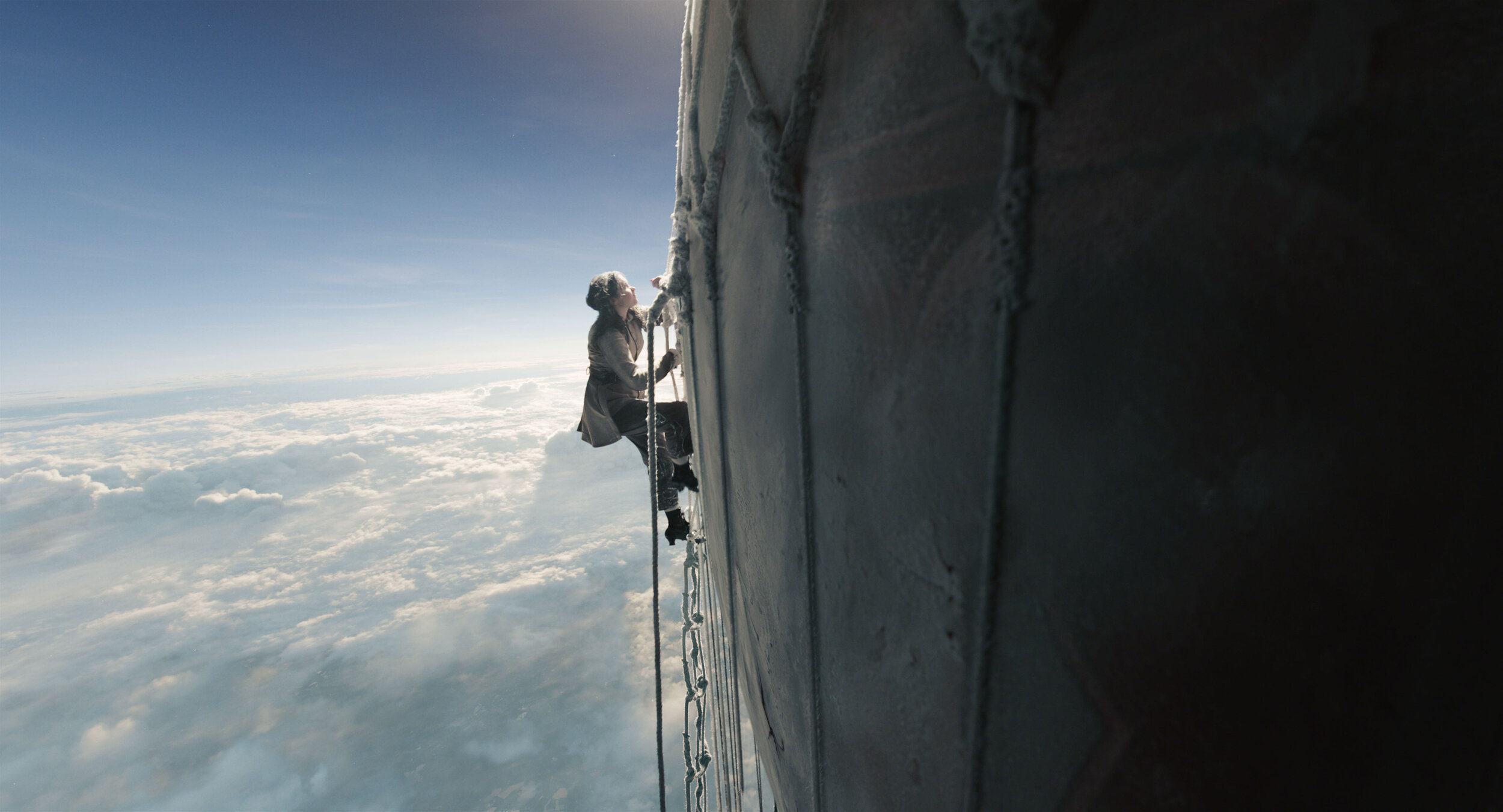
Felicity Jones plays a balloonist on a mission, in the adventure drama “The Aeronauts.” (Image courtesy of Amazon Studios.)

Felicity Jones plays a balloonist on a mission, in the adventure drama “The Aeronauts.” (Image courtesy of Amazon Studios.)

'The Aeronauts'

December 04, 2019 by Sean P. Means

An odd but mostly satisfying mix of gee-whiz adventure and wrenching drama is the fuel for “The Aeronauts,” a story of science and discovery that stays afloat more steadily than you might guess.

It’s 1862, and aspiring scientist James Glaisher (Eddie Redmayne) is determined to prove his theories about meteorology, that he can find patterns in the weather and use them to predict what weather we will get. To do this, he must go airborne, and his only option is daredevil balloonist Amelia Wren (Felicity Jones), who’s more about show business than science.

The script, by Jack Thorne (who shares story credit with director Tom Harper), paints in broad strokes how mismatched these two characters are. Glaisher disdains Wren’s theatrics, like parachuting her dog down to the cheering crowd, but she knows it’s what pays the bills. Meanwhile, Wren thinks Glaisher is too buried in his measurements and readings to appreciate the glory of flying above everyone and everything on Earth.

The trip is presented practically in real time — the flight almost precisely matches the movie’s running time — though the thrills and spills of the balloon trip are augmented with flashbacks. There, we learn how Glaisher is fighting the entrenched scientific forces, who equate predicting the weather to fortune telling. We also see that Wren is more nervous than she lets on, because of a balloon accident involving her husband, Pierre (Vincent Perez).

Harper — who’s having a good year, between this and the country-music drama “Wild Rose” — deftly juggles the backstory with the ongoing airborne adventure. He also reunites the stars of “The Theory of Everything,” though this time giving Jones the juicier role, one that she leaps into with a rebel’s heart. The narrative ride of “The Aeronauts” is bumpy at times, but Jones is a confident pilot who handles the story’s emotional turbulence with ease.

——

‘The Aeronauts’

★★★

Opens Friday, December 6, at the Broadway Centre Cinemas (Salt Lake City), Megaplex Valley Fair (West Valley City), Megaplex Jordan Commons (Sandy).and Megaplex at The District (South Jordan); begins streaming on Amazon Prime on December 20. Rated PG-13 for some peril and thematic elements. Running time: 100. minutes.

December 04, 2019 /Sean P. Means
Comment
  • Newer
  • Older

Powered by Squarespace