The Movie Cricket

Movie reviews by Sean P. Means.

  • The Movie Cricket
  • Sundance 2026
  • Reviews
  • Other writing
  • Review archive
  • About
Queen Elsa (voiced by Idina Menzel) makes a new friend, in a moment from Disney’s “Frozen II.” (Image courtesy of Disney.)

Queen Elsa (voiced by Idina Menzel) makes a new friend, in a moment from Disney’s “Frozen II.” (Image courtesy of Disney.)

'Frozen II'

November 15, 2019 by Sean P. Means

Disney’s animated “Frozen II” is wetter and wilder than its predecessor, showing that sometimes the elements can come together to make magic twice.

Co-directors Jennifer Lee (who again writes the screenplay) and Chris Buck gather most of the voice cast from the first “Frozen” — including Idina Menzel as the snow-powered Elsa and Kristen Bell as her non-magical sister Anna, along with Josh Gad as the snowman Olaf and Jonathan Groff as hunky reindeer herder Kristoff. More importantly, they bring back husband-and-wife songwriters Robert Lopez and Kristen Anderson-Lopez, who made “Let It Go” the Oscar-winning earworm that even Elsa is a bit embarrassed about now.

Read the full review at sltrib.com.

November 15, 2019 /Sean P. Means
Comment
Christian Bale plays race car driver Ken Miles, preparing for the 24 Hours of LeMans, in the drama “Ford v. Ferrari.” (Photo courtesy of 20th Century Fox.)

Christian Bale plays race car driver Ken Miles, preparing for the 24 Hours of LeMans, in the drama “Ford v. Ferrari.” (Photo courtesy of 20th Century Fox.)

'Ford vs. Ferrari'

November 14, 2019 by Sean P. Means

If movies were automobiles, “Ford vs. Ferrari” would be an old-fashioned muscle car, a big piece of Detroit steel, gleaming on the surface but with plenty of horsepower where it counts.

The title suggests one kind of conflict, between two automakers. And, yes, director James Mangold shows us that battle in the 1960s, as the Ford Motor Company and its CEO, Henry Ford II (Tracy Letts), seeks to overcome slumping sales by coming up with something new. That idea, brought in by a younger executive, Lee Iacocca (Jon Bernthal), is to put Ford’s money behind a race car, to challenge the legendary Ferrari at the 24 Hours of LeMans.

But the real battle at the heart of this story is waged by two men, auto designer Carroll Shelby (Matt Damon) and race driver Ken Miles (Christian Bale). Ford, at Iacocca’s suggestion, hires Shelby to lead the effort to develop a car that can beat the grandmaster, Enzo Ferrari (Remo Girone). Shelby hires Miles, a great driver but also a temperamental one, and they soon are in the throes of building a great race car from the ground up.

But Shelby and Miles soon realize they’re not just fighting the clock or gravity. They’re also fighting the entrenched corporate culture of Ford, often in the person of the image-obsessed marketing boss Leo Beebe (Josh Lucas). Beebe is more concerned with what Miles might say into a hot microphone than whether he can win a race — and Shelby finds he has to claw back at Ford’s straitlaced attitude to get a car in shape for LeMans.

It’s a man’s world in “Ford vs. Ferrari,” but one woman does stand out. That’s Caitrione Balfe (“Outlander”) as Mollie, Ken’s wife, who’s supportive of her husband’s racing dream but not blind to the dangers he faces behind the wheel.

Damon captures Shelby’s Texas swagger, and a tight-lipped determination to get his car on the track no matter what. It’s not as splashy a role as Bale’s Miles, but it’s a dead heat which actor does more to keep the story flowing.

Mangold and his writers (Jez Butterworth, his brother John-Simon Butterworth, and Jason Keller) capture the cool, retro feel of the 1960s nicely. They also manage to capture that special swagger of Detroit’s car culture, and the executives who have faith that their product to overcome the tumult of the Vietnam War, the Kennedy assassination, and the whole upheaval of the ‘60s.

Mangold’s command of the camera and editing bay are seen in the movie’s frenetic final half hour, a nail-biter depiction of the 24 Hours of LeMans. It’s a perfect half-hour at the movies — something as elusive as the “perfect lap” Miles seeks — and a capper on a biographical drama that has both speed and gentle handling.

——

‘Ford vs. Ferrari’

★★★1/2

Opens Friday, November 15, in theaters everywhere. Rated PG-13 for some language and peril. Running time: 152 minutes.

November 14, 2019 /Sean P. Means
Comment
Secret agents Sabina Wilson (Kristen Stewart, left) and Jane Cano (Elsa Balinska, center) are assigned to protect a tech expert, Elena Houghlin (Naomi Scott), from getting killed, in the rebooted “Charlie’s Angels.” (Photo by Chiabella James, courte…

Secret agents Sabina Wilson (Kristen Stewart, left) and Jane Cano (Elsa Balinska, center) are assigned to protect a tech expert, Elena Houghlin (Naomi Scott), from getting killed, in the rebooted “Charlie’s Angels.” (Photo by Chiabella James, courtesy of Columbia Pictures / Sony.)

'Charlie's Angels'

November 14, 2019 by Sean P. Means

Brimming with excitement, solid comedy and good feeling, writer-director Elizabeth Banks’ “Charlie’s Angels” is the action movie you didn’t know you needed.

Yes, it’s a reboot of Aaron Spelling’s famously titilating ‘70s detective series, which made Farrah Fawcett-Majors, Jaclyn Smith and Kate Jackson household names. And, yes, we went down this road in the early aughts, with Drew Barrymore, Cameron Diaz and Lucy Liu.

The fact that Banks shamelessly references both incarnations of the franchise — and, in an instant, makes them canon — is just the first sign that she’s got the chops to make this thing fly.

“I think women can do anything,” says Sabina Wilson (Kristen Stewart), in the movie’s first line of dialogue. In context, she says it seductively to draw out a sexist embezzler (Chris Pang), and to distract his guards so her colleague, Jane Kano (Elsa Balinska), can knock them out cold. But it also serves as a mantra for the cast and for Banks.

The Townsend Agency, the boutique detective firm from TV days, has gone international, performing secret missions for a select clientele. Sabina and Jane are two of the Angels. Their fixers are all called Bosley, and when the original Bosley (Patrick Stewart) retires, a younger Bosley (played by Banks) guides them through a new case.

The client is Elena Houghlin (Naomi Scott), a tech genius on a team that has just developed a groundbreaking renewable energy source. Elena has discovered that the device could be weaponized, emitting an electromagnetic pulse that could silently dismantle a person’s nervous system. The problem for Elena is that other people have also figured this out, and will go to lethal lengths to stop Elena from telling the company’s visionary CEO, Alexander Brock (Sam Claflin).

It’s up to Sabina, Jane and Bosley to protect Elena, and find the devices before they fall into the wrong hands. This leads to globe-hopping from Hamburg to Brazil to Istanbul, with Elena (and, by extension, us) learning about the Townsend Agency’s inner workings along the way. Needless to say, it beats your job, hands down.

Banks, directing only her second movie (she debuted well with “Pitch Perfect 2”), strikes the perfect balance of comedy, action and glitz, as the movie runs the Angels through their paces. Stewart’s reputation as a dour, serious actress gets happily demolished here; she hasn’t been this playful, or funny, even in her turns hosting “Saturday Night Live.” Scott, last seen as Jasmine in the “Aladdin” remake, makes the wide-eyed Elena a happy participant in the danger. And Balinska, who at 5-foot-10 towers over her co-stars, has a deadpan comedic delivery that punctuates the movie’s sneakily smart humor.

This “Charlie’s Angels” is more energetic, and more fun, than an action franchise as familiar as this one has the right to be. Let’s get this franchise rolling with another installment, and pronto.

——

‘Charlie’s Angels’

★★★1/2

Opens Friday, November 15, in theaters everywhere. Rated PG-13 for action/violence, language and some suggestive content. Running time: 118 minutes.

November 14, 2019 /Sean P. Means
Comment
Adam Driver plays Daniel J. Jones, a congressional staffer tasked with compiling the details of the CIA’s detention and interrogation program during the Iraq War, in the drama “The Report.” (Photo courtesy of Amazon Studios.)

Adam Driver plays Daniel J. Jones, a congressional staffer tasked with compiling the details of the CIA’s detention and interrogation program during the Iraq War, in the drama “The Report.” (Photo courtesy of Amazon Studios.)

'The Report'

November 14, 2019 by Sean P. Means

While the news channels are riveted by one kind of presidential scandal, writer-director Scott Z. Burns’ procedural drama “The Report” takes us back to the good old days when presidents did things like authorize torture of detainees under the guise of fighting terrorism.

The story begins in 2009, when Sen. Dianne Feinstein (Annette Bening), the ranking Democrat on the Senate Intelligence Committee, reads in The New York Times that CIA agents destroyed videotapes of waterboarding procedures. “I want to know what’s on those tapes,” Feinstein tells one of her staffers, Daniel J. Jones (Adam Driver), and tells him to start digging into it. Soon, Jones is told to expand his investigation to a broader look at the CIA’s detention and interrogation practices.

Jones is given a room in the CIA’s headquarters in Langley, Va., with a separate computer server and as much access to documents as the CIA will allow. When he first enters the room, he notices there’s no printer or paper. “Paper has a way of getting people in trouble at our place,” his CIA minder tells him. Jones replies, “At our place, paper’s how we keep track of laws.”

Burns, who wrote Steven Soderbergh’s sprawling but concise global outbreak thriller “Contagion,” feeds the audience a lot of information, and makes it quick, understandable and devastating. 

Burns details how, after 9/11 and the panic that ensued, a pair of contract psychologists, James Mitchell (Douglas Hodge) and Bruce Jessen (T. Ryder Smith), sold the CIA on a scientifically shoddy program of humiliation and physical duress to try to break down detainees’ reticence to talk. The program, which included waterboarding, sleep deprivation, and putting detainees in stress positions, was given the bureaucratically banal name of “enhanced interrogation techniques” or EIT.

What Jones discovered was that EIT was more likely to produce bad information than good, and tainted any chance of trying detainees in American courts. A prime example of EIT done to ridiculous amounts was the supposed terrorism mastermind Khaled Sheikh Muhammed, who was waterboarded 183 times. As Feinstein asks Jones, “If it’s so effective, why do they have to do it 183 times?”

Compiling the information for the report — which ultimately grew to 6,700 pages — was one part of the battle. The other was getting it, or even an executive summary of the report, released to the public.

Burns assembles an impressive ensemble cast to tell the story of this investigation. Besides Bening’s rock-solid Feinstein, the cast includes Maura Tierney as a CIA official overseeing the EIT program, Tim Blake Nelson as a CIA whistleblower, Ted Levine as incoming CIA director John Brennan, and Jon Hamm as an Obama administration official who tries to minimize the damage the report’s release could cause.

At the center, standing like a very tall beacon of truth, is Driver, who calmly digs through the documents, analyzes what they mean, confronts moral quandaries on all sides, and tamps down his righteous fury when he discovers how badly the CIA behaved. Driver gives Jones — who is a real person, not a composite character created by Burns for narrative expediency — the indignation that any of us should feel at learning how much abhorrent, damaging and illegal behavior was done in the name of the American people.

——

‘The Report’

★★★1/2

Opens Friday, November 15, at select theaters, including Broadway Centre Cinemas (Salt Lake City), Megaplex Jordan Commons (Sandy) and Megaplex at The District (South Jordan). Rated R for some scenes of inhumane treatment and torture, and for language. Running time: 119 minutes.

November 14, 2019 /Sean P. Means
Comment
Dr. Amani Ballor, center, and Dr. Alaa, right, treat a patient in an underground hospital in war-torn Syria, in the documentary “The Cave.” (Photo courtesy of National Geographic Films.)

Dr. Amani Ballor, center, and Dr. Alaa, right, treat a patient in an underground hospital in war-torn Syria, in the documentary “The Cave.” (Photo courtesy of National Geographic Films.)

'The Cave'

November 14, 2019 by Sean P. Means

A documentary about the plight of people in Syria, battered by the constant barrage of Assad’s regime and their Russian allies, is nobody’s idea of fun. But if you need a real story about resilience and hope in such bad times, “The Cave” demands a viewer’s attention.

Director Feras Fayyad knows this territory well. The Syrian native won top honors at the 2017 Sundance Film Festival, an Emmy, and an Academy Award nomination for his documentary “Last Men in Aleppo.” He missed the Oscar ceremony, though, because his visa was rejected as part of President Trump’s travel ban on several mostly Muslim countries.

In “The Cave,” Fayyad goes to Al-Ghouta, a city on the east side of Damascus that regularly is bombarded by Syrian and Russian warplanes. Deep in the city is an underground hospital, where the wounded are brought to be treated and given shelter in a network of tunnels that honeycomb the city.

At the center of the action is Amani Ballor, a doctor who manages the hospital. In the United States, she might be still considered a medical student, but in Syria, she’s one of the few doctors still there.

Besides dealing with the steady stream of wounded patients, a great many of them children, Dr. Amani must contend with the fear of warplanes overhead, the regular shortages of supplies, and the callous sexism of men who think women shouldn’t manage hospitals but stay at home and clean house.

Still, there are small moments of joy and hope. She has a solid working relationship with Dr. Salim, the hospital’s surgeon, who fills the operating room with classical music playing on his iPhone. And she shares smiles with the head nurse, who is also responsible for cooking vast amounts of rice to keep the hospital staff going.

Those moments are fleeting, though, and the horrors of Syria’s war — a war Trump recently withdrew from, leaving people like Dr. Amani to the tender mercies of Bashar al-Assad and Vladimir Putin — grind on. “The Cave” is a stark reminder that leaders wage war, but people on the ground pay the price.

——

‘The Cave’

★★★1/2

Opened  in select cities; opens Friday, November 15, at the Broadway Centre Cinemas (Salt Lake City). Rated PG-13 for disturbing war-related thematic content and images. Running time: 95 minutes; in English, and Arabic with subtitles.

November 14, 2019 /Sean P. Means
Comment
Lakshmibai (Devika Bhise), the Rani of Jhansi, leads an uprising against the British in the 1850s, in the battle epic “The Warrior Queen of Jhansi.” (Photo by Nick Wall, courtesy of Roadside Attractions.)

Lakshmibai (Devika Bhise), the Rani of Jhansi, leads an uprising against the British in the 1850s, in the battle epic “The Warrior Queen of Jhansi.” (Photo by Nick Wall, courtesy of Roadside Attractions.)

'The Warrior Queen of Jhansi'

November 14, 2019 by Sean P. Means

The battle epic “The Warrior Queen of Jhansi,” one of the few movies made in India to make the leap to mainstream American screens, is an audacious debut for director Swati Bhise, even if the results aren’t always up to snuff.

Lakshmibai, the Rani of Jhansi, was queen of a northern India district in the mid-1800s. It was a time when the British East India Company had subjugated millions of Indians to increase their profit margins, using the British army as their enforcers and a stream of nonsense about “civilizing” the Hindus and Muslims living there.

When the Rani (played by American-born actress Devika Bhise, the director’s daughter) fails to provide her husband, the king (Ajinkya Deo), a male heir, they adopt a nephew. But the British East India Company rejects this substitution, and annexes the kingdom, another violation of the treaty between the two countries. Rani decides to fight, leading what was the largest rebellion against the British until the Mahatma Gandhi led an independence movement nearly a century later.

The story focuses much time on Queen Victoria (Jodhi May), back in London, telling her prime minster, Lord Palmerston (Derek Jacobi), to avoid a massacre. Even more time is in the tent of the British army’s commander in Jhansi, Sir Hugh Rose (Rupert Everett), enduring the impatient taunting of the British East India Company’s representative, Sir Robert Hamilton (Nathaniel Parker). Much of Hamilton’s ire is aimed at a junior officer, Maj. Robert Ellis (Ben Lamb), who knows Jhansi well — and has an unrequited crush on the Rani.

Swati Bhise, a former dancer and choreographer, is a one-woman film crew — she’s director, producer, co-screenwriter (alongside her daughter and Olivia Emden), and designed the Rani’s ornate costumes — and she puts a lot of passion into the Rani’s rousing speeches and the “Braveheart”-like battle scenes. Unfortunately, that zeal can’t overcome rookie lapses in pacing and editing, or the low budget and sometimes slapdash story structure.

She does give her talented daughter, Devika, a great showcase. The younger Bhise (who starred opposite Dev Patel in “The Man Who Knew Infinity”) gives Lakshmibai the gravity and passion to make those stirring rally-the-troops moments sing. She’s a warrior queen who will reign again in more movies.

——

‘The Warrior Queen of Jhansi’

★★1/2

Opens Friday, November 15 in select theaters, including Megaplex Gateway (Salt Lake City) and Megaplex Jordan Commons (Sandy). Rated R for some violence. Running time: 102 minutes; in English and in Hindi with subtitles.

November 14, 2019 /Sean P. Means
Comment
Fungi expert Paul Stamets holds a massive Agarikon, in a moment from the documentary “Fantastic Fungi.” (Photo courtesy of Moving Art Studio.)

Fungi expert Paul Stamets holds a massive Agarikon, in a moment from the documentary “Fantastic Fungi.” (Photo courtesy of Moving Art Studio.)

'Fantastic Fungi'

November 14, 2019 by Sean P. Means

Don’t worry, folks, because the offbeat and visually arresting documentary “Fantastic Fungi” knows the answer to one of life’s biggest questions: What happens when we die?

What happens — spoiler alert! — is that we become food for molds, yeasts, mushrooms and other types of fungi. They break us, and any plants and animals, down into nutrients that go into the ground and feed other plants, which feed other animals. And that’s how the circle of life rolls on and on.

If that doesn’t sound beautiful, you haven’t reckoned with the amazing time-lapse photography director Louie Schwartzberg and his team has shot and collected here. Mushrooms pop up jauntily, mold overtakes a strawberry, tendrils of mycelium create networks between trees, and so on. It’s really quite amazing.

Then the humans talk, and we learn how many different ways fungi can benefit us. Some, like mushrooms and mycologically grown meat substitutes, can nourish us. Some can eat oil spills. Some molds, like penicillin, fight off diseases. Others, like some forms of psychedelic mushrooms, could be used to treat depression and help terminally ill patients prepare for a peaceful death.

Schwartzberg lets us get to know some people who have devoted their lives to studying fungi. Most interesting is Paul Stamets, who began as an amateur biologist and has developed a fungi-based business and delivers impassioned TED talks about the subject.

“Fantastic Fungi” gets a little apocalyptic at times, particularly when narrator Brie Larson speaks, Lorax-like, for the fungi. The message is essentially that fungi were here before we humans started walking upright — and it’s up to humans whether we want to be part of the solution of cleaning up this planet we have messed up, or be one more pile of carbon-based material for the fungi to mop up when we’re dead. The fungi don’t really care either way.

——

‘Fantastic Fungi’

★★★

Opened October 11 in select cities; opens Friday, November 15, at the Tower Theatre (Salt Lake City). Not rated, but probably PG-13 for discussions of drug use. Running time: 81 minutes.

November 14, 2019 /Sean P. Means
Comment
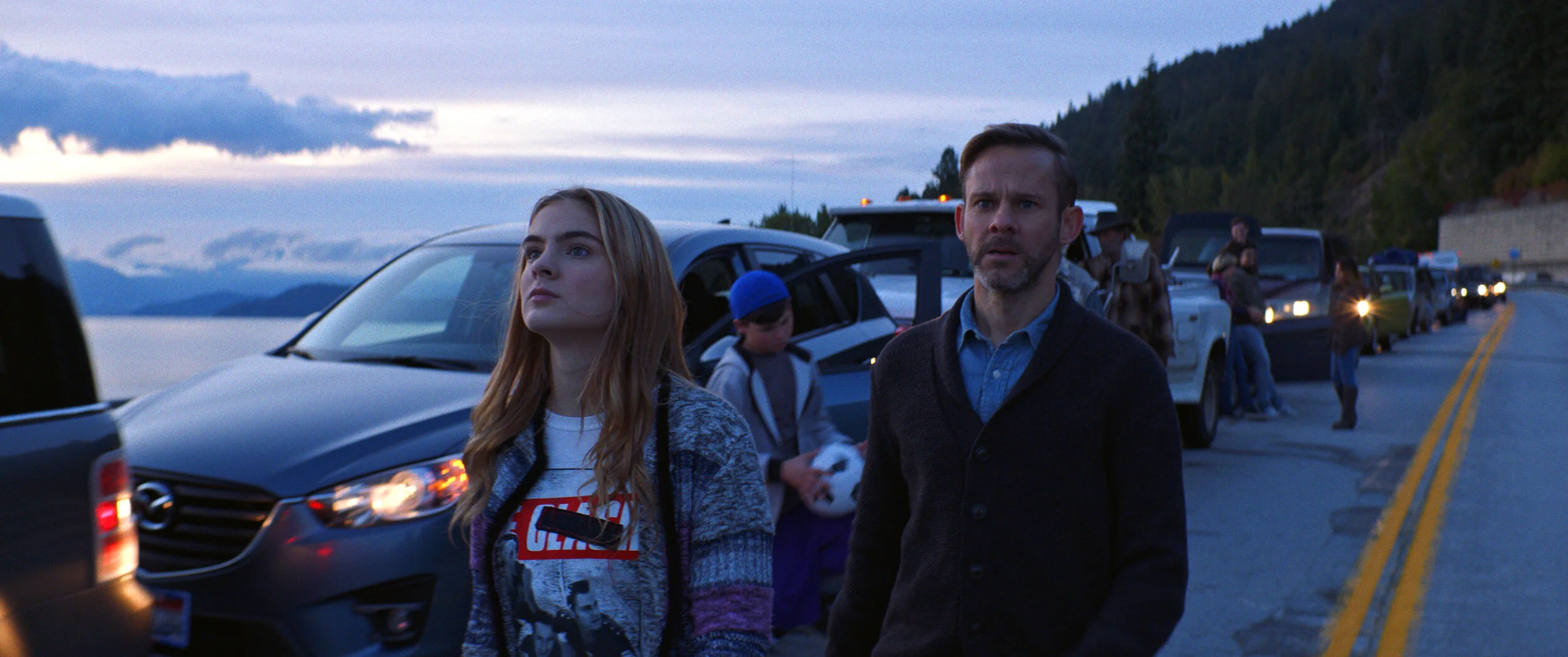
An electromagnetic pulse wipes out the power grid, and leaves teen Reese (Brighton Sharbino, left) and her father, Chris (Dominic Monaghan) stuck trying to get out of town, in the thriller “Radioflash.” (Photo courtesy of IFC Midnight.)

An electromagnetic pulse wipes out the power grid, and leaves teen Reese (Brighton Sharbino, left) and her father, Chris (Dominic Monaghan) stuck trying to get out of town, in the thriller “Radioflash.” (Photo courtesy of IFC Midnight.)

'Radioflash'

November 14, 2019 by Sean P. Means

The apocalyptic thriller “Radioflash” is a road movie that meanders an exasperatingly long time before figuring out where it’s going — and, by then, a viewer has ceased to care.

Reese (Brighton Sharbino) is a teen who applies her considerable brainpower to solving complex puzzles in virtual reality. Writer-director Ben McPherson begins with Reese engaged in such a problem, in a room with dial telephones covering the walls and water rapidly rising. This makes for a visually striking image, and has dog-all to do with the rest of the movie.

One day, an electromagnetic pulse — or radioflash — zaps across the western United States, leaving everything that was plugged in, including the electrical grid, completely inoperative. Reese’s cellphone and tablet still work, but there’s no internet with which they can connect. Her dad (Dominic Monaghan, from “Lost”) thinks they can ride things out until all returns to normal, but Reese sees her neighbors’ mounting anxiety and believes they need to escape the city. (The city in this case is Spokane, Wash., and the movie was filmed there and parts of Idaho and Montana.)

Hooking a car battery to the ham radio in the shed, Reese makes contact with her survivalist grandfather (Will Patton), who says he has a safe haven if he and her dad can get there. That turns out to be not so simple for this Little Red Riding Hood, because there are wolves of all kinds between her and Grandpa’s house.

Reese’s perils on the road would make for a tight little thriller, but getting her to the point where she’s using her problem-solving skills to save herself takes an infuriating amount of time. The pacing feels sluggish in some places, and jumpy in others, which doesn’t give Sharbino’s Reese an honest chance to earn her action-hero conclusion.

——

‘Radioflash’

★★

Opens Friday, November 15, in area theaters. Not rated, but probably PG-13 for violence and language. Running time: 95 minutes.

November 14, 2019 /Sean P. Means
Comment
  • Newer
  • Older

Powered by Squarespace