The Movie Cricket

Movie reviews by Sean P. Means.

  • The Movie Cricket
  • Sundance 2025
  • Reviews
  • Other writing
  • Review archive
  • About
Dr. Amani Ballor, center, and Dr. Alaa, right, treat a patient in an underground hospital in war-torn Syria, in the documentary “The Cave.” (Photo courtesy of National Geographic Films.)

Dr. Amani Ballor, center, and Dr. Alaa, right, treat a patient in an underground hospital in war-torn Syria, in the documentary “The Cave.” (Photo courtesy of National Geographic Films.)

'The Cave'

November 14, 2019 by Sean P. Means

A documentary about the plight of people in Syria, battered by the constant barrage of Assad’s regime and their Russian allies, is nobody’s idea of fun. But if you need a real story about resilience and hope in such bad times, “The Cave” demands a viewer’s attention.

Director Feras Fayyad knows this territory well. The Syrian native won top honors at the 2017 Sundance Film Festival, an Emmy, and an Academy Award nomination for his documentary “Last Men in Aleppo.” He missed the Oscar ceremony, though, because his visa was rejected as part of President Trump’s travel ban on several mostly Muslim countries.

In “The Cave,” Fayyad goes to Al-Ghouta, a city on the east side of Damascus that regularly is bombarded by Syrian and Russian warplanes. Deep in the city is an underground hospital, where the wounded are brought to be treated and given shelter in a network of tunnels that honeycomb the city.

At the center of the action is Amani Ballor, a doctor who manages the hospital. In the United States, she might be still considered a medical student, but in Syria, she’s one of the few doctors still there.

Besides dealing with the steady stream of wounded patients, a great many of them children, Dr. Amani must contend with the fear of warplanes overhead, the regular shortages of supplies, and the callous sexism of men who think women shouldn’t manage hospitals but stay at home and clean house.

Still, there are small moments of joy and hope. She has a solid working relationship with Dr. Salim, the hospital’s surgeon, who fills the operating room with classical music playing on his iPhone. And she shares smiles with the head nurse, who is also responsible for cooking vast amounts of rice to keep the hospital staff going.

Those moments are fleeting, though, and the horrors of Syria’s war — a war Trump recently withdrew from, leaving people like Dr. Amani to the tender mercies of Bashar al-Assad and Vladimir Putin — grind on. “The Cave” is a stark reminder that leaders wage war, but people on the ground pay the price.

——

‘The Cave’

★★★1/2

Opened  in select cities; opens Friday, November 15, at the Broadway Centre Cinemas (Salt Lake City). Rated PG-13 for disturbing war-related thematic content and images. Running time: 95 minutes; in English, and Arabic with subtitles.

November 14, 2019 /Sean P. Means
Comment
Lakshmibai (Devika Bhise), the Rani of Jhansi, leads an uprising against the British in the 1850s, in the battle epic “The Warrior Queen of Jhansi.” (Photo by Nick Wall, courtesy of Roadside Attractions.)

Lakshmibai (Devika Bhise), the Rani of Jhansi, leads an uprising against the British in the 1850s, in the battle epic “The Warrior Queen of Jhansi.” (Photo by Nick Wall, courtesy of Roadside Attractions.)

'The Warrior Queen of Jhansi'

November 14, 2019 by Sean P. Means

The battle epic “The Warrior Queen of Jhansi,” one of the few movies made in India to make the leap to mainstream American screens, is an audacious debut for director Swati Bhise, even if the results aren’t always up to snuff.

Lakshmibai, the Rani of Jhansi, was queen of a northern India district in the mid-1800s. It was a time when the British East India Company had subjugated millions of Indians to increase their profit margins, using the British army as their enforcers and a stream of nonsense about “civilizing” the Hindus and Muslims living there.

When the Rani (played by American-born actress Devika Bhise, the director’s daughter) fails to provide her husband, the king (Ajinkya Deo), a male heir, they adopt a nephew. But the British East India Company rejects this substitution, and annexes the kingdom, another violation of the treaty between the two countries. Rani decides to fight, leading what was the largest rebellion against the British until the Mahatma Gandhi led an independence movement nearly a century later.

The story focuses much time on Queen Victoria (Jodhi May), back in London, telling her prime minster, Lord Palmerston (Derek Jacobi), to avoid a massacre. Even more time is in the tent of the British army’s commander in Jhansi, Sir Hugh Rose (Rupert Everett), enduring the impatient taunting of the British East India Company’s representative, Sir Robert Hamilton (Nathaniel Parker). Much of Hamilton’s ire is aimed at a junior officer, Maj. Robert Ellis (Ben Lamb), who knows Jhansi well — and has an unrequited crush on the Rani.

Swati Bhise, a former dancer and choreographer, is a one-woman film crew — she’s director, producer, co-screenwriter (alongside her daughter and Olivia Emden), and designed the Rani’s ornate costumes — and she puts a lot of passion into the Rani’s rousing speeches and the “Braveheart”-like battle scenes. Unfortunately, that zeal can’t overcome rookie lapses in pacing and editing, or the low budget and sometimes slapdash story structure.

She does give her talented daughter, Devika, a great showcase. The younger Bhise (who starred opposite Dev Patel in “The Man Who Knew Infinity”) gives Lakshmibai the gravity and passion to make those stirring rally-the-troops moments sing. She’s a warrior queen who will reign again in more movies.

——

‘The Warrior Queen of Jhansi’

★★1/2

Opens Friday, November 15 in select theaters, including Megaplex Gateway (Salt Lake City) and Megaplex Jordan Commons (Sandy). Rated R for some violence. Running time: 102 minutes; in English and in Hindi with subtitles.

November 14, 2019 /Sean P. Means
Comment
Fungi expert Paul Stamets holds a massive Agarikon, in a moment from the documentary “Fantastic Fungi.” (Photo courtesy of Moving Art Studio.)

Fungi expert Paul Stamets holds a massive Agarikon, in a moment from the documentary “Fantastic Fungi.” (Photo courtesy of Moving Art Studio.)

'Fantastic Fungi'

November 14, 2019 by Sean P. Means

Don’t worry, folks, because the offbeat and visually arresting documentary “Fantastic Fungi” knows the answer to one of life’s biggest questions: What happens when we die?

What happens — spoiler alert! — is that we become food for molds, yeasts, mushrooms and other types of fungi. They break us, and any plants and animals, down into nutrients that go into the ground and feed other plants, which feed other animals. And that’s how the circle of life rolls on and on.

If that doesn’t sound beautiful, you haven’t reckoned with the amazing time-lapse photography director Louie Schwartzberg and his team has shot and collected here. Mushrooms pop up jauntily, mold overtakes a strawberry, tendrils of mycelium create networks between trees, and so on. It’s really quite amazing.

Then the humans talk, and we learn how many different ways fungi can benefit us. Some, like mushrooms and mycologically grown meat substitutes, can nourish us. Some can eat oil spills. Some molds, like penicillin, fight off diseases. Others, like some forms of psychedelic mushrooms, could be used to treat depression and help terminally ill patients prepare for a peaceful death.

Schwartzberg lets us get to know some people who have devoted their lives to studying fungi. Most interesting is Paul Stamets, who began as an amateur biologist and has developed a fungi-based business and delivers impassioned TED talks about the subject.

“Fantastic Fungi” gets a little apocalyptic at times, particularly when narrator Brie Larson speaks, Lorax-like, for the fungi. The message is essentially that fungi were here before we humans started walking upright — and it’s up to humans whether we want to be part of the solution of cleaning up this planet we have messed up, or be one more pile of carbon-based material for the fungi to mop up when we’re dead. The fungi don’t really care either way.

——

‘Fantastic Fungi’

★★★

Opened October 11 in select cities; opens Friday, November 15, at the Tower Theatre (Salt Lake City). Not rated, but probably PG-13 for discussions of drug use. Running time: 81 minutes.

November 14, 2019 /Sean P. Means
Comment
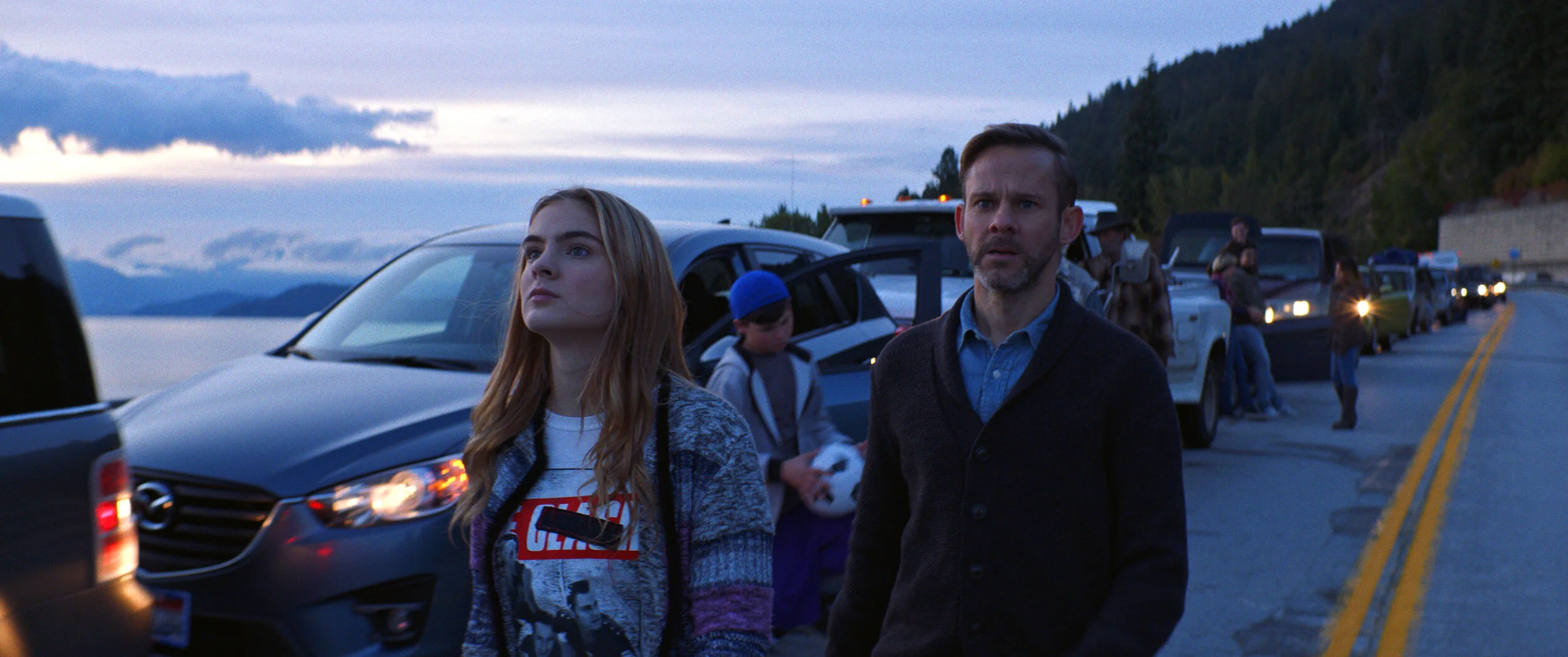
An electromagnetic pulse wipes out the power grid, and leaves teen Reese (Brighton Sharbino, left) and her father, Chris (Dominic Monaghan) stuck trying to get out of town, in the thriller “Radioflash.” (Photo courtesy of IFC Midnight.)

An electromagnetic pulse wipes out the power grid, and leaves teen Reese (Brighton Sharbino, left) and her father, Chris (Dominic Monaghan) stuck trying to get out of town, in the thriller “Radioflash.” (Photo courtesy of IFC Midnight.)

'Radioflash'

November 14, 2019 by Sean P. Means

The apocalyptic thriller “Radioflash” is a road movie that meanders an exasperatingly long time before figuring out where it’s going — and, by then, a viewer has ceased to care.

Reese (Brighton Sharbino) is a teen who applies her considerable brainpower to solving complex puzzles in virtual reality. Writer-director Ben McPherson begins with Reese engaged in such a problem, in a room with dial telephones covering the walls and water rapidly rising. This makes for a visually striking image, and has dog-all to do with the rest of the movie.

One day, an electromagnetic pulse — or radioflash — zaps across the western United States, leaving everything that was plugged in, including the electrical grid, completely inoperative. Reese’s cellphone and tablet still work, but there’s no internet with which they can connect. Her dad (Dominic Monaghan, from “Lost”) thinks they can ride things out until all returns to normal, but Reese sees her neighbors’ mounting anxiety and believes they need to escape the city. (The city in this case is Spokane, Wash., and the movie was filmed there and parts of Idaho and Montana.)

Hooking a car battery to the ham radio in the shed, Reese makes contact with her survivalist grandfather (Will Patton), who says he has a safe haven if he and her dad can get there. That turns out to be not so simple for this Little Red Riding Hood, because there are wolves of all kinds between her and Grandpa’s house.

Reese’s perils on the road would make for a tight little thriller, but getting her to the point where she’s using her problem-solving skills to save herself takes an infuriating amount of time. The pacing feels sluggish in some places, and jumpy in others, which doesn’t give Sharbino’s Reese an honest chance to earn her action-hero conclusion.

——

‘Radioflash’

★★

Opens Friday, November 15, in area theaters. Not rated, but probably PG-13 for violence and language. Running time: 95 minutes.

November 14, 2019 /Sean P. Means
Comment
Danny Torrance (Ewan McGregor) finds himself back at the Overlook Hotel, in the horror-thriller “Doctor Sleep,” a sequel to “The Shining.” (Photo by Jessica Miglio, courtesy of Warner Bros. Pictures.)

Danny Torrance (Ewan McGregor) finds himself back at the Overlook Hotel, in the horror-thriller “Doctor Sleep,” a sequel to “The Shining.” (Photo by Jessica Miglio, courtesy of Warner Bros. Pictures.)

'Doctor Sleep'

November 07, 2019 by Sean P. Means

In the horror thriller “Doctor Sleep,” director-screenwriter-editor Mike Flanagan gives Stephen King what he’s always wanted: A new hold on the fate of Danny Torrance, the little boy at the heart of his classic “The Shining.”

Whether that’s good for the rest of us, or for the memory of Stanley Kubrick’s 1980 adaptation of “The Shining” — hated by King and his loyalists, but beloved and obsessed over by an army of fans — is a split decision.

Flanagan, who was responsible for the amazing and creepy Netflix series “The Haunting of Hill House,” starts with imagery from Kubrick’s classic. In the prologue, it’s 1980, Danny (played as a youth by Roger Dale Floyd) and his mom, Wendy (Alex Essoe, done up to look a bit like Shelly Duvall), are living in Florida, far from the snows of the Overlook Hotel. Sometimes, though, Danny still sees Dick Hallorann (Carl Lumbly, doing a muted version of Scatman Crothers from the original), a ghost who teaches him how to use his “shining” powers.

The plot of “Doctor Sleep” kicks in when Flanagan introduces the True Knot, a caravan of travelers who seek out and consume the gifts of kids with “the shining.” Their leader is Rose the Hat, an ageless and powerful beauty played by Rebecca Ferguson (from the last couple “Mission: Impossible” movies).

Flash forward to this decade, and Danny — played as an adult by Ewan McGregor — is using alcohol to mute his “shining” abilities. Ultimately, he ends up in a small town in New Hampshire, and meets friendly guy, Billy Freeman (Cliff Curtis). Billy sees something in Danny, so he gets him an apartment, and gets him into an AA meeting. Sober, Danny gets a job as an orderly at a hospice, where he finds himself easing terminally ill residents to a peaceful death.

But Danny, thanks to his “shining” power, detects Abra Stone (Kyliegh Curran), a 13-year-old girl who has the same gifts a thousand-fold. Abra finds Danny, but their powers attract Rose’s attention — and soon the caravan is headed toward New Hampshire to hunt.

Through this middle section, Flanagan establishes a tight pace and a darkly brooding atmosphere. Taken on its own, this part of the film would stand up as a smart little horror thriller, and we’d all go home having enjoyed some satisfying scares.

But those bookends, when Flanagan tries to re-create the oppressive mood of Kubrick’s classic, become a problem. They stand as reminders of that earlier film, and make Flanagan’s effective work look tame and small in comparison. (Something similar happened with Peter Hyams’ 1984 movie “2010,” a perfectly serviceable outer-space thriller that fell apart because the beginning and end tried to redo Kubrick’s “2001: A Space Odyssey.”)

Flanagan tries to serve two masters in “Doctor Sleep,” to make a movie that’s both a worthy successor to Kubrick’s “The Shining” and a faithful adaptation of King’s books. But those two things are so much in opposition — King famously hates Kubrick’s version, and wrote a 1997 remake for TV — that Flanagan can’t square them. He’s like a host who invites both halves of a divorced couple to a party, and for all his efforts can’t make both of them happy.

——

‘Doctor Sleep’

★★1/2

Opens Friday, November 8, in theaters everywhere. Rated R for disturbing and violent content, some bloody images, language, nudity and drug use. Running time: 152 minutes.

November 07, 2019 /Sean P. Means
Comment
Antonio Banderas plays Salvador Mallo, a film director beset with back pain, migraines and nostalgia, in Pedro Almodóvar’s drama “Pain & Glory.” (Photo courtesy of Sony Pictures Classics.)

Antonio Banderas plays Salvador Mallo, a film director beset with back pain, migraines and nostalgia, in Pedro Almodóvar’s drama “Pain & Glory.” (Photo courtesy of Sony Pictures Classics.)

'Pain & Glory'

November 07, 2019 by Sean P. Means

Federico Felliini once said “all art is autobiographical,” and certainly the Spanish director Pedro Almodóvar hasn’t shied from strip-mining his life for material, in such films as “All About My Mother” and “Volver,” among others.

Almodóvar’s latest, “Pain & Glory,” feels on the surface to be even more overtly autobiographical — though with the director’s puckish nature, who’s to say that this story of an aging movie director isn’t pure fiction?

Like Fellini’s classic “8 1/2,” this movie is about a movie director, Salvador Mallo (Antonio Banderas). Mallo has decided to retire from directing, mostly because of his chronic back pain, migraines and other ailments that leave him in various sorts of pain. When his illnesses work in concert to give him several pains at once, he says in his narration, he believes in God — but when only one pain is afflicting him, in that moment, he’s an atheist.

When he’s in pain, or on his pain medication, he often flashes back to his childhood — mostly to memories of his loving mother (played by Penélope Cruz). The flashbacks grow more frequent after a reunion with Alberto (Asier Etxeandia), the tempestuous star of Salvador’s career-making movie 32 years ago, when the actor gets Salvador interested in smoking heroin.

Almodóvar, who wrote and directed, takes Salvador down some other excursions down memory lane — while his loyal assistant Mercedes (Nora Navas) tries to keep him on track and seeing his doctor.

The movie is a showcase for Banderas, who gets to play so many emotions — agony, desire, love, hate, anger and ecstasy — and makes them each authentic. It’s a subtle performance, but all the more powerful in the way Banderas’ charming exterior gives way to everything Salvador is keeping inside.

“Pain & Glory” could be read as Almodóvar’s thesis on the intersection of love and art, and how a director like Salvador may sacrifice the things he cares about — like his mother’s feelings or his old friendships — for the sake of creating his art. No matter how close this story is to Almodóvar’s own truth, he makes this story feel real, which maybe is all that matters.

——

‘Pain & Glory’

★★★1/2

Opened October 4 in select cities; opens Friday, November 8, at the Broadway Centre Cinemas (Salt Lake City). Rated R for drug use, some graphic nudity and language Running time: 113 minutes; in Spanish with subtitles.

November 07, 2019 /Sean P. Means
Comment
Kate (Emilia Clarke, left) and Tom (Henry Golding) have a holiday romance brewing in “Last Christmas.” (Photo by Jonathan Prime, courtesy of Universal Pictures.)

Kate (Emilia Clarke, left) and Tom (Henry Golding) have a holiday romance brewing in “Last Christmas.” (Photo by Jonathan Prime, courtesy of Universal Pictures.)

'Last Christmas'

November 07, 2019 by Sean P. Means

If there ever was a movie that was utterly ruined by its own marketing, it’s “Last Christmas,” a warm and winsome holiday romantic comedy that works best if you don’t know too much about it.

Since I’m not in Universal’s marketing department, I can deploy some restraint in synopsizing the movie. It centers on Kate, played by Emlia Clarke, a Croatia native who moved to London as a kid with her parents (Emma Thompson, who co-wrote the screenplay, and Boris Isakovic) and her sister, Marta (Lydia Leonard). 

Now, in 2017, Kate is 26 and something of a train wreck, alienating her friends by couch surfing to avoid living with her parents, getting drunk at night, and having disastrous auditions that do not help her nonexistent singing career. She works as a clerk and assistant elf at a Covent Garden shop that sells Christmas stuff all year long, and barely hangs on thanks to her indulgent boss, a Chinese woman who goes by the name Santa (played by Michelle Yeoh).

One evening, Kate meets Tom — played by Yeoh’s “Crazy Rich Asians” son, Henry Golding — who takes an instant shine to her. Kate is more jaded, but slowly she warms up to his perpetually sunny disposition.

This being a romantic comedy — and, what’s worse, a Christmas rom-com — there are complications in the script, by Thompson and rookie writer Bryony Kimmings (with story credit going to Thompson and her husband, Greg Wise). There’s a big one that would be a “Crying Game”-level shocker, if half the internet hadn’t deduced what it was when they saw the trailer a couple months ago.

But forget about that, if you can, and revel in how director Paul Feig (“Bridesmaids,” “Spy,” “Ghostbusters”) and the writers fill out the story with so many whimsical details — from the postcard-perfect London scenery to the playful use of George Michael songs throughout the soundtrack, including the title tune.

Mostly, the delights of “Last Christmas” are in the cast. Thompson, in heavy Slavic accent, brings some acid wit to Kate’s old-country mum. Leonard is appropriately brittle as Kate’s often-ignored sister. And Yeoh steals her scenes, bringing a comic goofiness to offset her polished screen persona.

And the leads are everything a romantic would want. Golding’s Tom is impossibly handsome and charming, and his effusive optimism is infectious. He’s nicely matched by Clarke, who displays a wealth of comedic skills that didn’t get much play in her last job, as the genocidal Mother of Dragons on “Game of Thrones.” Clarke’s bright smile and willingness to play the fool or the jerk will serve her well, in what could be a promising career as England’s next rom-com icon.

——

‘Last Christmas’

★★★

Opens Friday, November 8, in theaters everywhere. Rated PG-13 for language and sexual content. Running time: 102 minutes.

November 07, 2019 /Sean P. Means
Comment
Sound designer Walter Murch, working on the mix for the 1979 film “Apocalypse Now,” one of the movies discussed in the documentary “Making Waves: The Art of Cinematic Sound.” (Photo courtesy of Ain’t Heard Nothin’ Yet.)

Sound designer Walter Murch, working on the mix for the 1979 film “Apocalypse Now,” one of the movies discussed in the documentary “Making Waves: The Art of Cinematic Sound.” (Photo courtesy of Ain’t Heard Nothin’ Yet.)

'Making Waves: The Art of Cinematic Sound'

November 07, 2019 by Sean P. Means

For 92 years, since “The Jazz Singer,” movies have been talkies — and the documentary “Making Waves: The Art of Cinematic Sound” is a fond look at the art of melding sound to image and the pioneers who have changed how it’s done.

Even before we’re born, the legendary sound editor Walter Murch says to start the movie, “sound is the first sense that gets plugged in.” It’s a good reminder when talking about movies, because our focus on the visual aspect of filmmaking — the cinematography, the action, the faces — often shortchanges the other half of the equation: What we hear in a movie.

“The Jazz Singer” was a sensation when it debuted in 1927, but the advent of sound also took cinematic art back a step — because studios had to build cavernous sound stages so they could eliminate ambient sound. But soon, sight and sound worked hand in glove, with pioneers like Murray Spivack (“King Kong”) showing what could be done. Another hero mentioned is Barbra Streisand, who as producer of the 1976 “A Star Is Born” insisted on recording in stereo and urging theaters to install stereo speaker systems.

Director Midge Costin focuses largely on three greats in movie sound design. One is Murch, who met up with a guy named Francis Ford Coppola and worked on “The Godfather” and “Apocalypse Now,” the latter introducing six-track surround stereo. Next is Ben Burtt, who collaborated with George Lucas to make the many creatures and robots of “Star Wars” sound realistic. The third is Gary Rydstrom, who took sound-effects collection into the digital age, working on Pixar’s “Luxo Jr.” and “Toy Story,” and with Steven Spielberg on “Jurassic Park” and others.

The movie then dissects the elements of sound design, from the different types of dialogue to the variety of sound effects, and finally the music. All these elements are then brought together in the re-recording mixing studio, where all the sounds are melded together for maximum emotional impact and to further the story.

Costin draws from dozens of movie clips, and some solid interviews with many sound designers and the directors who rely on their work to tell the story. They share childhood anecdotes and dissect scenes from classic movies to show how the sound changes everything.

One wishes Costin didn’t feel the need to cram everything about sound design into 95 minutes, and could linger with some filmmakers and scenes. Frankly, I could hear Murch talk about “The Godfather” for the entire run time. Even so, “Making Waves” is a great primer for the up-and-coming armchair film scholar, and you’ll never listen to a movie the same way again.

——

‘Making Waves: The Art of Cinematic Sound’

★★★

Opened October 25 in select cities; opens Friday, November 8, at the Broadway Centre Cinemas (Salt Lake City). Not rated, but probably PG-13 for depictions of violence. Running time: 95 minutes.

November 07, 2019 /Sean P. Means
Comment
  • Newer
  • Older

Powered by Squarespace