The Movie Cricket

Movie reviews by Sean P. Means.

  • The Movie Cricket
  • Sundance 2025
  • Reviews
  • Other writing
  • Review archive
  • About
Emma (Charlotte Best, left) finds herself charmed by Dr. Samuel Sussican (Patrick Fugit), in the road movie-turned-horror thriller “A Name Without a Place,” written and directed by Kenny Riches. (Photo courtesy of Dualist.)

Emma (Charlotte Best, left) finds herself charmed by Dr. Samuel Sussican (Patrick Fugit), in the road movie-turned-horror thriller “A Name Without a Place,” written and directed by Kenny Riches. (Photo courtesy of Dualist.)

'A Name Without a Place'

September 25, 2019 by Sean P. Means

Every critic knows the electric thrill of tearing into a horrible Hollywood-made movie, but there’s no such joy when a small-budget independent movie sucks. So it pains me to declare that “A Name Without a Place,” written and directed by former Salt Lake City resident Kenny Riches, is a woeful mess, an intersection of ill-conceived characters and a nonsensical story.

First, Riches takes a painfully long time introducing his lead character, Gordon Grafton (Bryan Burton), a Miami slacker who basically housesits for his often absent girlfriend, Gretchen Lansing (“Downton Abbey’s” Elizabeth McGovern), a fading movie star who worries her wrinkles are losing her movie roles. 

Gretchen returns from a shoot just as Gordon is about to embark on a trip south to the Florida Keys. The purpose of his trip is to dispose of the ashes of someone named Ivan. One of Riches’ first mistakes is not letting his audience know early enough who Ivan is — when there are entire scenes that would make a lot more sense if we had that information.

The other main character is Emma Lee Herring (Charlotte Best), who is obsessed with porno films and wants to perform in them. She also proclaims herself a believer in fate, such as the idiotically complex chain of events that cause Emma and Gordon to meet. That’s not fate, sweetheart — that’s bad writing.

But neither fate nor bad writing is enough to explain the sharp left turn the movie takes after Gordon and Emma meet. Technically, it’s a swerve off the road, and onto the compound of the mysterious Dr. Samuel Sussican, played by Patrick Fugit (“Almost Famous,” “Gone Girl”).

It’s here where Riches basically stops the road-rip romantic comedy he was making, and starts its new life as a “Get Out”-style horror thriller. It’s also when Fugit puts in a performance deserving of a far better movie surrounding it.

But even Fugit’s cleverly whacked-out performance can’t compensate for the grating presence of Burton’s character, the sexist cliches Best must embody, and Riches’ misguided directing and pacing. “A Name Without a Place” — even the title doesn’t make sense — is a painful disaster.

——

‘A Name Without a Place’

1/2

Opens Friday, September 27, at the Tower Theatre (Salt Lake City). Not rated, but probably R for sexual situations, some violence, and language. Running time: 109 minutes.

September 25, 2019 /Sean P. Means
Comment
Peter Sarsgaard plays a “house tuner” with a theory about the harmonics of New York, in the drama “The Sound of Silence.” (Photo courtesy of IFC Films.)

Peter Sarsgaard plays a “house tuner” with a theory about the harmonics of New York, in the drama “The Sound of Silence.” (Photo courtesy of IFC Films.)

'The Sound of Silence'

September 25, 2019 by Sean P. Means

There is no more frustrating sight than a movie that squanders a good idea with a lot of pretentious moodiness — which “The Sound of Silence” has in abundance.

The premise is fascinating: Peter Lucian (played by Peter Sarsgaard) is a professional “house tuner,” performing a sort of aural feng shui on New York apartments so that everything — the radiator, the fridge, and the ambient sound in the room itself — is striking a pleasant chord. This is the professional side of Peter’s other research, finding a universal constant in the sounds of New York itself.

One of Peter’s clients, Ellen (Rashida Jones), proves to be a tough case to crack. She complains of sleeplessness and irritability, and he thinks he’s tracked it to her old toaster, which plays a dissonant note. But when the toaster is replaced, Ellen’s problems remain. As he continues deeper into her issues, something resembling a romance starts — or it would, if this movie weren’t so wrapped up in its own obtuseness.

Director Michael Tyburski, co-writing with Ben Nabors, presents an intriguing notion of New York as a symphony, with each street and building a chord in the larger score. His lyrical depiction of that city is finely crafted, which makes it more of a shame when other things — like a subplot involving a high-tech company trying to steal Peter’s research — strike such sour notes.

——

‘The Sound of Silence’

★★1/2

Opened September 13 in select cities; opens Friday, September 27, at Megaplex Jordan Commons (Sandy), Megaplex at The District (South Jordan), and Megaplex Thanksgiving Point (Lehi). Not rated, bur probably PG-13 for thematic material and some language. Running time: 85 minutes.

——

This review ran on this site on January 31, when the movie premiered at the 2019 Sundance Film Festival.

September 25, 2019 /Sean P. Means
Comment
Workers remove a car from the ice-covered waters of Russia’s Lake Baikal, in a scene from Victor Kossakovsky’s documentary “Aquarela.” (Photo courtesy of Sony Pictures Classics.)

Workers remove a car from the ice-covered waters of Russia’s Lake Baikal, in a scene from Victor Kossakovsky’s documentary “Aquarela.” (Photo courtesy of Sony Pictures Classics.)

'Aquarela'

September 25, 2019 by Sean P. Means

There are very few words in director Victor Kossakovsky’s documentary “Aquarela,” but the images that capture the power and beauty of water made me think of a few words.

They are words spoken in 2009 by David Tennant, as The Doctor, in the “Doctor Who” episode “The Waters of Mars.” “Water is patient,” The Doctor says. “Water just waits. Wears down the cliff tops, the mountains. The whole of the world. Water always wins.”

Kossakovsky first shows water’s power, in solid form, to swallow automobiles. On a frozen Lake Baikal in Russia, workmen use ropes and a hoist to pull cars out of the water, after they have fallen through the ice. While they do, they yell at drivers who still attempt to drive across the lake. One responds, essentially, that he should be able to drive across the lake because at the same time last year, the ice was still solid enough for cars for three more weeks. If there’s a more succinct example of the perils of denying climate change, I can’t think of it.

From Russia, Kossakovsky finds more ice in motion, in icebergs cleaving off of glaciers in Greenland. Their loud cracks pierce the air like gunfire, their rumbling as they splash into the water feel like an earthquake.

Crossing the oceans, Kossakovsky eventually lands in Miami, in September 2017, in the middle of Hurricane Irma. Elsewhere, he takes us to Venezuela’s Angel Falls, where the water plunges just over half a mile.

The water Kossakovsky photographs isn’t always so violent. But even the quieter footage of ocean waves still has its impact, as it shows us how much water is out there.

The footage often surprises, enough to make viewers jump upright in their seats. At other times, though, it’s like an oversized screensaver, calming and hypnotic. The striking views are a reminder to humanity that, even as we pollute the oceans and rivers, the water was here before we were — and will wash us away when we’re gone.

——

‘Aquarela’

★★★

Opened August 16 in select markets; opens Friday, September 27, at the Megaplex Gateway (Salt Lake City). Rated PG for some thematic elements. Running time: 89 minutes.

September 25, 2019 /Sean P. Means
Comment
Brad Pitt plays Maj. Roy McBride, an astronaut sent to locate his missing father (Tommy Lee Jones), in the science-fiction drama “Ad Astra.” (Photo by Francois Duhamel, courtesy of 20th Century Fox.)

Brad Pitt plays Maj. Roy McBride, an astronaut sent to locate his missing father (Tommy Lee Jones), in the science-fiction drama “Ad Astra.” (Photo by Francois Duhamel, courtesy of 20th Century Fox.)

'Ad Astra'

September 18, 2019 by Sean P. Means

It’s a curse that any moviemaker venturing within a few light years of a serious space movie — like director James Gray does with “Ad Astra” — will have to face comparisons to Stanley Kubrick’s “2001: A Space Odyssey.”

Visually, Gray measures up, with images of interplanetary travel that are as arresting as Kubrick’s, and also feel as scientifically accurate. It’s in the storytelling that “Ad Astra” comes up short, focusing on little human problems more than the vast questions “2001” explored so poetically.

The protagonist is Maj. Roy McBride (Brad Pitt), a devoted and talented veteran of the U.S. Space Command, who we meet as he is barely surviving an accident on a giant space antenna. The accident, Roy learns, was caused by surges in electricity wreaking havoc on Earth. The source of the surges is near Neptune, the last known location of the Lima space probe, commanded by McBride’s father, Clifford (Tommy Lee Jones).

Roy is assigned to leave Earth for the Moon and onward to Mars, so he can send a message to his father to convince Clifford, if he’s alive, to stop whatever is sending the surges. Accompanying Roy for the ride is one of Clifford’s old colleagues, Col. Pruitt (Donald Sutherland), who appears to be working from a different agenda.

Gray (“The Lost City of Z”) and co-screenwriter Ethan Gross try so hard to stay away from “2001” comparisons — they fail, but more about that later — that they back into another cinematic classic: “Apocalypse Now.” McBride’s journey, experiencing violent adventures on his way to an inevitable confrontation with his possibly-mad father, mirrors a bit too closely the “Heart of Darkness” ride Martin Sheen’s Capt. Willard took to find Marlon Brando’s Col. Kurtz. You know what they say: In space, no one can hear you pay homage.

In the episodes on the way to Neptune, Gray and Gross plant so many references, intentional or not, to Kubrick’s 1968 film that it feels like they built a “2001” kit in the wrong order. The moon is a strip mall, with a Subway where the Howard Johnson’s used to be. There are murderous apes (really). There are weird non sequiturs, like Ruth Negga’s odd appearance as the head of the Mars colony. And, like when HAL was working on orders Bowman and Poole didn’t know about, Roy must contend with people with a different assignment than his.

Also, at some point, somebody told Gray that he couldn’t trust the audience to understand that space is a big metaphor for disconnection. Thus we get Pitt’s oppressive narration, which is halfway between descriptive audio and the poetic ruminations of a Terrence Malick movie. Pitt muses on being separated from his father, and how he’s repeating the cycle with his own wife, Eve (Liv Tyler). The voiceover undercuts the minimalism of Pitt’s performance, and turns “Ad Astra” into a wondrously scenic ride with the most boring book-on-tape ever. 

——

‘Ad Astra’

★★1/2

Opens Friday, September 20, in theaters everywhere. Rated PG-13 for some violence and bloody images, and for brief strong language. Running time: 122 minutes.

September 18, 2019 /Sean P. Means
Comment
Sisters Rachel (Hannah Pearl Utt, left) and Jackie (Jen Tullock) discover their mother isn't dead, as they were led to believe, in the comedy "Before You Know It," directed by Utt and written by Utt and Tullock. (Photo courtesy of 1091 Media.)

Sisters Rachel (Hannah Pearl Utt, left) and Jackie (Jen Tullock) discover their mother isn't dead, as they were led to believe, in the comedy "Before You Know It," directed by Utt and written by Utt and Tullock. (Photo courtesy of 1091 Media.)

'Before You Know It'

September 18, 2019 by Sean P. Means

The only significant stumbling block that director Hannah Pearl Utt’s insightful comedy-drama “Before You Know It” makes may be that title, the sort of generic phrase usually attached to a Nancy Meyers-directed comedy where all the kitchens are immaculate — not the inspired mess that’s found here.

Utt and her longtime writing partner Jen Tullock star as sisters Rachel and Jackie, polar opposites in a rather dotty family. Rachel is stage manager and producer of the struggling Greenwich Village theater the family owns, mostly producing the brilliant but unappreciated plays of their dad, Max Gurner (Mandy Patinkin). Jackie is an underemployed actor who chases after the wrong men, drinks too much, and sometimes neglects her daughter, Dodge (Oona Yaffe). Rachel, Jackie, Dodge and Max all live upstairs from the theater, which puts a damper on Rachel being able to bring new girlfriends home after dates.

Then a family tragedy happens, and Rachel and Jackie are forced to confront the financial fate of their theater. That’s when they get a second shock: The co-owner of the property is the sisters’ mom, whom they thought had died decades ago. Nope, she’s alive and, under the name Sherelle, the longtime star of a network soap opera, played exquisitely by Judith Light.

Utt and Tullock’s script finds hilarious moments in Hannah and Jackie’s infiltration of the soap-opera studio to meet Sherelle for the first time. In the course of it, the sisters end up being background players, and Hannah becomes Sherelle’s secret punch-up writer.

Of course, the irony of Rachel and Jackie infiltrating a soap opera, considering their lives would make a great soap opera, is not lost on Utt and Tullock. They take the dysfunction of their oddball stage family and draw out both the humor and sorrows of being too up close and personal.

The movie assembles a solid supporting cast, which includes Mike Colter (“Luke Cage”) and Alec Baldwin. But the MVPs here are Utt and Tullock, whose longtime comic pairing (including the series “Disengaged”) has honed their comic timing until every joke in “Before You Know It” sails through the screen and into our hearts.

——

‘Before You Know It’

★★★1/2

Opened August 30 in select cities; opens Friday, September 20, at the Broadway Centre Cinemas (Salt Lake City). Not rated, but probably R for language and sexual content. Running time: 98 minutes.

——

This review first ran on this site on January 28, when the movie premiered at the Sundance Film Festival.

September 18, 2019 /Sean P. Means
Comment
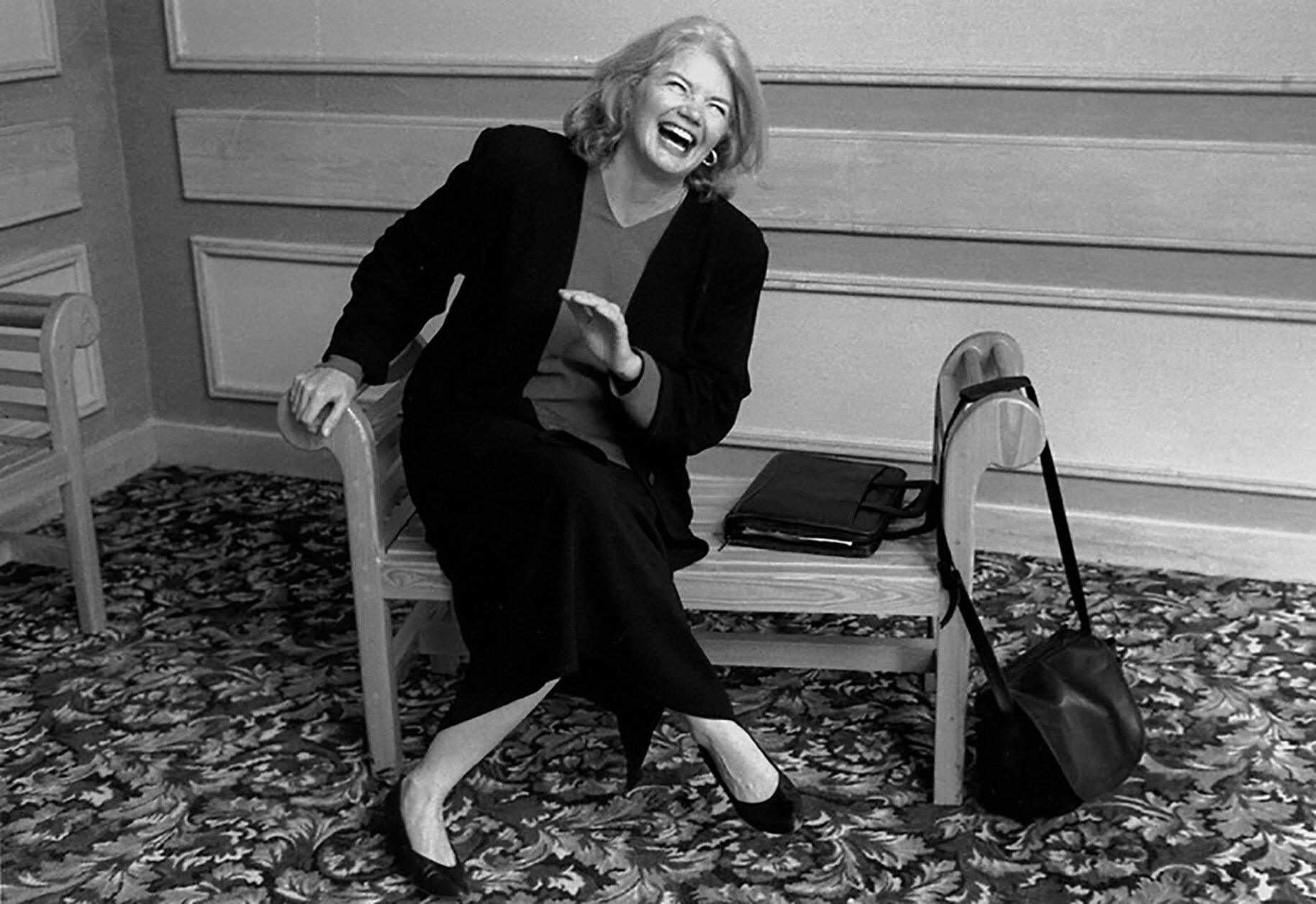
Texas political journalist Molly Ivins is profiled in the documentary “Raise Hell: The Life & Times of Molly Ivins.” (Photo courtesy of Magnolia Pictures.)

Texas political journalist Molly Ivins is profiled in the documentary “Raise Hell: The Life & Times of Molly Ivins.” (Photo courtesy of Magnolia Pictures.)

'Raise Hell: The Life & Times of Molly Ivins'

September 18, 2019 by Sean P. Means

Journalists make unlikely heroes — we’re usually too jaded, too cynical, and too tired — but the late Molly ivins, the jaunty chronicler of Texas politics and stalwart defender of the First Amendment, is one of those heroes, and the documentary “Raise Hell: The Life and Times of Molly Ivins” is the profile of her that we have needed.

She was a striking figure, six feet tall with flaming red hair, with the ability to drink heartily and a mouth that would make a longshoreman blush. Raised in Houston by a domineering father, Ivins attended Smith College, studied in Paris, and got her journalism degree from Columbia. She worked briefly for the Minneapolis Star-Tribune, before going home to Texas in 1970 to be co-editor and political writer at the alternative Texas Observer in Austin.

Thus began a long career of pointing out the foibles of the Texas Legislature, of which there were many. The New York Times hired her away in 1976, but didn’t quite know how to handle her iconoclastic spirit. A high spot of her Times career was getting the byline for Elvis Presley’s obituary and flying down to Memphis to cover the funeral. The low spot was when she covered a “community chicken-killing festival” in New Mexico and tried to get the phrase “gang-pluck” past the copy desk and the Times’ imperious editor Abe Rosenthal.

(This isn’t in the movie, but in 1979, she covered the opening of Salt Lake City’s Symphony Hall — now Abravanel Hall — for The Times.)

Texas beckoned again. The Dallas Times-Herald gave her a political column in 1982, and she worked there until 1991, when the rival Dallas Morning News bought the paper and shut it down. She moved over to the Fort Worth Star-Telegram. She also syndicated her column to more than 400 papers, and wrote for Mother Jones and other publications. (The documentary omits my favorite Mother Jones column of hers, an appraisal of culture critic Camille Paglia: “Christ! Get this woman a Valium!”)

Director Janice Engel includes some of Ivins’ best witticisms. There was the time when she called former vice-president Dan Quayle “dumber than advertised” and said that “if you put his brain in a bumblebee, he’d fly backwards.” Or there’s her assessment of Pat Buchanan’s infamous “culture war” speech at the 1992 Republican National Convention, which she said “probably sounded better in the original German.”

Engel also shows when Ivins got serious, like when she and investigative reporter Lou Dubose dissected George W. Bush, as he went from Texas’ governor to the presidency.

Chock full of interviews with friends and the occasional political opponent, the documentary doesn’t shy away from Ivins’ demons — namely her alcoholism and the cancer diagnosis that ultimately killed her in 2007. Engel also compares the political landscape then to now, and leaves the open question of how righteously angry Ivins would have been if she had encountered President Donald J . Trump. One suspects she would have cut him to ribbons, like a ninja assassin.

——

’Raise Hell: The Life & Times of Molly Ivins’

★★★1/2

Opened September 6 in select cities; opens Friday, September 20, at the Broadway Centre Cinemas (Salt Lake City). Not rated, but probably R for F-bombs. Running time: 93 minutes. 

——

This review first ran on this site on January 29, when the movie premiered at the Sundance Film Festival.

September 18, 2019 /Sean P. Means
Comment
A team of racers in the Blackfoot Confederacy’s Indian Relay, part of the Calgary Stampede, and featured in the documentary “Fast Horse,” one of the films in the “Sundance Short Film Tour 2019.” (Photo courtesy of Sundance Institute.)

A team of racers in the Blackfoot Confederacy’s Indian Relay, part of the Calgary Stampede, and featured in the documentary “Fast Horse,” one of the films in the “Sundance Short Film Tour 2019.” (Photo courtesy of Sundance Institute.)

'Sundance Short Film Tour 2019'

September 18, 2019 by Sean P. Means

This year’s compilation of short films from the Sundance Film Festival is an odd mix, with a little animation, a bit of documentary, and a whole lot of experimentation.

What is a surprise this year is that only two of the seven films in the touring collection — the documentary “Fast Horse” and the music-filled “The Minors” — were award winners in Park City. (Both received special jury prizes for directing.)

“The Minors,” directed by Robert Machoian is a gentle trifle, in which a grandpa (Bruce Graham) makes music with his young grandsons, until their attention spans get the better of them. “Fast Horse” is a visual stunner, as director Alexandra Lazarowich and her crew deploy GoPro cameras to show the breakneck pace of the Indian Relay, a horse race held in Alberta’s Blackfoot Confederacy during the Calgary Stampede.

The program starts with director Stefanie Abel Horowitz’s introspective “sometimes, i think about dying,” in which a depressed office worker, Fran (Katy Wright-Mead), gets an unexpected boost when a coworker, Robert (Jim Sarah), asks her out to a movie. The deliberately downbeat filmmaking fits the tentative nature of Fran’s emotional state.

“Suicide by Sunlight” isn’t as depressing as its title suggests. Director Nikyatu Jusu, co-writing with R. Shanea Williams, introduces a world where vampires exist — but black vampires rule, because their melanin allows them to venture out in daylight, unlike their white counterparts. That premise is more fascinating than the drama in the foreground, in which a vampire (Natalie Paul) fights for custody of her daughters.

The one animated entry, Aggie Pak Yee Lee’s “Muteum,” is a four-minute masterpiece. It uses minimalist design to depict schoolboys on a field trip to an art museum, and the happy havoc that comes when the chaperone turns around for a minute.

The oddest of the bunch is Christopher Good’s “Crude Oil,” in which Jenny (Andriene Byrne) discovers she has a superpower — not a particularly useful one — while also dealing with a toxic friendship. Good’s images, evoking comic book panels and YouTube mash-ups, are witty and totally of the moment.

Lastly, the Tunisian-made “Brotherhood” — the longest of the bunch, at 25 minutes — puts the audience into the middle of a family dispute, when a shepherd (Mohamed Grayaâ) reluctantly welcomes back his oldest son, who left to fight with the Islamic State in Syria and returns with a pregnant wife in a burqa. The politics are straight out of the headlines, but director Meryam Joobeur finds in her characters family tensions that are as old as time itself.

——

‘Sundance Short Film Tour’

★★★

Opened July 5 in select cities; opens Friday, September 20, at the Tower Theatre (Salt Lake City). Not rated, but probably PG-13 for some violence and language. Running time: 97 minutes.

September 18, 2019 /Sean P. Means
Comment
Katie Stevens plays Harper, one of a group of college kids who get the Halloween of their nightmares in the horror thriller “Haunt.” (Photo courtesy of Momentum Pictures.)

Katie Stevens plays Harper, one of a group of college kids who get the Halloween of their nightmares in the horror thriller “Haunt.” (Photo courtesy of Momentum Pictures.)

'Haunt'

September 18, 2019 by Sean P. Means

The horror thriller “Haunt” is set in an “extreme” haunted house — false advertising for a slasher movie that, like most haunted houses, veers between predictable and random while never becoming satisfyingly terrifying.

The movie’s protagonist, college student Harper (played by Katie Stevens, recently of “The Bold Type” and a 2010 “American Idol” finalist), already has enough horror in her life. The movie begins with her roommate Bailey (Lauryn Alisa McClain) catching Harper applying makeup to cover the latest black eye administered by Harper’s abusive boyfriend, Sam (Samuel Hunt).

As a distraction on Halloween, Harper accompanies Bailey and roomies Angela (Shari Raja) and Mallory (Schuyler Helford) to a bar, where they meet nice-guy Nathan (Will Brittain) and obnoxious doofus Evan (Andrew Caldwell). When Evan flnds a flier for a haunted house way in the middle of nowhere, and the group decides to check it out.

At the haunted house, a silent figure in a clown mask has the students sign a rather extensive waiver, then stashes their cellphones in a lock box. Inside, they encounter the usual assortment of spring-loaded skeletons and spaghetti-for-brains tricks — but something seems just a little bit off. Then they see a simulated murder that maybe wasn’t so fake.

The writing-directing team of Scott Beck and Bryan Woods — who wrote the screenplay for “A Quiet Place” that director John Krasinsky rewrote — aim to inject some energy and fear into the trite conventions of haunted houses and knock-off-the-cast slasher flicks. They succeed sporadically, with set pieces likely to elicit genuine terror.

For far too much of the movie, “Haunt” drops the hammer — and other deadly implements — with little sense or internal logic. Too many of the onscreen deaths feel like wasted opportunities, too rushed or poorly conceived to generate the emotional response a smart horror movie should. All the screams are coming from the screen, and not enough from the audience.

——

‘Haunt’

★★

Opened September 13 in select cities and digital on-demand; opens Friday, September 20, at Megaplex Gateway (Salt Lake City), Megaplex Valley Fair (West Valley City) and Megaplex Jordan Commons (Sandy). Rated R for horror violence/gore, and language throughout. Running time: 92 minutes.

September 18, 2019 /Sean P. Means
Comment
  • Newer
  • Older

Powered by Squarespace